
Don’t Look Away: The Children of Gaza
Why the World Must Listen to the Voices of Its Youngest Victims
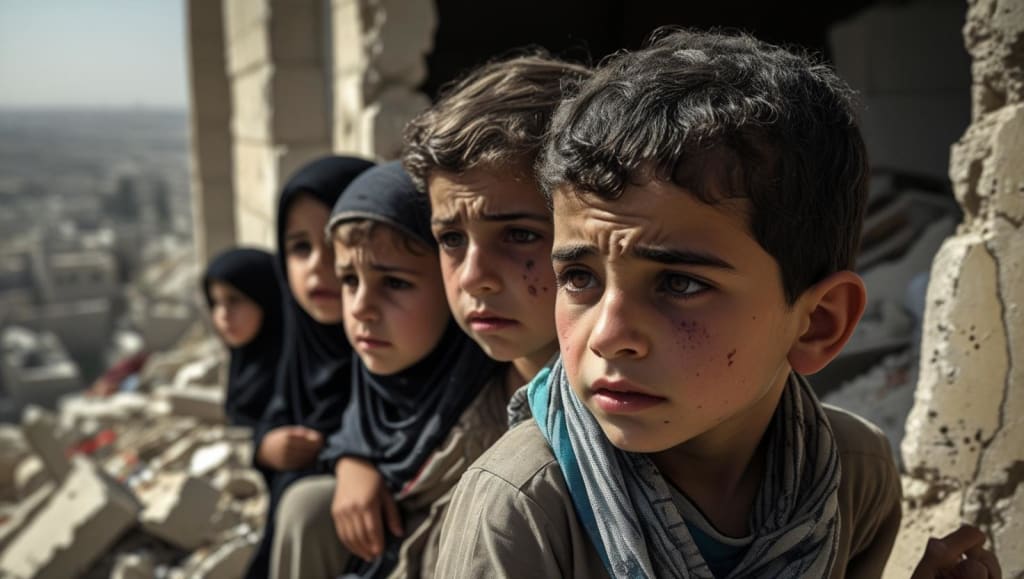
Don’t Look Away: The Children of Gaza – Why the World Must Hear Their Cries
The war in Gaza is not only a geopolitical tragedy—it’s a moral one. At its center are the youngest victims: the children. Their voices—stifreined by rubble, starvation, and trauma—are begging the world not to look away. We must listen.
1. Childhood Under Siege
Imagine growing up in a playground that can’t be reached, in a home that might be bombed any moment, with no clean water or medicine. That’s the daily life of Gaza's children. With over 2 million residents—and nearly half under 18—children are bearing the brunt of this conflict. UNICEF warns that this is “the most dangerous place in the world to be a child.”
Thousands have died. As of late 2023, over 5,000 children were reported killed—exceeding the total number of child fatalities in all global conflicts during 2022. Hospitals and schools have been wrecked; there’s limited food, water, or sanitation. Nearly 1 million kids are displaced. They’ve lost homes, friends, siblings, and any sense of security.
2. Beyond Statistics: Human Stories
Numbers can numb us. But behind each statistic is a child with dreams, laughter, pain, and fright.
Eight-year-old Shaimaa lost her foot and hand when her friend’s home was shelled. She told UNICEF, “I dream of becoming a journalist to document the attacks against children in the Gaza Strip.” Another child, Malek, acquired a disability after losing part of his leg to explosive weapons; he is among milliers of children now facing life-changing injuries and psychological scars.
Even amid horror, glimpses of resilience shine through. Journalist‑turned‑mentor Ahmed Dremly—from Gaza—writes about riding horses at dawn—his escape from trauma. He pleads for his voice to reach the world. But so many voices have been lost: one WANN young writer asked mentors, “Can you kindly publish the attached stories if I die?”
3. Crushed Innocence: Death, Disability, Trauma
Violence hasn’t just ended lives—it has cracked the minds and bodies of survivors.
• Pervasive mental trauma: Ninety percent of pediatric patients in Gaza hospitals show anxiety and PTSD symptoms. Symptoms of bedwetting, nightmares, aggression, and convulsions are widespread.
• Catastrophic injuries: As many as 3,000 children lost limbs by mid‑2024, with many surgeries performed without anesthesia due to supply shortages.
• Starvation and disease: The famine deepened, with children dying of dehydration and hunger. One 10-year-old boy with cerebral palsy, Yazan al‑Kafarneh, became the tragic emblem of hunger in Gaza when he died on March 4, 2024.
Yet children with disabilities are often invisible in global discourse—why isn’t their suffering mobilizing more urgent humanitarian action?
4. Systemic Neglect & Media Silence
Global indifference compounds their suffering.
In Western media, Gaza’s children are too often stripped of individuality—mere numbers in casualty counts. One activist put it bluntly: “We have become numbers … not humans, not people, not dreams, not children, not women or men or families. We have become numbers in the news.”
Internationally, governments continue to enable the violence. Despite widespread condemnation, substantial aid and decisive political pressure remain tragically absent. As The Guardian highlighted, voices demanding the use of words like “genocide” or “ethnic cleansing” are still dismissed or muted.
5. Why Voice Matters—and What We Must Do
Children cannot vote, lobby, or protest—but they can bear witness. Their stories are testimonies to an unspeakable reality. These voices ground the conflict in human terms—and they demand our urgent action:
1. Hear them: The stories of Shaimaa, Ahmed, and Yazan matter. Amplifying their voices honors their humanity.
2. Act for them: We must press for a humanitarian ceasefire. Aid agencies urgently plead for clean water, fuel, medicine, shelter, schools—and psychological support.
3. Advocate responsibly: Use accurate, courageous language—“genocide,” “ethnic cleansing,” “crime against humanity.” Bold words build moral clarity.
4. Support recovery: Beyond halting violence, we must invest in mental‑health programs, prosthetics, trauma rehabilitation, education, and safe spaces—long after the bombs fall.
6. A Moral Call: Future, Potential, Hope
Remember: every child is a unique individual, a potential doctor, artist, teacher, parent. We robbed polite hopes when we strip them to numbers. When we let them die silently, we stain our global conscience.
The world must not avert its gaze. Let Gaza’s children return to childhood—laughter, learning, dreaming. Let us be the generation that refused to look away.
About the Creator
Hasbanullah
I write to awaken hearts, honor untold stories, and give voice to silence. From truth to fiction, every word I share is a step toward deeper connection. Welcome to my world of meaningful storytelling.
Keep reading
More stories from Hasbanullah and writers in Humans and other communities.
The Botox blues: how Botox changed the way I look at myself
“You look too young for Botox,” the practice owner said as I got up from the waiting room chair. The clinic was Scandi as ever, light wood, beige tones, Vitamin C serums with triple-digit price tags. There was a framed photo of a French Bulldog on the wall wearing a pink bow tie. His forehead folds looked like mine. The only difference was that he hadn’t spent £75 on a consultation to chat about having them frozen off.
By Chelsea Branchabout 15 hours ago in Humans



Comments
There are no comments for this story
Be the first to respond and start the conversation.