
Do You Know What Your Child Is Doing?
Criminogenic Factors of Juvenile Delinquency

One of the important problems facing society is juvenile delinquency, which presents any crime committed at a given time in a social environment, and juvenile delinquency is any young person aged between 14 and 18 years.
There are many criminogenic factors of juvenile delinquency, which can be decisive in committing a criminal act from an early age, as well as the continuation of this criminal behavior, a phenomenon known as recidivism.
The main criminogenic factor of juvenile delinquency, which triggers its appearance is represented by the family climate, a family climate characterized by an amalgam of deficiencies in various fields such as communication, passive listening, empathy, abuse of power and authority, lack of involvement, etc.
The family environment is a particularly important criminogenic factor in juvenile delinquency because there is a lack of communication with parents, but the time spent with them is less and less. It seems that the interest in the education of children in some families is limited to the formal situations of giving it to the kindergarten, then to the school, ensuring for this, a relative material basis. Current statistics as well as the oldest ones state that, in general, delinquent children come from such families.
To protect the minor when he comes in contact with the criminal law, certain elements should be taken into account, such as: "crimes committed by minors often have a low degree of social danger - here we can say that they are the destruction of property that does not belong to them, then the placement of juvenile delinquents in prisons or guarded institutions can do more harm than good, after leaving the juvenile learns new things that he will want to implement when he leaves the institution respectively.
It would be best to avoid contact with such institutions, to put the young person in question to work for the benefit of the community because there he will not have contact with that environment full of vices, and another element is to give them minors feel that they are free without being persecuted. It is the most appropriate thing;
Most of the time, the use of force against them leads to the formation of delinquent behavior - here the family should give importance to communicating with the young person but also to listen to all the problems he faces, but also to find a suitable solution. It is good that the family does not neglect the young man.
"Today, young people are becoming addicted to drugs or alcohol, at an early age, for completely different reasons, but what separates them from the young people of the '60s and 80s is the social environment they come from."
Another social problem gradually transformed into a criminogenic factor of juvenile delinquency, again obvious, is the conflicts in marital environments because the negative effects can be seen in the quality of education of young people and their social integration.
Sociologists and criminologists are the ones who face the following situation and ask themselves: "How is it possible that such different behaviors as theft and robbery, rape, prostitution, drug addiction, and others have the same causes?".
Trying to answer this question, it can be said, as has been argued with previous arguments, that the most important criminogenic factor of juvenile delinquency that influences behaviors towards crime is given by the family. The family is the one who has to take an attitude on the young man, to remove him and show him where he went wrong, to communicate as much as possible with him to get where he wants.
To be able to behave as diplomatically as possible, one should avoid sudden reactions of anger and the application of degrading punishments, such as a ban on the young person going outside.
Some young people do not know where to go or what to look for, those who do not have a well-established horizon, some people fail to do anything in life because they are unable to tell the difference between what is good and what is good. which is not good for them. And from here comes that hedonistic state when they are not eager for an adventure and the execution of high-risk things.
It can be said that the moral deviance was manifested because the young man violated the moral norms accepted by a certain community but also the violation of the norms of the society. Functional deviance is given by those persons who violate the mandatory norms at work, it is that deviance that produces dysfunction in the development of the activity, here being able to refer to the disciplinary violations of an employee.
Violence exerted by parents who expose their superiority and resort to methods of isolating young people, lack of communication, and antisocial behavior are the reasons why the young person can reach isolation.
Relationship difficulties between parents - this affects the young person the most, we refer to those moments when the parents are in a conflict and the young person participates directly or indirectly. The effects are not immediately apparent, they are reflected in the time and can even lead to relationship difficulties between children and parents.
Another criminogenic factor of juvenile delinquency, almost as important and defining as the family environment, is the group of friends, or their entourage. The young man, after finishing school, spends his time with his friends. They have places they frequent together but also hiding places. The young people start to tell everyone what they did during the day, but also where they have been before.
Here we can say that a method of group socialization intervenes because it is the place where everyone exposes their events. A classification of the groups is made by Adrian Neculau who states that the groups are formed following some common points. "They are the ones who have a common goal, they can have relationships of affinity and sympathy for a person in the group."
Adolescence, more than other periods of the individual's life, can be considered as the period in which socialization as a psychosocial phenomenon is fully asserted with all its intensity. The teenager is the one who does everything to stand out and assert himself, but through these things, he manages to attract attention. Organized groups (gangs) represent gangs of young people who have more rebellious or antisocial behavior, but their actions are represented by acts of breaking the law.
Groups of young people have identical elements that help them interact, they are those who have a common goal but can have relationships of affinity and sympathy for a person in the group. The group can influence a young person negatively or positively, but the attitude he adopts depends only on him.
This is because the phenomenon of mutual influence to which each member of the group is exposed occurs. Young people may be perceived by the community where they live differently because they may have a different and irresponsible language.
As a criminogenic factor of juvenile delinquency, the group to which the delinquent belongs is the one that puts pressure on the individual, and the latter, out of the desire to show his powers, begins to get involved in various things that can have disastrous effects on him.
The group is also the one that helps him get over the family problems he is facing. There is also disinhibition on the part of young people, but also a lack of shame because they are not around a family member. They are the ones who have common aspirations, but also the same concerns and interests. "Criminogenic studies show that the influences exerted by the entourage, and especially by friends, are a determining criminogenic factor.".
Thus, most crimes occur in groups because it is desired to show courage by the young person, and this happens after the exercise of influence over him.
That being said, do you know what your child is doing?
About the Creator
Keep reading
More stories from Delilah Booker and writers in Humans and other communities.
Are There Lies Accepted in a Relationship?
Lies in a relationship: sometimes a controversial topic! Some people say that in any relationship the partners lie, that it is a common fact, based on arguments that "it is in human nature to lie", "it is better to lie than to hurt the other" or "what you do not say, it is not a lie, but an omission "… But the truth is that lies usually have nothing to do with a harmonious relationship!
By Delilah Booker4 years ago in Humans
A Historic Declaration
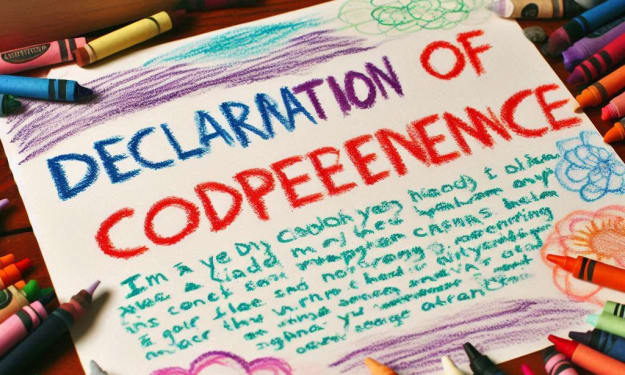
We the People of the Husbands of the United States of America, in Order to form a more perfect Union, and I mean you...with me...establish Justice, insure domestic Tranquility, provide for the common defence, promote the general Welfare, and secure the Blessings of Liberty to ourselves, after Puberty, do ordain and establish this Declaration of Co-Dependence.
By Gerard DiLeo7 days ago in Humans
The Joy, Happiness and Love...JHL Cluster.
The acronym JHL can have multiple meanings depending on the context. In the context of hierarchical clustering, it refers to algorithms used to build a dendrogram (a diagram representing a tree graph) of nested clusters. JHL is associated with specific statistics that measure performance. Additionally, JHL can stand for various terms across different fields, indicating its versatility as an acronym.
By Antoni De'Leon7 days ago in Humans
I was in a Toxic Relationship, with my Workplace
“You got that?” My ex yelled. His hands were balled into fists at his side. At six foot three, he towered over me. A normal person would have been afraid, but I looked up a video of George Lopez repeatedly saying, “I got this,” and showed it to him. I had grown used to this treatment, so much so that I didn’t blink when he ripped the phone from my hand and threw it across the room.
By Jade M.7 days ago in Confessions



Comments
There are no comments for this story
Be the first to respond and start the conversation.