
Developing Inclusive Small Businesses to Empower Villages
A One-of-a-Kind Initiative to Help Differently Abled Entrepreneurs Improve Rural Communities
Introduction
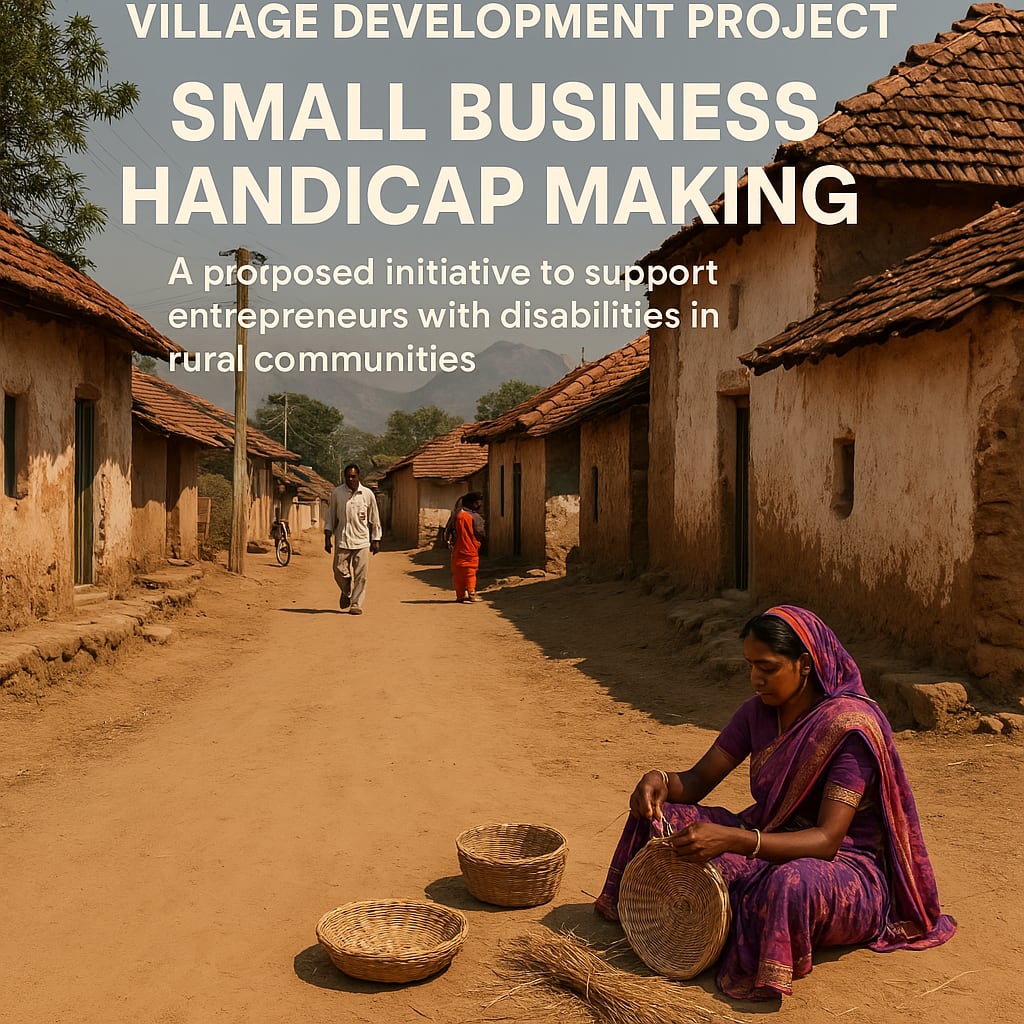
For a long time, rural India has been a treasure trove of culture, skill, and perseverance. However, economic disparities and lack of opportunities often hinder the growth potential of villages. Differently abled individuals, who bear the double burden of unemployment and disability, are among the most affected. A novel rural development initiative known as the "Inclusive Small Business Empowerment Initiative" has been proposed to address this problem. Its goal is to provide people with disabilities in villages with sustainable means of subsistence through entrepreneurship and skill development. --- The Project's Goals and Objectives The fundamental concept is straightforward yet potent: turn differently abled villagers into small-business owners to empower them. The initiative focuses on identifying individuals with disabilities, understanding their unique talents, and providing tailored vocational training, resources, and mentorship. The project promotes self-reliance and economic independence rather than charity, assisting individuals in regaining confidence, respect, and dignity within their communities. --- Project Components 1. Disability Mapping at the Village Level In order to identify individuals who have a variety of physical, sensory, or intellectual disabilities, community outreach and surveys will be carried out. A database will be created, detailing their needs, skills, and aspirations. 2. Hubs for Skill Development and Education Small training centres will be established using existing community buildings or low-cost eco-huts. Courses may include tailoring, handicrafts, agro-processing, bamboo work, mushroom farming, soap and candle making, and digital services. Special attention will be given to adaptive tools and assistive technology to ensure full participation. 3. Setup of a Micro-Enterprise Participants will receive low-interest microloans or seed funding following training completion. Village cooperatives and Self-Help Groups (SHGs) will be mobilised to support small business setups. Products can be marketed locally, through fairs, and eventually, on e-commerce platforms. 4. Mentorship & Ongoing Support Mentoring and business coaching will be provided on an ongoing basis by NGOs and successful entrepreneurs. Legal aid, branding assistance, and digital literacy sessions will be included to boost professionalism. 5. Community Awareness and Inclusion Events and storytelling sessions will be organised to challenge social stigma and promote inclusive thinking. Local leaders and schoolchildren will be engaged to create a village culture of support and empathy. --- Expected Impact Social Empowerment: Helps disabled people regain their dignity and become active members of society. Economic Growth: Adds new income sources to rural households and diversifies the local economy. Transformation of the Community: Promotes a rural society that is more welcoming, understanding, and cohesive. Replication Potential: This model can be adapted in other villages across India and even globally. --- A story of success in the making Consider Rupa, a young woman who lives in a remote village and has a physical disability. With no job and little social interaction, she was often sidelined. Rupa learnt how to make organic soaps as part of this project and set up a home-based unit with the help of SHGs. Today, not only is she financially independent, but she’s also employing two other women from her village. Her story is only the beginning of many upcoming transformations. ---Conclusion The Inclusive Small Business Empowerment Initiative is more than just a development programme—it’s a movement. A movement that believes no one should be left behind, especially in rural India where potential often goes unnoticed. By creating a platform for disabled individuals to thrive as entrepreneurs, we are not only transforming lives but also redefining the future of village economies—one business at a time.
About the Creator
Keep reading
More stories from Kazi Faruqul Islam and writers in Humans and other communities.
'I Just Want to Breathe': A Trans Student's Fight for Belonging Divides a Small Town" is the title.
" Watertown Schools at Crossroads: Trans Student Support Sparks Community Identity Crisis"* Image Concept:** A striking split-frame visual: On the left, a blurred chalkboard with phrases like “equality” and “tradition” partially erased; on the right, a diverse group of teens holding a pride flag outside Watertown High. The community's struggle to connect is symbolized by the bridge at the center of the image. WATERTOWN, NY— What started out as a routine meeting of the school board on Tuesday has turned into a heated argument about identity, safety, and the role of public education in this close-knit community in upstate New York. At the center of the storm is 16-year-old Alex Martinez (they/them), a transgender student whose request for updated locker room accommodations has forced Watertown Unified School District (WUSD) into a national debate—and exposed deep fractures in a town once united by Friday night football and apple harvest festivals. The Spark: When Personality Meets Policy** Alex, a sophomore honor student and robotics team captain, approached school administrators in August seeking access to gender-neutral changing facilities ahead of gym class rotations. Currently, transgender students must use staff bathrooms or facilities aligning with their birth certificates—a policy adopted in 2019 but rarely tested until now. Alex told The Watertown Chronicle, "I just want to change for swim class without feeling like a zoo exhibit," with a steady voice and sparkling eyes". This is not political. It all comes down to breathing. Their mother, Marisol Martinez—a third-generation dairy farmer and EMT—says the family anticipated pushback but never foresaw the vitriol. She was stacking hay bales on the family's 40-acre farm when she said, "We've had folks who have known Alex since preschool suddenly quoting Bible verses at us in the Piggly Wiggly parking lot." When did simple acts of kindness become controversial? Community Whiplash: Jobs, Jeers, and Jeopardized Unity** As national advocacy groups descend on Watertown (pop. 24,700), the debate is reshaping local dynamics: The Conundrum of the Educator** Last week, 12th-grade biology teacher Sarah Cheng received complaints from parents regarding her LGBTQ+ history lesson. “One dad accused me of ‘recruiting,’” said Cheng, who’s taught in WUSD for 17 years. "However, my job is to teach facts, such as how the American Psychiatric Association declassified being transgender in 2012 as a disorder." Whispers in the Medical Field** At Carthage Area Hospital, pediatric nurse Liam O’Connor reports a 30% spike in anxiety-related ER visits among LGBTQ+ teens since September. He stated, "Kids are hearing parents argue about Alex's case at dinner." "They're turning that fear inside out." Small Business Squeeze** Gina Patel, the proprietor of the "Brewed Awakening" café on Main Street, now rotates pride and "Don't Tread on Me" flags on a weekly basis to avoid boycotts. “Regulars who’ve shared scones for years won’t sit together anymore,” she lamented. Legal Limbo** Albany-based civil rights attorney Elena Ruiz warns WUSD could face Title IX violations if they deny Alex’s request. Citing July's Doe v. Ruiz, Ruiz stated, "Courts increasingly side with trans students." Texas ruling by Midland ISD. National Script, Local Cast* The conflict in Watertown is indicative of broader tensions, as 18 states passed laws in 2023 that restricted transgender youths' access to facilities and healthcare. Yet here, the conflict wears familiar faces: According to First Baptist Church Pastor Jim Holloway**, schools are "overstepping": "God created male and female." Period”. Dr. Alicia Monroe**, WUSD’s first Black superintendent, counters, “Our duty isn’t theology—it’s ensuring every student thrives.” Even the local trades are split. Union pipefitter Joe Kowalski, 54, circulated a petition supporting Alex after his niece came out as trans. “I weld pipes, not judge people,” he shrugged. The Path Forward—Or Backward? ** Both sides are mobilizing ahead of the crucial November 7 vote on the school board: Advocates** hosted a “Rainbow Rally” featuring Alex’s robotics team demoing a pride-themed robot. Opponents held a prayer vigil where chants of "Let kids be kids!" and hymns competed. Alex, on the other hand, concentrates on college applications and taking care of their prize-winning 4H goats. They said, adjusting their rainbow-striped face masks, "I didn't choose this fight." However, "it's worth it if speaking up helps one kid feel less alone." Image Suggestion for Social Media:** A close-up of Alex’s weathered barn door spray-painted with “Y’ALL MEANS ALL,” their shadow cast long against Upstate New York’s golden autumn light.
By Kazi Faruqul Islam10 months ago in Confessions
Whiskey At Dusk
Guess the whiskey was more important to you in the end, wasn’t it? It was more than the well-being of your friends; more vital than showing up to the places you promised you would and could come to; more critical of a matter than fulfilling your damn responsibilities and getting the press off your back.
By Snarky Lisa4 days ago in Humans
When TikTok Goes Dark: What TikTok Outages Mean for Creators
One moment your screen scrolls with laughter and small confessions. The next, it freezes. Comments refuse to load. Videos vanish. For many people, TikTok is not just entertainment. It is routine, comfort, and sometimes income. When the app goes quiet, confusion spreads fast. People refresh, restart, and wonder if they did something wrong. They did not. TikTok outages happen more often than most users realize. They arrive without warning and leave behind questions. What caused this silence? How long will it last? And why does it feel so unsettling? This article looks closely at tiktok outages, how they happen, how they affect real people, and what you can realistically do when the feed goes dark for creators and everyday viewers.
By Muqadas khan2 days ago in Humans
The Blue Ridge Stalker
Tom had left the Ford down the way, its spark plugs finally exhausted and no mechanics for a dozen miles back through the foothills to Strossburg. No matter, he had worn his boots—almost as if he planned for this to happen. The puzzle he sought to solve emanated from the woods clinging to the slopes above; the valley behind held no mysteries.
By Stephen A. Roddewig7 days ago in Fiction




Comments
There are no comments for this story
Be the first to respond and start the conversation.