
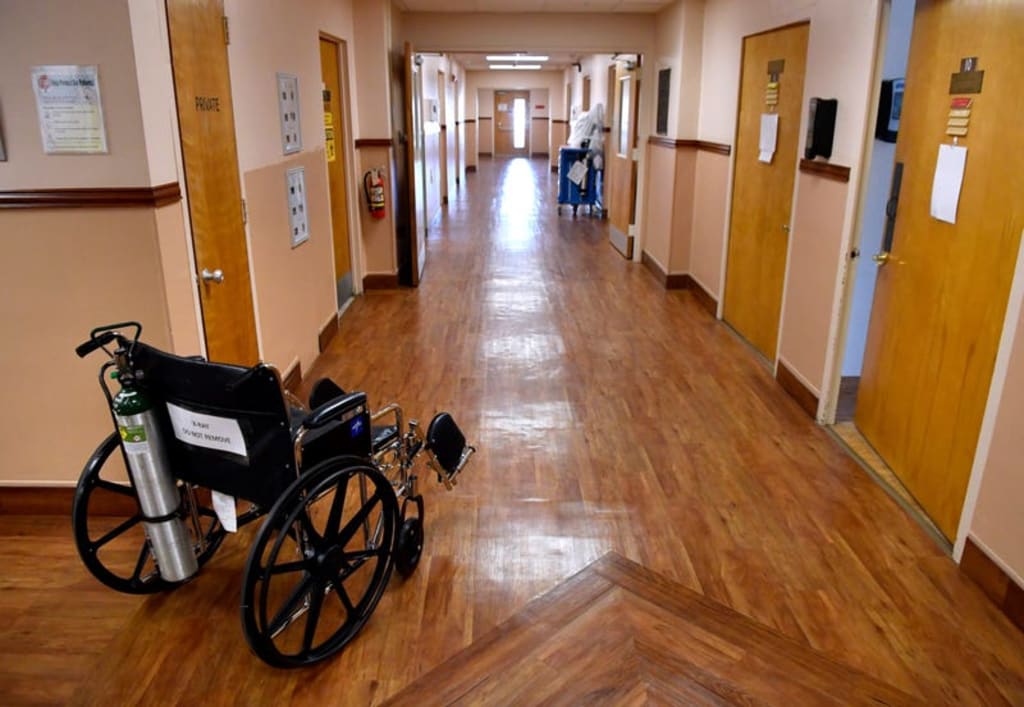
Bright April sun filtered through the carmine leaves of a Japanese maple and seeped into the hospital room, illuminating Ruslan’s thin arm resting on his bed’s raised side rail.
“I haven’t written by hand since I signed my job offer five years ago,” he ground out, glaring at the man in a pristine doctor’s coat sitting beside him. Dr. Kazuo inclined his head and drew a small book from his deep pockets.
“Treat it like physical therapy, then; writing is one of the most intricate and demanding fine motor movements our brains can orchestrate.”
He placed a little black notebook on Ruslan’s blanket, tapping the supple binding with a sinuous knuckle. Ruslan took one look at the cover and winced. Dr. Kazuo caught his grimace and leaned back in his chair, steepling his quivering fingers--they reminded Ruslan of an insect’s antennae with their perpetual twitching.
“If that doesn’t do the trick, then think of it as meditation. There’s nothing more universally personal than keeping a journal.” The surgeon patted Ruslan on the shoulder and stepped out of the room. When his white coat drifted out of sight, Ruslan flung the book against the wall. It landed on the polished floor with a dull thud, spine up. The crumpled pages stared at him in mute accusation until he called a nurse to pick it up. Ruslan tried to smooth the pages, but the creases refused to yield, the blank planes marred by irreversible damage.
Now we have something in common.
After the realization, Ruslan began to write.
Two months ago, my life ended.
The line was brief, threadbare. But to him, it conveyed everything; the smell of petrichor emanating from freshly planted municipal flower boxes, the tendrils of warmth rising from the slick asphalt. Boston was a place of contrasts in the summer, skipping from blistering sun-soaked days to sudden torrential downpours in the span of a coffee run. Ruslan was hurrying across Boylston Street, cursing his chafing loafers and praying his manager wouldn’t be on the floor when he burst into the office fifteen minutes late. The light was green. It all happened in an instant–he kneeled to tug on the back of his shoe. A shrill screech sounded to his left, and he looked up just in time to see a pair of headlights. They rose out of nowhere, their blinding, solid beams freezing a scattering of raindrops, suspending them in Ruslan’s eyes as his vision tunneled and he felt the collision. The Toyota ellipses struck him right in the hipbone, shattering it on impact.
Laying on the ground, legs twisted almost perpendicular to him, he thought how morbid it would be if the logo left a brand. In the ambulance on the way to Mass General Hospital, he realized how ludicrous his fear was; there was no skin left on his leg to mark.
Ruslan didn’t realize he was sobbing until a hot tear streaked down his cheek, searing a blazing path across the enormous road burn wound blooming across his jaw.
And so began the endless march of days in the hospital, the dry rattle of painkillers in their glaring orange bottles haunting his every waking moment. An ache settled in his back, neuropathic pain from the spinal cord lesion. Ruslan wanted to ask Dr. Kazuo how long it’d last, but a hollow, broken part of him whispered he didn’t want to know.
Seven surgeries and they still couldn’t fix me, he wrote one evening. Why even bother trying? What does it matter if I’m paralyzed from the chest or waist down? What did their efforts even save?
Ruslan chewed on his Mass Gen pen, overcome with a brief flash of anger coiling in his stomach, flaring to life in a nauseating pulse.
I suppose I should be thankful. That’s what I’ve been told over and over again; thankful the driver wasn’t going too fast. Thankful the ambulance got me just in time. Thankful I'm not a quadriplegic. Thankful I’m not dead.
A mirthless smirk curled his mouth. Ruslan’s insurance was superb, so he didn’t need help covering his bills. The man in the Toyota still insisted on leaving a check at the front desk. Ruslan crumpled it up without glancing at the sum. He debated tossing it out, but Dr. Kazuo came in, and Ruslan shoved the check into his hospital bag.
As if my forgiveness could be bought. As if my life could be refunded, he scrawled after his checkup. Ruslan didn’t notice how hard he was pressing until the pen tip tore a gash in the paper, its edges bleeding black. He closed the notebook–that was enough writing for one day.
***
People visited, of course--cousins, coworkers, college roommates, high school friends… the door of his room never seemed to close. But their numbers dwindled. Just as he expected.
Ruslan’s parents flew in from St. Petersburg. They stayed a month but then were forced to return—companies didn’t run themselves, after all. Ruslan tried not to blame them too much--they were just going through the motions, clinging to the same parenting routine of benign neglect tempered with the free-flowing wealth they'd upheld with him since he was young.
Sometimes, Ruslan reasoned as he methodically took quadruple his dose of Percocet, the motions were all people had. Everyone inevitably returned to their lives, but Ruslan struggled to find something worth returning to when the nurses resuscitated him.
***
A change came when he was wrapping up an evening work call. The door slid open, the person behind it still swathed in the shadows of the hospital hall.
“I knocked, but it may have been too quiet,” said a lilting voice, and Ruslan lifted his head at the unexpected Russian.
“Nick?” The young man nodded, a bright smile breaking across his freckled face. “Long time no see. Fifteen years, give or take?”
Nikolai made no comment about Ruslan’s folded wheelchair or the stark hospital room as he strode in. He set a large bouquet of white peonies on the bedside table and offered a firm handshake, bracing his elbow on the bed railing as if it were any old armrest, and not the bars of Ruslan's personal prison. Ruslan nodded in mute shock, groping for what to say until the surprise receded and released his voice.
“What brings you here?”
Last he’d seen Nick, the man was a child, thin as a driftwood scarecrow with a front tooth missing, sobbing on his apartment’s tattered carpet back in Russia when Ruslan came to say he couldn't babysit him anymore, that he was a high schooler now, and high schoolers had more interesting things to do than play with eight-year-olds.
“I got accepted to Boston University for my Master’s. Not as flashy as MIT, but it will get the job done,” he simpered, grin stretched so wide Ruslan wondered whether it strained his cheeks—over the last few months, he’d forgotten what a genuine smile even felt like. When Nick left, Ruslan sketched the peonies under his journal entry for the day, until his tear stains blotted out the lines.
After that, they spent nearly every day together. Nick was the first to make Ruslan forget where he was and who he’d become—no condescension, no assumptions, just the easy flow of a friendship that held fast despite half a lifetime of absence.
***
The next week, Ruslan was scheduled for discharge. He was still weak after the accident, and his arms shook from the strain of sliding his body into the wheelchair and heaving his lifeless legs over after. He thought it looked simple, but he’d never been more wrong. A driver with a new handicap van greeted him by the hospital entrance, and in the time it took the car's ramp to lower, Ruslan wanted the ground to swallow him whole.
Nick waited in the lobby of Ruslan’s Seaport apartment and unearthed a six-pack of Corona just as Ruslan was wheeled in—an apology for skipping their daily hangouts hangout during finals week.
“Peace offering?”
“Bribe accepted.” Nick mirrored Ruslan’s subtle smile tenfold. He helped Ruslan set the table, attentive but not invasive. Ruslan had forgotten what it felt like to get tipsy, and spent an hour cataloging the experience in his little black notebook. As he wrote the date, he did some simple math--Dr. Kazuo gave it to him in April. It was nearly July, and the book was a third full by now.
On the first day home, Ruslan needed to change the catheter himself. A simple task, one he watched the nurse do countless times, yet now, alone in his marble bathroom, he screamed into the wall when his fingers wouldn’t stop trembling. Something splintered deep inside his chest, where he thought he had begun to heal.
He started physical and occupational therapy the same week. A “torturous, painful and soul-sucking process”, he christened it in his book. He returned to work full time from home, but still refused any corporate events that required him to leave the house.
A contractor came over and began making his apartment “accessible”, outfitting it with wheelchair railings and every other possible reminder that Ruslan’s life would never be the same, no matter how much Nick tried to make it so.
Ruslan finished a bottle of whiskey before the contractor left for the day. The crawl to the bathroom to vomit was especially painful after he crashed his wheelchair and fell out of it. Sprawled on his torn bathrug, his manic laugh ricocheted off the walls when he thought about whether the Toyota had a similar dent after it barreled into him.
Nick came the next morning. His phone showed fourteen missed calls from the night before. Ruslan cried again, but this time on Nick’s shoulder as he rocked him back and forth.
“Just know that to me, nothing's changed, and never will. You're still Ruslan, and I'm still your friend,” he whispered. Nick squeezed his shoulder, and for the first time in weeks, Ruslan felt himself looking forward to tomorrow.
***
New England autumn came in a riot of kaleidoscopic glory. It was a balmy September Saturday, and Ruslan was going out to get coffee with his coworkers.
He wheeled himself out the door, only to knock into Nick on his doorstep, face pallid as a sheet. Panic seized Ruslan’s chest as he dragged Nick inside the apartent by his coat sleeve.
“What’s wrong?”
“Nothing, I just needed to come see my best friend. I feel better now,” Nick muttered once his breathing evened out. Ruslan gripped his hand.
“Tell me what happened.”
Nick sniffed. “My parents. Dad’s company went bankrupt, and mom’s job is all they have left. I need to go back and help.”
Ruslan sat Nick on the couch. He climbed on after him, wrapping a hand around his shoulders.
“Do they have enough to pay bills and support themselves?” Ruslan felt Nick give the slightest nod.
“Then you’re returning because they can’t afford tuition?” Nick stiffened, but Ruslan felt a smile prickle the corners of his mouth, a warmth unfurling in his chest, shining through the cracks within.
“I know you’re on a big scholarship, and you’re halfway done with your program. How much d'you need?”
Nick lifted her head, eyes glistening with unshed tears.
Ruslan shifted himself into the wheelchair and rolled into the bedroom, to his forgotten hospital bag, and wrestled a crumpled check out from its side pocket. Behind him, Nick crept into the room and stood by the doorway. Ruslan faced him and smoothed out the check over his knee.
“Will twenty thousand cover it?” Ruslan asked, grinning so wide it hurt his cheeks, feeling whole again for the first time since his accident.
Nick burst into tears instead of an answer, and Ruslan knew what he would write on the last page of his little black notebook.
About the Creator
Keep reading
More stories from writers in Humans and other communities.
Self Help: Grifters' Gospel
On Self-Help, Snake Oil, and the Illusion of Change Psychology professionals and students can be imagined on two opposite sides of a line called self-help books: likely a larger group opposes pop-science and step-by-step manuals filled with talk of success, journaling, and not giving a f**k; others love them, but they aren’t many.
By Avocado Nunzella BSc (Psych) -- M.A.P a day ago in BookClub



Comments
There are no comments for this story
Be the first to respond and start the conversation.