

Adrift
The water was coming over the side of the boat. It was so cold. With his hands, Mo tried to bail as much as he could back out into the English Channel but he sensed it was a losing battle; they would soon be drowned.
Mo and his father had evaded the Shia militias in their hometown of Baghdad, travelled almost four thousand miles across land and sea, and now, with the white cliffs of Dover peering through the first light, they were to die within a few hundred metres of their goal. Mo was fourteen years old; his contemporaries on the other side of the cliffs were likely arguing with their parents over an extra twenty minutes in bed whilst he assessed how he was going to get himself and his father ashore unharmed.
Mo’s father, Ibrahim, had made the difficult decision to quit Baghdad the month before. Ibrahim had been an interpreter for the United States army and had now become a target for the Iranian-backed Shia militias who were seeking to avenge the assassination of their leader, Qassem Soleimani, the previous year. Having lost his wife and daughters to a marketplace bomb a few years previously, Ibrahim had decided that for he and Mo there was nothing more to lose; they would seek asylum in England. Now, this most nuclear of families was floating adrift off the English coast in a dinghy rapidly taking on water along with twenty other men, women and children. This was Ibrahim’s fault; as a result of his recklessness, they would die. He looked towards Mo, searching for what might be his last words.
“Ahoy!” The English word sounded awkward and out of place as Ibrahim shouted out into the murk. “Ahoy!” Ibrahim started waving his arms and fell forward onto Mo. A large fishing boat had rounded the headland and was heading in their direction. Ibrahim was bellowing as loud as he could whilst the other passengers looked on, agog. As the boat pulled alongside and its crew started helping the refugees aboard, it was clear they were going to make it.
Struggling for Breath
Philip was floating on the edge of consciousness. He was losing his perception of colour, the equipment surrounding his intensive care bed taking on the other-worldly shades of a solarized black and white photograph. The solitary intensive care nurse held the tablet up to his face as Alice and Michael, his wife and son, said their final goodbyes.
It was the summer of 2020, the global COVID-19 pandemic was raging and Philip was its latest casualty. A victim of good living as much as the virus, Philip was a bonvivant and had the vital statistics to show for it: a fifty year-old pre-diabetic with borderline hypertension and a fatty liver. A man of discerning taste, he was always striving for the best. His shoes came from Northampton, his suits from Savile Row, his watches from Switzerland, his stationery from Milan.
Michael turned off the tablet as Alice slowly lowered her head into her hands. They sat in silence for a minute; it felt like thirty. What next? How did one organise a funeral in the middle of a pandemic? Were family allowed to attend? How would they survive? Was there insurance in place? Would it cover death due to the pandemic? So many questions and no Philip to answer them.
Settling In
Despite the turmoil of the past few months, Mo was settling into school. Ibrahim had taught all his children English from a young age so there was little or no language barrier and although remote learning was a challenge, it was also a great leveller for a foreign teenager of an awkward age. They had been introduced to a very pleasant local woman, Rachael, who had contacts with various charities and a foodbank, and it was from there that Mo had been provided with a beaten-up old laptop and a 4G modem so he could access his online lessons. Whereas Ibrahim had always had a preference for humanities subjects, Mo preferred science, technology & mathematics. Ibrahim was profoundly proud of Mo’s ability to move on and throw himself into his studies and was astonished at how quickly he had learnt to write small computer games to run on his laptop.
Ibrahim was also settling in. Through Rachael, he had made contact with a human rights lawyer who was vigorously pursuing their asylum claim pro bono. They had a room in sheltered accommodation and things were looking up for the first time in a long time.
Moving On
The bedroom looked like a working laundry. On the bed were three piles of suits. Around the bed were numerous pairs of shoes, all containing solid cedar-wood shoe trees. Covering the chaise-longue under the window, were two piles of shirts and a box of collar stiffeners and cuff links. In the doorway to the en-suite bathroom were two suitcases full of summer clothes.
“Rachael, I’m not sure these clothes would be appropriate,” Alice said doubtfully into her phone. “I’m not a snob, I just think refugees fresh off the boat are unlikely to want a dead man’s monogrammed velvet slippers.” She laughed, her first laugh in some time. Rachael, although annoyingly tenacious, had great skills of persuasion and Alice was realising how some of Philip’s most extreme tastes had also been his most endearing. “Fine, you can have all his old clothes but please don’t let your refugees think they are representative of English couture; I wouldn’t want to scare them back off to France! I’ll dig out some of Michael’s old things too.”
Asylum
Ibrahim put down the phone, covered his eyes and wept silently. Mo, eager to know the outcome of their application, sat attentively, looking for any sign that they might have been granted asylum.
“Dad. Dad. Is it good news?” Ibrahim nodded his head shakily, unable to look up, trying to keep the stream of emotion from turning into a flood. They had a new future in a safe place where they could follow their dreams. Mo was dizzy with the anticipation of a future.
The following day, Ibrahim was awoken from a deep and restful sleep by a knock at the door. He put on his dressing gown and made his way to the apartment door. It wasn’t often that they had visitors and he was curious to find who it was.
“Ibrahim! Congratulations! You must be so relieved.”
“Rachael, thank you! I can’t thank you enough for all you have done for us.”
“That’s no problem at all. Here, I have a gift for you.” Rachael handed Ibrahim a hold-all containing a suit of clothes, two shirts and a pair of shoes. Ibrahim strained under the unexpectedly heavy bag. “Sorry, that’s the cedar wood shoe trees, they’re rather heavy but they make the shoes last longer, apparently.” Ibrahim had no idea what a cedar wood shoe tree was, but he realised that the contents of the bag would be invaluable in his search for employment now that he had been granted asylum. “Sorry, love, I’ve got to go as I’m parked on double yellow lines. See you next week at the foodbank?” And with that, Rachael swept away down the corridor.
Ibrahim took the hold-all into the apartment and unpacked it. The suit was made of the finest worsted, navy blue with a faint pink pinstripe. The jacket lining was bright pink and appeared to be silk. The shoes had Goodyear welts and Derby facing with fine calf leather inners. It would have taken Ibrahim months, if not a year, to earn enough money to pay for this outfit on his Iraqi salary. He was quite taken aback and more than a little uncomfortable with the largesse Rachael had shown him with this gift. As he considered whether he should return them, something fell from the jacket’s breast pocket.
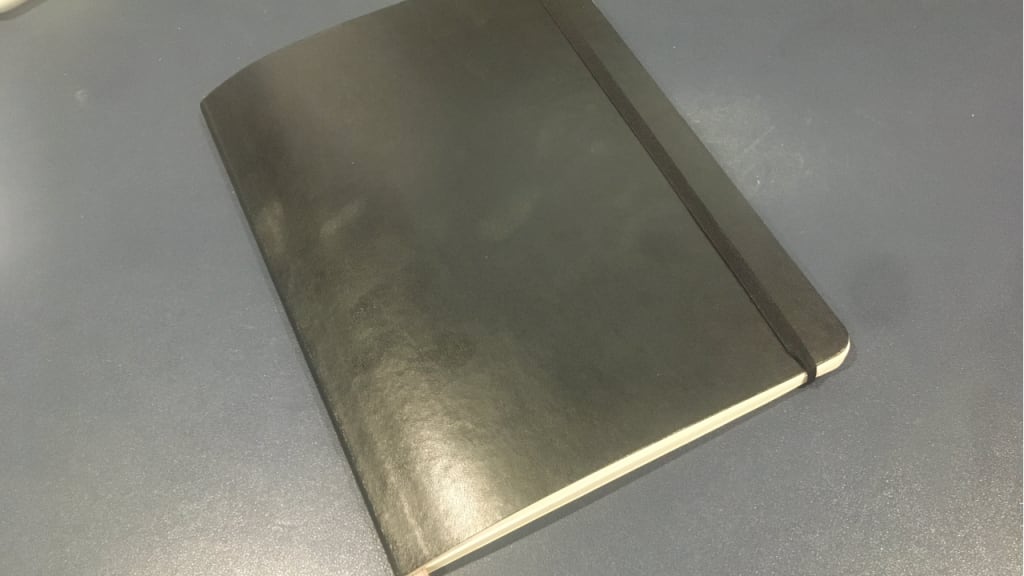
It was a small black notebook. It was bound in a leather-like cover with a bookmark ribbon and an elastic enclosure. Upon first glance, it appeared to be unused. Ibrahim put it on the kitchen side as he continued to consider whether he could accept Rachael’s overly generous gift.
“Morning Dad.”
Mo entered the kitchen and proceeded to make himself a quick bowl of cereal; his first online assembly would be starting in 5 minutes and he was running late. Very quickly, he noticed the notebook. Exercise books and paper for rough working were in short supply due to remote learning and lockdown and it was exactly what Mo needed. He picked it up with his cereal bowl and made out of the kitchen to the small dining table in their one reception room. “Ok if I take this notebook?”
“Sure,” Ibrahim replied, still distracted.
As the online morning assembly started, Mo flicked through the notebook, relishing the feel of the precisely engineered pages on his thumb. Almost all the pages were empty but at the back of the notebook were what looked like a collection of someone’s online passwords.
Ocado : L3ttuc3
iCloud : Lucy1nThe5ky
There were no usernames, just names of online services and what looked like passwords. At the bottom of the page were two lines that looked different:
1FseM9kGjkKWKZEdKjmiXh2oUJXrzTA4Jb
5KRZi7fFSUmMcyiBvZ4kd1qrZ4jbdtuzQhLh7oMBcBHUgDdMLgd
Mo was intrigued. What could these codes be? Were they also passwords? Maybe they were some special encrypted message? Mo suddenly realised he was about to miss the start of his first lesson of the day. It was his favourite, Information Technology, and today they were going to learn about crypto currencies.
Mrs Larch described how crypto currencies transactions were all published in a public ledger and that once a transaction had been written to the ledger and agreed by a number of people it became permanent. A person’s ability to transact in crypto currencies, that is, their “ownership” of some crypto currency, came down to their knowledge of the secret key needed to unlock a particular account in the public ledger.
Mo pondered this for a while. Maybe the codes he had just seen were related somehow. If the ledger was public, could it be found on the internet? And if so, were one of these codes an account on the public ledger? Mo started by typing the shorter code into his web browser.
“About 276 results (0.39 seconds)”
He was right, this was a bitcoin address and no doubt the other line on the page was the secret key required to unlock the account! Mo followed one of the links which took him to a page showing the balance of the bitcoin address: 0.5 BTC. Hadn’t Mrs Larch said a bitcoin was worth almost $50,000? That meant he was holding the key to almost $25,000 in his hands!
Mo was overjoyed, this was money that could significantly change their lives but how would he persuade his father not to give it back….?
About the Creator
Keep reading
More stories from writers in Humans and other communities.
The Boy Who Cried Love
After Terrence ghosted me, it took me awhile to move on. I was well aware that we hadn't been dating, but after three months of 'hanging out' and being intimate, it seemed like we were at the very least, on the road to dating. I couldn't understand how he could just cut me out of his life so callously, how he could live with himself knowing the pain and distress that he was causing me. It wasn't until the following spring that I even started to seriously talk to guys again.
By Gabriel Bradshaw 5 days ago in Humans
Dead and Wearing Green
She was wearing that green dress when I first saw her, five years ago to the day. Flowing meadow fabric draped over long legs, thick auburn hair flowing down her back. That smile. Of course, she is still beautiful now. But now she is no longer alive.
By Karen Cave5 days ago in Fiction



Comments
There are no comments for this story
Be the first to respond and start the conversation.