

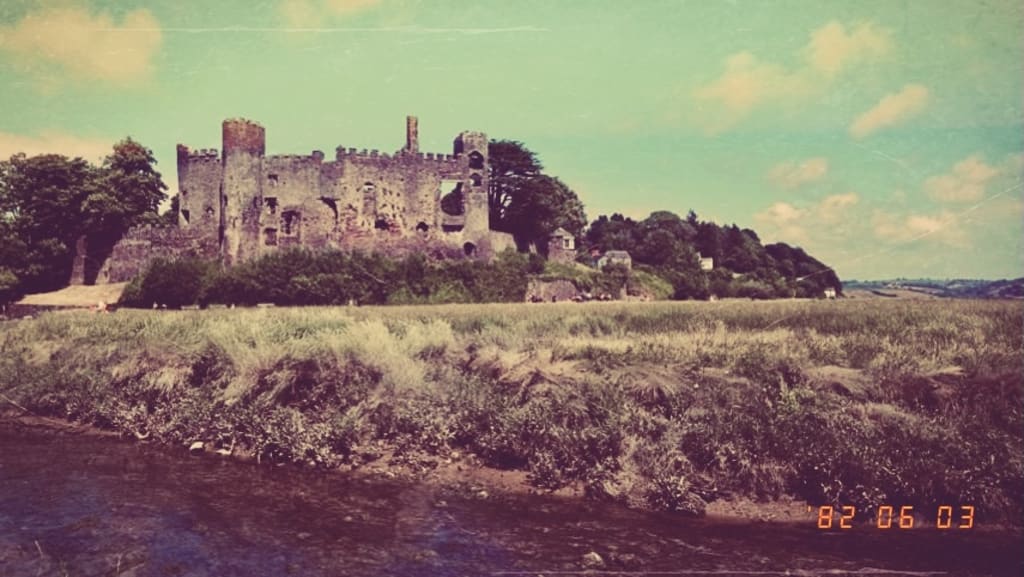
On the first day of my life as Maria Garcia, they told me skin was fish food for days, but the baby was safe. Smoke enough tobacco, and you'd have heaven itself smelling like your local pub; that was precisely what Doctor Jones did wherever he went, and on that day, the first day of my life as Maria, he chose to satiate the ashtray by my hospital bed. Oh, I knew I ought to be used to the smell of wet cigarette ends--I knew some things I know I always knew. And thus, as Doctor Jones carried on narrating how the kind fishermen of Carmarthen spotted my body floating along the shore where Laugharne Castle stood, I knew I missed out on something somewhere. Doctor Jones told me how among suitcases, champagne bottles, jewelry boxes, hardbound books, leather-bound notebooks, hollow ceramic icons of gods and saints, cans of Pepsi-Cola, cigar cases, and shards of the plane I went down with, my belly swelled out to the chill and seagulls. My hands got nibbled to the bone, so they couldn't know if I had a ring.
After all his huffs and puffs and talking about my fascinating exposed finger bones—there was no sign of infection; ergo, they took time to decide on amputation. The skin miraculously healed. No need to amputate—, how they sliced me open and scooped out a healthy baby boy, and how I should cope with life after comatose, Doctor Jones called the nurses in. Before they made me meet the baby, who they didn't consider a baby anymore, they reported how they placed bets on guessing my identity. They also told me they regarded me as family. Within the years of prying my mouth open and brushing my teeth, turning me on my sides, changing my sheets and gown, applying Aquaphor on my back and hands and genitals, and whispering their lives into my unconscious ears, they said I became their lost and found, unknown and dearest sister from across the oceans. At that moment, grey light peeking through the room made the swirls of smoke appear solid like baroque wood carvings, twirling, twisting, suspended in the air along with my thoughts. I knew I liked baroque art. My life before my life as Maria flew off to I did not know where, but I just knew some things I know I will have always known. One of the nurses, Mrs. Shelley, pulled the blinds up, cracked the window open, and said, "There's the Welsh sun for you." I could never say that sentence as she said it.
I missed the baby's first steps, and it already spoke English. I knew, just very well knew, that English was not my native tongue though I could speak it. Because of my looks, they said, they called me Maria and the boy Juan. After they took the boy Juan out of the room because he began wailing when he saw me, after they gave me a woolen jumper and trousers in exchange for my hospital gown, Mrs. Shelley told me how horrible it must be to be me. Tears in her eyes, lips and shoulders quivering, she said the ocean reclaimed my pearls, and I had not a penny to my name and my name wasn't even really mine. "All we retrieved that is probably of use is this," she said, handing me a small black leather-bound notebook. Most of the writings in it gave in to saltwater, save for one page. Mrs. Shelley said, "We assumed it was a telephone number. We attempted calling it, and someone answered, but all we know is Hola and Amor."
After that, in Doctor Jones' polished hardwood ashtray of an office, I spoke to Xiuhtecuhtli. My exposed fingerbones denting my face as I pressed the telephone onto my ears, I listened to the god of fire asking me for a confession. His voice warmed me like home, and he said he will bring me home only if I could tell him my sins. I had not one sin to tell. After that, Mrs. Shelley offered her house to be my house for as long as I needed. "Mi casa es su casa, yeah?" There's Welsh hospitality for you.
In the afternoon of the first day of my life as Maria, Mrs. Shelley offered to drive me to the location where the fishermen found me. I accepted with a hollow gut. Somewhere in my drenched, irretrievable memories, I knew someone called me ingrata. Ingrata means exactly how it sounds to a native English speaker. Mrs. Shelley told me that wet paper covered the shore like paper mache on the same day they found me. "I'm not kidding," she said laughing, "it was like a haunting of the ghost of Dylan Thomas whose house is over there." The famous Welsh writer's version of rage, rage, raging against death, according to her. A group of people volunteered to clean up the beach, yet on the next day, everything went back to how it was. Traces of anything that did not belong to nature there vanished. Everyone both eased and wondered, and in the years heaping up to Margaret Thatcher's reign and the end of my coma, all was forgotten. At my request, Mrs. Shelley left me alone there and said she'd pick me up for supper.
I let the cold sand get my feet as unfeeling as my heart while my mind sought memories and sunken jewels in the ocean. As my entire being tugged and pulled against letting things be and giving up, as the sharp, freezing breeze whipped my face, and the clouds gloomed and threatened to break, I met the Paper Man. That was the first time I saw him, though I just knew I know him, and he knew me. He was a figure everybody in the world who'd had their heart broken is too familiar of. He was the one you let in your room when all the lights were out, the one for whom you would take the world over. The one you stole glances with, the one who went to war. The one you ran away with, the one who got you in debt. The one who made you think you wanted to be somebody else; the one you gave up all your time for. The one who dragged you through hell, the one you wrote songs about.
The Paper Man said he knew me better than I knew myself before the plane crash. Recognizing a chance to go back home, recalling the telephone conversation with Xiuhtecuhtli, I asked him what I've done in the past. To know who I was, I needed to know my sins. The Paper Man said I could only make new ones. He spoke in poetry and riddles in English in an American accent. I just knew I could get used to not speaking my native tongue. At some point during our conversation, he cried, except his tears weren't water but coins. I just knew they were dimes—American dimes squeezing out of the curve on his face where eyes should be. He said, "I will weep for you as long as you needed." He then peeled the gloves protecting my skeleton fingers and kissed my wrists. From where his lips should be oozed white liquid that settled and firmed as my brand new hands. My paper mache hands looked like that of an unpainted holy ceramic icon's hands. Despite my confusion, despite my hollow gut--my being ingrata--I know I loved the Paper Man from that moment until now.
The Paper Man and I became husband and wife. Our wedding of mead and beer, love spoons and moonlight and music, white myrtle flowers, and more beer lasted three dawns. Those three days verged what you would define as happiness. My dress was torn. They said it was good luck. There's a happy Welsh wedding for you. Mrs. Shelley and Doctor Jones, as Maid of Honor and Best Man, took us to a convent to talk to the sacred eels that lived in the well there. The eels would tell you your future, but to us, they were silent. Nevertheless, we danced and twirled and drank mead and beer until we couldn't feel our bones. And after that, a spark and a turn of a page and years after that, the Paper Man drank a lot alone.
Those days of my life as Maria were days you would wish for. Those were days of fresh-cut grass smells and daffodils, chains of green hills peppered with noisy sheep. Those were weeks upon weeks of clothes upon clothes upon jackets upon coats. The nights were all black, and the days were all sunshine yellow. I craved blinding neon lights. I longed for sweat in my palms, sweat running down my back, and humid air. My life as Maria ought to be a happy one; however, I was not unhappy either. The Paper Man lived as the proper man of the house and my life. He was a good father to Juan. And I ought to be happy, yet I longed for the life I forgot.
The Paper Man worked as a miner while I spent my time writing; that was all my sanity allowed me to. I didn't bake because I feared my paper hands would stick to the dough. I never cleaned the house. The Paper Man worked with coal in the day, soap at night; rinse, lather, repeat. He did the laundry and helped Juan do fractions and measurements. He cooked and washed the dishes. He locked up the house, made love to me, brewed coffee in the morning, and then, again, drove to Ammanford to work with coal.
The Paper Man was a frugal man, an excellent domestic manager. It didn't take long until we had our own brand new washing machine, dishwasher, and microwave oven. Every month, the postman wheeled a new cardboard box into the living room. Those moments, Mrs. Shelley would die for. That's what she told me during our tea every afternoon, and in one of those afternoon teas, I told her I attempted knitting. I knitted and watched The Dukes of Hazzard. I then complained about the knot in my stomach, sans diarrhea. I reported how my heart would lately beat mercilessly. My lungs would run out of air even though I just lounged in our brand new three-seater velvet red sofa by De Sede all day. "It's anxiety, love," Mrs. Shelley said, "save the future for the future." Except, I was not worried or upset about anything. Even when I watched on our brand new Sony TV VCR how President Ronald Reagan defied "Give me your tired, your poor, your huddled masses yearning to breathe free," even though I very well knew in my very veins that I share the blood of those asylum seekers, I had no concern. I didn't even bat an eye over the Paper Man's progressing alcoholism. And when one day, when the Paper Man's fellow miners hauled in jars and jars of dimes and I still didn't feel a thing, Xiuhtecuhtli called me on our brand new Motorola telephone. "My child," he said, "forget the sins I required for you to confess. It is safe for you to come home."
On our sandalwood dining table, Juan did fractions and measurements and understood that those dimes were the remnants of the Paper Man. Juan made peace with the firedamp in the mine that took the Paper Man away from us, and I was gradually learning how to feel once more. Ashes to coins, dust to money, Juan stopped counting at $20,000. And so, life broke open my heart, and coins fell in. All must come to dust, and in the Paper Man's case, money. As one could only love the stars when it's night, only when the Paper Man was gone that I have truly known him, and I became me again.
About the Creator
T.M. García-Reiș
research psychologist, maker of stuff, mother of 2 cats, used to sing very angry songs.
Keep reading
More stories from T.M. García-Reiș and writers in Humans and other communities.
Happy Meal
You are always safe here where you can breathe. You are always safe here where you see time pass by just looking up at the sky. You are safe here, despite not having the things you used to have. You are needed here, and they do not need you. They rejected you. Years and years of breaking your back, chasing everybody's approval, achieving high test scores, dedicating your life to science and mathematics to save everyone else's; still, they deemed you not worthy. Well, we think you are. And if you were meant to be up there, you should have been. You are safe here. And you won't feel pain anymore. You will save lives—my life.
By T.M. García-Reiș5 years ago in Fiction
The CEO of Everything
They say "jack of all trades, master of none," but they forgot to mention the part where the jack of all trades is also the camera woman, the makeup artist, and the person currently yelling at a tangled Wii microphone cable in a her own bathroom while recording herself singing and trying to make it look realistic and professional. (As professional as you can make it with nothing but a cell phone camera and a mic that doesn't work)
By Sara Wilson7 days ago in Humans
The Man Who Heard the Steel Scream: Tom Alvarez and the Paper Shield
The untold story of Tom Alvarez, the construction foreman who documented the structural instability of the I-35W bridge weeks before its 2007 collapse, challenging the official engineering reports.
By Frank Massey 8 days ago in Humans


Comments
There are no comments for this story
Be the first to respond and start the conversation.