


Writing every day is often touted as the holy grail of writing advice.
Many successful writers and writing coaches swear by the practice, claiming that it's the key to improving your craft, developing a writing habit, and becoming a better writer overall.
But is daily writing really necessary for success? Is it feasible for everyone? And what happens when life gets in the way?
In reality, the idea of writing every day is a myth. It's an ideal that many writers strive for, but it's not always possible or even beneficial.
Here are some reasons why consistency matters more than daily writing.
Burnout and Writer's Block
Writing every day can quickly lead to burnout and writer's block.
If you force yourself to write when you're not in the right frame of mind, you'll likely end up producing subpar work, feeling frustrated, and possibly even resenting the act of writing itself.
Consistency, on the other hand, allows you to establish a sustainable routine that you can stick to over the long term.
Quality Over Quantity
Many writers focus on the quantity of their writing rather than the quality.
They believe that the more they write, the better they'll get. While it's true that practice makes perfect, writing for the sake of hitting a daily word count or time limit won't necessarily lead to improvement.
Instead, it's better to focus on the quality of your writing and strive to make every word count.
Life Happens
Life is unpredictable, and sometimes it's just not possible to write every day.
Illness, family obligations, work commitments, and other unexpected events can throw a wrench into even the most well-established writing routines.
If you're too rigid in your approach to writing, you'll end up feeling guilty or discouraged when you can't stick to your daily goal.
Consistency allows you to be more flexible and forgiving when life gets in the way.
Writing is a Marathon, Not a Sprint
Writing is a long game, and success rarely happens overnight. It takes time, dedication, and patience to develop your skills and build your career.
Consistency is key to achieving these goals.
By committing to writing regularly, even if it's not every day, you'll establish a solid foundation that you can build upon over time.
So, if daily writing isn't necessary for success, what should you do instead? Focus on consistency.
Make writing a regular part of your routine, whether that means writing for an hour every other day or 30 minutes three times a week.
Set achievable goals that allow you to make steady progress without overwhelming yourself. And most importantly, be kind to yourself.
Writing is hard enough without putting unnecessary pressure on yourself to do it every single day.
To expand on the idea of consistency in writing, it's important to note that it doesn't just refer to the act of writing itself.
Consistency also applies to other aspects of the writing process, such as editing, research, and submitting work to publications.
For example, if you're working on a novel, it's important to consistently dedicate time to editing and revising your manuscript.
This could mean setting aside a few hours each week to read through your work, make notes, and make changes.
Similarly, if you're a freelance writer, it's important to consistently research potential clients, pitch your ideas, and follow up on your submissions.
Consistency can also help you stay motivated and avoid burnout.
By breaking down your writing goals into smaller, achievable tasks and committing to them regularly, you'll be less likely to get overwhelmed and more likely to make steady progress.
Celebrating small victories, like finishing a chapter or getting a positive response to a pitch, can also help you stay motivated and excited about your writing.
Another benefit of consistency is that it can help you establish a writing routine that becomes a natural part of your daily life.
When writing becomes a habit, you're more likely to stick with it over the long term, even when other priorities or distractions arise.
This can be especially helpful for writers who struggle with procrastination or self-doubt.
Of course, there will be times when you can't stick to your writing routine or when life gets in the way.
This is normal and to be expected.
The key is to be flexible and forgiving with yourself, and to return to your writing routine as soon as possible.
In conclusion, while daily writing may work for some writers, it's not a requirement for success. Consistency, on the other hand, is crucial.
By making writing a regular part of your routine, setting achievable goals, and staying motivated, you can make steady progress and achieve your writing goals over time.
So, whether you write every day or a few times a week, focus on consistency and you'll be on your way to becoming the writer you want to be.
About the Creator
grab words
Your go-to destination for tips and tricks to elevate your writing. Our articles are tailored to help you grow your writing skills and unleash your creativity. Join the writing revolution and grab your words today!
Keep reading
More stories from grab words and writers in Humans and other communities.
Writers Are Also Humans
When we think of writers, we often imagine people who are larger than life, imbued with a rare talent and a singular creative vision. We see them as brilliant, mysterious, and somewhat otherworldly, capable of producing works of art that can move us to tears, laughter, or contemplation. But it's important to remember that writers are also humans, with all the joys, sorrows, and struggles that come with being alive.
By grab words3 years ago in Humans
A Historic Declaration
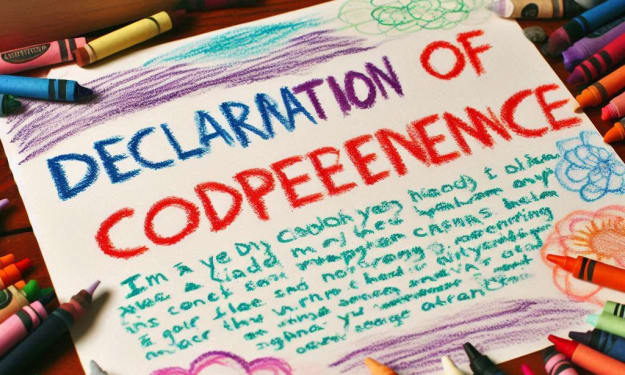
We the People of the Husbands of the United States of America, in Order to form a more perfect Union, and I mean you...with me...establish Justice, insure domestic Tranquility, provide for the common defence, promote the general Welfare, and secure the Blessings of Liberty to ourselves, after Puberty, do ordain and establish this Declaration of Co-Dependence.
By Gerard DiLeo6 days ago in Humans



Comments
There are no comments for this story
Be the first to respond and start the conversation.