

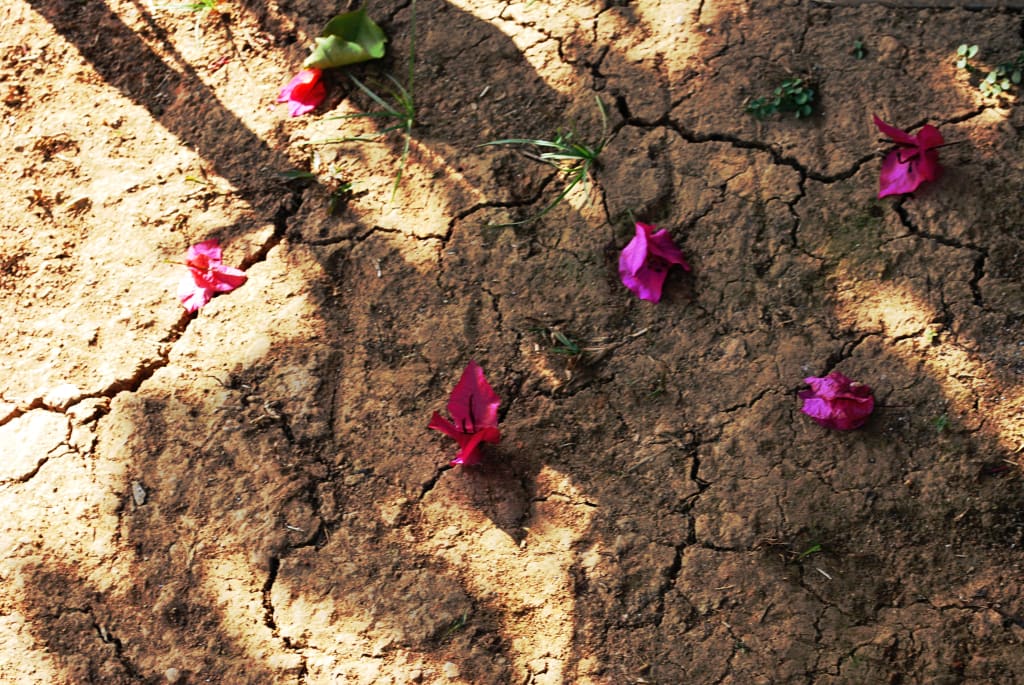
Cracked Earth
He slowly trudged along the side of the road with his arms crossed behind his back. His worn leather sandals slowly dragged in the sandy dirt of an unpaved road. The tired pair of sandals he wore were too big for his feet, making his big toe uncomfortably rub against the worn straps. His feet often blistered and bled, calloused over, and then blistered all over again. He noticed the beginnings of a hole forming in the sole of the shoe, so he made sure to shift his weight when he walked to avoid putting pressure on it - careful to prevent the hole from further expanding. He knew all too well that wearing his brother's old sandals was better than walking barefoot.
It’s uncertain if all of his clothes were just too big for him or if he was just incredibly small. He was no stranger to hunger as hunger was just a part of his day. Comb your hair, hunger. Apply paste to your finger to clean your teeth, hunger. Walk to school, hunger. Lie down to sleep, hunger.
The dry earth had split open from the summer heat - sending cracks like bolts of lightning across the ground. With the tip of his peeling sandal, the boy kicked at a mound of the dirt. The hot sun beat down his neck as he stared down at his feet - making sure not to make eye contact with the store that loomed before him.
The village bookshop had opened a month earlier to the awe of the locals. Literacy rates were low, and with all the day to day work to be done, reading was the furthest thing from the villager’s minds. At first they were intrigued, almost amused by the peculiar store. The modest window display held thick books of poetry, old science textbooks and novels stacked in all directions. The display drew crowds of curious onlookers in the afternoon. But as the days grew longer and busier, the villagers grew disinterested in the out of place store and continued about their daily lives. Now it served its purpose by providing much needed shade for stray dogs.
No matter how many times he washed the windows, a thick layer of dust and grime inexplicably returned to film the windows of the shop. It was a dream of his to take his worn books and sell them to eager readers. To watch their faces light up from the intriguing stories from around the world and for them to return to him ready to discuss their thoughts on their recent purchase. But so far, he had achieved none of this. This storefront was all he could afford after collecting used titles over the years, and regrettably, it was in a town where few could read and even fewer had idle time for stories and chit chat. Days felt long here. Long and quiet.
On this specific day, it was exceptionally hot. The stray dogs languished in the heat. As he absently polished his glasses with a rag, the bookshop keeper looked out at the boy who came by everyday. As sure as the sun would rise in the morning, the shy boy would appear in the afternoon and stand across the shop like a guard keeping watch. Endeared by the boy’s persistence, the bookshop owner took pity on him and motioned for him to come inside.
At first he wasn’t sure if he had imagined it. But when the shopkeeper came outside and motioned at him again, the boy realized he was being invited inside. His heart raced as he made his way over to the store.
Ancient and thick tomes lay before him. Some with bright and shiny covers and others with dull, cracked spines. Elaborate gold inscriptions, colorful covers and curly fonts surrounded him.The air was thick and stuffy with dust.
After months of not conversing with anyone, the shopkeeper completely forgot about preamble.
“Do you know how to read?” inquired the shopkeeper. The boy nodded shyly.
“What kinds of books do you like to read?” he asked.
The boy paused. His family couldn’t afford books. Every penny earned went to pay off their debts. They only ever had enough money to pay for grains of rice weighed on a scale. There was no budgeting for anything that wasn’t absolutely vital. Ever since he learned how to read, the boy would absorb any shred of paper that passed their doorstep. Leaflets, advertisements and government propaganda alike. Once he followed his father to the train station and found a rare discarded newspaper on a bench. For months he read it from cover to cover until the ink entirely wiped away and the paper turned powdery in his hands.
“I like all kinds of books,” he finally replied.
“Well then, you’re welcome to all kinds of books here.”
The boy’s body crumpled as he looked down at his feet.Without looking back up he responded.
“I can’t afford any books, sir.”
“Hm,” the shopkeeper had assumed as much. But this wasn’t going to dissuade him from his decision. He wished for company and the boy was the only one in the village remotely interested in his store. No harm could come from lending him some already used books. He turned and shuffled through a pile of books until he returned a thick novel to hand to the boy.
“Do not damage it and bring it back next week. Tell me what you think of it,”.
And that is how it began. Each week, the boy would return, invigorated from his latest read. He and the shopkeeper would discuss each story at great length over hot cups of tea. Eventually, he went from one book each week to a few more thin paperbacks. Several months went by and he consumed each one so quickly, the shopkeeper was afraid he’d run out of books. He became unable to recommend books to the boy as he even outpaced his own reading. So when the boy came at the end of each week, the shopkeeper would hastily put together a stack of books to give him and they would resume their discussion.
After each session with the shopkeeper, the boy would run home with the bundle of books under his arm. He waited to get back home to review the newest selections. Having something to look forward to was a welcome change for him. Immersing himself in the stories allowed him to forget the hunger pangs and the burning heat. Reading about distant lands took him far from the village. Reading stories about other poor young boys in the world made him feel so much less alone.
One day, after a typical visit to the bookshop the boy was reviewing the latest heap of books seated on a mat over the dirt floor of his home when he came across a small black notebook. The book was smooth and had no inscriptions on the cover, no title whatsoever. He sat up straighter as he opened the book. To his surprise, the pages were entirely blank. He slowly flipped through the yellowing pages until the very end, where a concealed pocket wrinkled under his touch. The pocket bulged a bit. He opened the book a bit wider to reach the opening of the pocket and reached in. The seal made a small crack when he opened the pocket and to his utter shock, his hands carefully fished out a large wad of cash. He held it in his hand for a minute or so before he meticulously counted it. A sum of $20,000. This was more money than he’d ever seen in his entire life. Probably more than his father had ever seen. Or even two generations of his family had altogether seen.
But where did this money come from? Surely not the bookshop keeper with his ramshackle store in the middle of a poor village. Was it an accident? Was someone hiding their life savings in a notebook? Will someone come looking for it?
But then, his anxious thoughts gave way to happier musings. He realized he could use the money to make his family the wealthiest family in the village. He could have his own room. He could eat a steaming hot bowl of rice all to himself, not divided 5 ways for him and his brothers to share. He could even own a proper pair of shoes that fit. But how long would the money last them? There were so many mouths to feed and bodies to clothe. What if the villagers got envious or started questioning the source of their sudden success? What if they robbed his family? What if someone got hurt?
Perhaps instead, he could run away and use the money on himself. That would be far less complicated. The faraway lands he read about in his stories were now well within his reach. He could visit mountains, deserts, forests and glaciers. He could travel by boats and trains. He could smell the salt from the cool ocean breeze, he could hear horses clopping down cobblestone streets. He could feel fields of billowing pampas grass under his outstretched fingers. He could grow up somewhere else outside of the village. There seemed to be no limit to what this money could do for him.
He realized the more he had to share with others, the less he’d have to himself. He could either feed his family and live a life as a villager forever or be on his own and see the world. He couldn’t have both. So, he decided then that under the cover of darkness, he would slip out of his home and head out to see the world. That night, he packed: the black notebook full of cash, another book from the shop, a small wedge of soap, a flask of water and a small sack full of grains which would not go unnoticed. He wrapped up the belongings and started his journey.
After some time, he stopped at the top of a large hill to take rest. As he wiped the sweat from his brow, he looked down at what he brought with him. Food stolen from his family, which would inevitably force them to go hungry. A borrowed book from his friend, the shopkeeper. How could he not return the lot of books to a man who showed him so much kindness? And a stack of money that did not belong to him.
He turned to see the tiny specks of light from his village in the distance. Before he came across this money, he was perfectly content with what he had. This money had made him greedy and insatiable. It made him take things from others and want more and more.
This money could help his family. His father and mother wouldn’t have to work as much. They would have enough to get by. But would it solve all of their problems? Would it change how they cared for one another?
A week later, the shopkeeper watched the boy wordlessly enter his store. He timidly handed the stack of books he borrowed to the shopkeeper. While the shopkeeper busied himself putting on a pot of tea for their discussion, the boy swiftly slipped the black book amongst the massive disorganized piles of books in the shop.
Later when he turned to leave, he held the doorknob and paused for a moment but then continued through the door.
As he made his way out the shop and towards his home, the boy made sure to shift his weight to avoid putting pressure on the hole developing in his brother’s old sandal.
About the Creator
Keep reading
More stories from writers in Humans and other communities.
Time to change your life.
Is it even possible for you to change your life? A lot of people, more than there should be, are unhappy with their lives. But what are they doing about it? Usually nothing. People talk about how shitty their lives are and want change, but are they not taking the actions to change?
By Jen Phillips2 days ago in Humans
Don Lemon’s Career, Controversies, and Public Turning Points
Public figures rarely live in simple categories. They become symbols, targets, voices, and sometimes cautionary tales all at once. Don Lemon is one of those figures. For years, his face and voice were tied to nightly news, breaking stories, and heated discussions. Viewers formed strong opinions about him, both supportive and critical. His journey through television news has included career highs, public backlash, personal revelations, and sudden change. That mix keeps people searching his name and following updates about his path. This article looks closely at Don Lemon’s career, major turning points, controversies, and media presence, using clear context and plain language. Instead of praise or attack, the goal here is understanding how his story developed and why it still draws attention.
By Muqadas khana day ago in Humans
Trouble at the Tea Leafing Café
The rain had started right around the time that Annie was buttering her second thick slice of homemade toast for breakfast, and hadn’t paused since. Not that anyone could tell. The windows of the café were fogged over, and with every seat filled with happy customers munching on fresh baked pastries or steaming bowls of the delicious soup of the day, it was hardly surprising. Annie looked around the room, finally taking a moment to breathe after the lunch time rush. Her old life already felt like a bad memory, a part of her history, always, but just that. History.
By Hannah Moore3 days ago in Fiction




Comments
There are no comments for this story
Be the first to respond and start the conversation.