
Chapter 5: The Big Brother Who Came Back in Debt
Return of the Brother… and His Creditors

In the 1990s, people shouted "Unification Soldier" like it was a sacred title. It was an honor, a promise, even a dream. They believed that marching off in uniform meant you would come back as a hero—respected, decorated, maybe even reunited with a united Korea.
But now, in a world well past the year 2000, no one ever became that mythical soldier. No one brought back unification.
And my brilliant older brother, the one who swore he would return as a Unification Soldier with glory and purpose, came back ten years later looking like he had barely survived.
What returned to us wasn’t a hero. It was a man whose face had aged far beyond his years, whose back bent lower than our father’s, and whose clothes hung on him like rags.
The country that once honored his service now ignored his existence. His ten years of loyalty were invisible to the system.
Yes, the same big brother who once polished his white sneakers until they shined and combed his bangs with cooking oil like he was some movie star... now walked around like a man erased.
The boy who once dreamed of being part of a great national cause had returned as another burden to our struggling home.
No medals. No welcome. shame, and a thousand untold stories buried behind tired eyes.
In North Korea, people have a nickname for young men returning home after ten years of military service: they call them “three-year stoneheads.”
It’s not just a joke—it’s a bitter truth wrapped in sarcasm. The idea is simple: after spending a full decade in the military, your mind becomes as stiff and unmovable as a stone.
Why? Because you’ve lived for ten years in a world where money doesn’t decide your worth, where lying is punished, and where rules—however harsh—are consistent. Then, you’re dropped back into civilian life, where survival demands flexibility, negotiation, and often deception.
These ex-soldiers, like my brother, find themselves unable to understand the pace and tone of regular life. They speak differently. They move differently. And most of all, they trust too easily, because they’ve never lived in a system where people lie to protect themselves.
It usually takes at least three years of struggling through civilian life before a returned soldier can begin to “thaw out” from this frozen state of mind. Until then, they are disconnected—mentally, emotionally, and culturally.
That’s what “three-year stonehead” really means: a man trying to remember how to be human again.
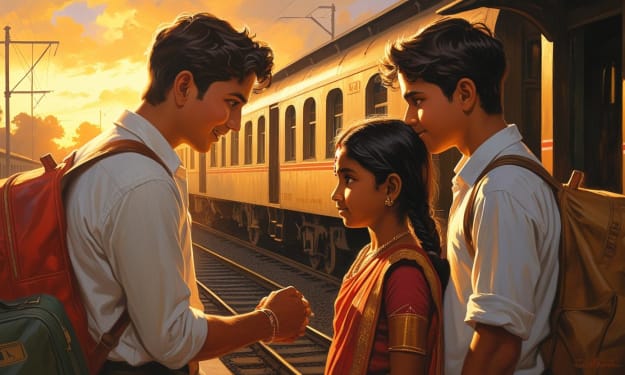
When my older brother came home from the military, he was not the proud, uniformed hero my mother had imagined.
He returned not with honor but in a single, ragged army uniform—worn and faded, the fabric tired like his spirit. There was no fresh uniform. No shiny discharge backpack. Nothing to suggest he'd served ten full years as a “Unification Soldier.”
My mother couldn’t hide her disappointment.
“Other sons come home in crisp new uniforms,” she said bitterly. “They carry new bags and look like soldiers. Why do you look like a beggar?”
My brother’s answer only deepened her fury.
He had been discharged alongside another soldier who confessed that he had no home to return to—no food, no family, no place to sleep. So my brother gave him his brand-new uniform and backpack.
“He needed it more than I did,” he said quietly. “He could sell it to survive.”
My mother exploded. “Do you think your family isn’t hungry too? This country is starving! Even the government can’t help us, and you—what makes you think you can? Do you think you're some kind of savior?”
She was livid. “That uniform and backpack might be nothing to you, but it’s all you had to show for ten wasted years! You couldn’t even come home looking like a soldier? You either think too little of your parents or too much of yourself. If you can’t come back properly dressed, go back and come again when you can. Otherwise, don’t come home at all.”
She sent him away right there at the doorstep.
No warm welcome. No meal. Not even a coin in his hand for the long journey back.
Trains in North Korea don’t run like they do in other places. To return meant crossing the country, end to end. And yet, my brother turned around in silence, without protest, and left to find our father—who was still working at the factory—and begged him for enough money to return with the dignity our mother demanded.
He didn’t complain. He didn’t argue.
He just went.
When my brother finally took off his military uniform, there was nothing underneath but shame and cold skin. From his underwear to his socks, shirt, and pants—everything had to be bought at the jangmadang, the black market.
He came home after ten years in service, and the state gave him nothing—not a coin, not a piece of civilian clothing, not even a pair of shoes. If he wanted to look like a person again, we had to build him from the skin up.
My mother was already doing all she could. She raised a pig behind our house, brewed homemade liquor in secret, and traded them at the local market. My father still worked faithfully at the state factory, just like millions of other North Korean fathers—but his monthly salary, paid at state-fixed prices, wasn’t even enough to buy 500 grams of corn.
In truth, if a father in North Korea had any real money, it was usually from stealing factory materials, participating in illegal side deals, or receiving bribes as a Party official. My father did none of those things. He was honest, and therefore, we were poor.
After the mid-1990s, women over 45 were finally given the "right" to trade in markets. That’s how most families survived—not through socialism, but through the sweat and grit of mothers.
Still, the money my mother earned from selling homemade liquor and that single pig was never enough for a family of four.
Thankfully, I had a job at a decent workplace. And it was my paycheck—not the state, not the army, not even our parents—that allowed us to clothe my brother when he came home.
My brother had done too much labor during his military years—more than any boy his age should have.
When he returned, his height was frozen in time, like he had walked straight out of high school. But his face, still youthful, held onto a kind of soft charm that women found difficult to ignore.
He had the kind of looks that made people say, “He could never do anything bad.”
A gentle, persuasive voice.
A quiet intelligence in his manner of speaking.
A Party membership card tucked neatly in his pocket—a sign that he belonged to the political elite, or at least had the potential to be.
Add to that his well-respected parents—still young, upright, and admired in the neighborhood—and you had the picture of a perfect future husband.
No one could find fault in his family background, and anyone who knew our parents would say, “That boy comes from a proper home.”
Marriage proposals flooded in, one after another.
Daughters from good families, introduced by neighbors or distant relatives, hoping to secure a promising match.
On paper, he was flawless.
In a country where so much is uncertain, he looked like someone who could offer a stable life—someone who would surely succeed.
My brother chose love—not prestige, not family pressure.
He married a young woman from a small farming village near the sea. She wasn’t from the city, nor from a wealthy family. But the two of them looked perfect together, and everyone said it was a beautiful match.
The wedding was modest but full of joy. For once, our family celebrated something without fear or hunger hanging over us.
I’m not sure what people in South Korea would say, but in North Korea, we called her hyeongnim—a respectful word for a brother’s wife.
When she moved to the city to live with my brother, people in her hometown looked at her with quiet admiration.
“She married up,” they whispered—into a good family, with a kind, handsome, and intelligent man from the city.
And she had.
My sister-in-law had chosen someone she truly loved, and their marriage began with genuine happiness.
But that happiness did not last.
Two years. That was all she was given.
Her smile began to fade before anyone was ready for it.
My brother had a good face and a good nature, which ironically became a useful tool for borrowing money. When he first asked Mom for a large sum of 4,000 won, she asked me whether we should give him the money since he wanted to try some kind of business. I told her that since it was his first time entering the working world, even if he failed, it would be a valuable experience. And if he succeeded, it would be an opportunity to see whether he had a talent for business. Encouraged by my words, Mom gave him a large amount of money for the first time.
However, he failed without making a single penny. Trying to earn big money, he busied himself running around here and there. Taking advantage of the fact that his friends’ older sisters or friends’ younger sisters liked him, he started borrowing money. Whenever antique trading seemed profitable, he put money into it and lost it; then when precious metal trading seemed promising, he invested and lost again. Eventually, he even used our parents’ connections to borrow money, and creditors began to flood our house.
Our parents, who had never lived their lives owing anyone anything—but rather helping others when they could—were utterly shocked by the unbelievable situation. Still, whenever the debt collectors showed up at our door, they stood their ground and boldly sent them away.
They would say things like, “Unless you lent the money to me directly, don’t come looking for repayment here. Go find that son of mine—the one you handed the money to face-to-face—and deal with him yourself.”
For my sister-in-law, the real suffering was only just beginning. In an effort to help repay her husband’s debts, she sold clams from her hometown to scrape together money for him—but it was like pouring water into a bottomless jar.
When she returned home during the final month of her pregnancy, she was struck by a cruel twist of fate: in the very same early morning her baby was born, the body of her beloved father was brought into the house. Life and death arrived hand in hand.
Later, when she came back to her in-laws’ home with her newborn on her back instead of the rice clams, debt collectors were waiting for her and my brother. They had no choice but to flee.
In the end, it became a divorce in everything but name. She had to return to her parents’ home and raise her child there, alone.
My brother promised his wife that he would come for her once things stabilized—but it was just that: a promise. There was no way to make it real. No doubt, when he borrowed money, he swore he’d pay it back. No doubt, he said, “I’m not a con man.” But in the end, he became exactly that—a con man who didn’t look like one.
Trying to repay the debt, he went out to sea for the first time in his life to fish, but came back empty-handed every time. Once, his boat collided with a foreign currency-earning company’s fishing vessel, nearly causing a fatal accident. To compensate for the damage, our family had to give up one of our most treasured possessions: our father’s bicycle.
Truly, my brother’s first three years in society were a mess—full of heartbreak and disaster.
Watching their child struggle so painfully was unbearable for our parents, but there was nothing they could do to help. He didn’t know how to lie, nor could he recognize a lie when he heard one. Setting out into the business world was a huge mistake for someone like him. But that mistake eventually taught him something valuable.
When he was first discharged from the military, he asked our parents, “Why did you live like this? What did you do in the ten years I was gone?”
I had heard of other sons saying that to their parents after coming home from the army, but I had always laughed it off—thinking it could never happen in our family. Surely not our brother. But now, here he was, asking the same thing. My parents and I were so stunned we couldn’t answer. Or maybe we chose not to. The question felt so disconnected from reality that the three of us had no words.
Thankfully, he eventually found his own answer—but by then, he was already broken.
In a country like North Korea, where money is scarce and opportunities scarcer, making a living is like climbing a mountain so tall you can’t even see the summit. And yet, he kept going. Because he was the eldest son. Because he believed it was his duty to care for our parents. Because now, he had a child of his own. He didn’t give up. He kept going back to the sea to catch fish.
I don’t know if he’s still drowning in debt, but if he’s still breathing and surviving in that land, then that alone is something to be grateful for.
About the Creator
Keep reading
More stories from Charlene Leigh and writers in Humans and other communities.
Chapter 4. An Eternal Goodbye to My Two Older Brothers.
When you open the window in our house, you can see everything—from the kitchen all the way up to the room at the very top. Our home is built like a tunnel of warmth and noise, one long stretch that holds all our lives inside it.
By Charlene Leigh8 months ago in Humans
Why Self Aware People Walk Away From Arguments Early.
Self aware people leave arguments early because they value clarity over control. You see this behavior in classrooms, offices, homes, and public spaces. They do not exit because they lack confidence. They exit because they understand how conflict works inside the human mind.
By Wilson Igbasi5 days ago in Humans
Instructions Included Challenge Winners
For the Instructions Included challenge, we asked writers to tell a story through instructions and to trust the form to carry what could not be said outright. Across the top entries, that trust paid off in many different ways.
By Vocal Curation Team3 days ago in Resources


Comments
There are no comments for this story
Be the first to respond and start the conversation.