
Chapter 2.The Woman Who Waited: My Grandmother’s Love That War Couldn’t Kill
An Ordinary Life in North Korea: My Grandmother’s Story, and Mine.
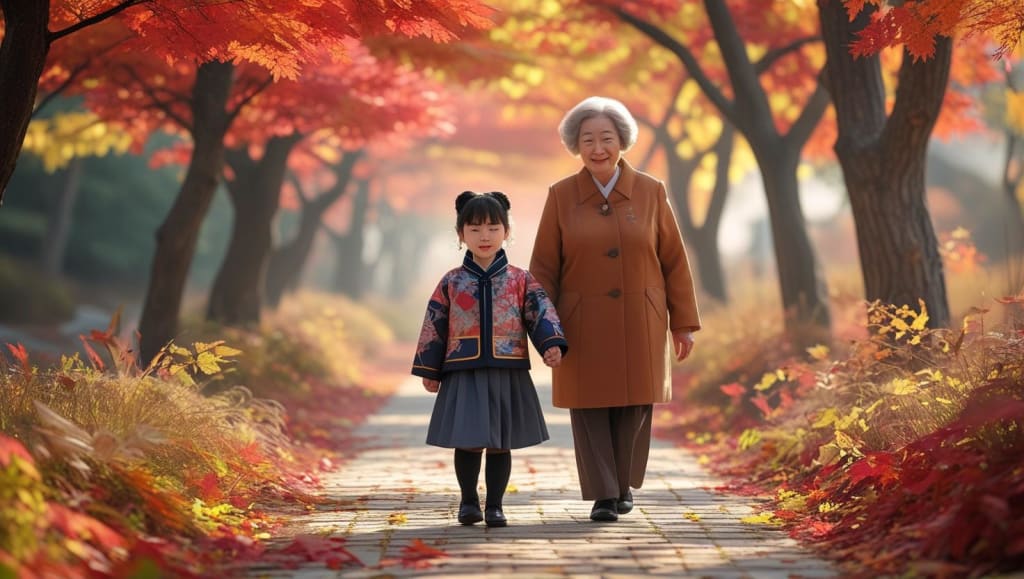
My brothers and I spent nearly all of our early childhood in our grandmother’s care. She was more than a guardian—she was the steady presence who fed us, protected us, and filled our days with love, even if we didn’t always recognize it at the time.
Grandmother loved farming. When we were young, she worked by herself on a military hillside farm, helping the soldiers grow corn and pumpkins. Every autumn, she would carry those crops—sacks full of golden corn and plump pumpkins—down the mountain to our house in the city. She walked the whole way alone, strong and determined.
When my brothers turned six, she sent them to live with our parents in town so they could begin attending kindergarten. That was when something unforgettable happened—something that still feels like a scene from a movie, or a vivid childhood dream.
One day, both of my brothers went missing from our home. Two small boys, vanished without a trace. My parents were frantic. They didn’t go to work that day. They couldn’t eat, couldn’t sleep. The entire village joined the search, combing the woods and roads through the night and into the next morning. We had no telephone, no way to call Grandmother, no clues. The fear that something terrible had happened was overwhelming.
We all assumed the worst—how could such young children survive alone? Our relatives lived far away, so the idea that the boys had gone to visit them seemed impossible. The only direction they could have gone was back to Grandmother. But that meant walking over 80 ri—nearly 30 kilometers—through rough terrain and narrow paths winding through the mountains. Could they really have made it?
Then, that evening, just as the sun began to set, Grandmother appeared.
She came walking down the road, holding each of my brothers by the hand. Her face beamed with quiet pride, as though she’d just returned from a great triumph. She wasn’t angry. She wasn’t surprised. She seemed to understand them better than anyone.
Those little boys, too young to express their longing in words, had simply followed their hearts. After two years of being with Grandmother every day—waking up to her voice, falling asleep to her stories—they couldn’t stand even one night apart from her. So while our parents were away at work, they packed up and left. No maps, no instructions—just a memory of the winding path that led home to her.
That day, I understood something deeply about love. Sometimes, children know exactly where they belong—not because someone tells them, but because they feel it in their bones.
When I lived alone with my grandmother, the nights were terrifying. Our mountain home sat deep in the countryside, far from the village lights, and after sunset, the darkness crept in like a living thing. Often at night, I would hear what I believed were wild animals crying—most frightening of all were the eerie howls of what Grandmother said were jackals, echoing so close it felt like they were right outside our window.
To this day, I still don’t know if those howls were truly jackals or just the groans of wind pushing through the valleys. But when I cried for my parents, longing for my mother’s embrace or my father’s voice, Grandmother would quickly hush me. “The jackals will hear you,” she warned, her voice low and serious. “If you keep crying, they’ll come closer.” That was all it took to stop my sobs. Fear quieted me when comfort couldn’t.
My very first Korean words were learned not from my parents or a classroom, but from Grandmother’s thick dialect. She didn’t teach me the clean, standard speech you’d find in books or hear on the radio. Instead, I learned the language of the mountains, words carved from old habits and hard lives. She called a neck a mok-ahji, a stomach bae-ttaegi, ears gwi-ttaegi. That was just how things were said in her world, and naturally, I said them too.
By the time I came down from the mountains to attend kindergarten, I spoke exactly like her. I still remember the first time I opened my mouth in class—how the other children burst into laughter at the strange, funny words I used. The neighbors chuckled too, whenever I tried to speak. I didn’t understand what was so amusing. All I had ever known was Grandmother’s way of speaking, and I had never thought of it as different. To me, that was just how people talked.
Grandmother was always working. Every single day, without fail, she rose at 4:30 in the morning. The rest of the world was still sleeping, but she would quietly wash her face, comb her hair neatly, then wrap her head in a clean white cloth like a symbol of dignity before starting breakfast. While my mother, my friends’ mothers, and all the neighborhood women usually washed up after they cooked or got the kids out the door—sometimes only after work—my grandmother insisted on cleanliness first. She believed that one must be clean before preparing food, as though the act of serving a family demanded respect, not just effort. That belief made her wake up earlier than everyone else and, in turn, work harder than anyone else I knew.
By 7 a.m., all five of us—everyone but Grandmother—had to be out the door. My parents left for work, and we children lined up at designated meeting spots for school, joining our classmates in neat rows before marching through the school gates. But before any of that happened, six people sat around the breakfast table. When we all left, the table was buried in bowls and spoons, rice and soup dishes piled high like a battlefield of a morning meal.
Our home turned into chaos within minutes. Five people raiding one shared closet, changing clothes all at once—it was a sight to behold. From the biggest room upstairs to the tiny space near the kitchen, socks were strewn across the floor, red neckties from the previous day dangled from doorknobs, and pajamas lay crumpled in every corner. Dust swirled in the air, kicked up by all the flailing limbs and rushed movements.
And when the house finally quieted down, it was Grandmother’s time to begin again. She would clean every dish and spoon from breakfast, then gather the clothes scattered everywhere, sorting them by what needed to be washed and what could be worn again. She would organize our study desks, which we had left in a frenzy, pulling out the books needed for that day’s schedule and straightening our messy shelves. Room by room, she mopped the floors from the top to the bottom of the house. By the time she finished, the sun had moved toward its descent, and it was nearly time to start dinner all over again.
I often think that Grandmother worked harder in our home than she ever did when she was a hired farmhand. At least back then, there was compensation for her labor. In our household, she worked herself to the bone for love, not wages—and rarely even got thanked for it.
My grandmother was full of complaints and never short on scolding. When she used to work as a farmhand, at least there was some kind of compensation for her labor—food, payment, even recognition. But in her son’s household, she worked herself to the bone, and no one seemed to truly see it. No wages, no thanks—just endless chores and expectations. The kitchen, which my mother managed, never quite met my grandmother’s standards. The food wasn’t prepared the way she believed it should be, and the cleanliness never felt quite right to her.
She adored my older brothers—the handsome grandsons—who could do no wrong in her eyes. Whatever they said or did, she smiled and nodded, understanding their moods and praising their talents. But when it came to me, the granddaughter, everything I said and everything I did seemed to irritate her. My words were too cheeky, my actions too strange, my behavior never quite right. It was as if I had been born under a different sky from the grandsons she doted on so naturally.
Still, looking back, I realize something now that I didn’t understand then: I was simply the safest place for her disappointment. She couldn’t nag her daughter-in-law the way she wanted to. That would have caused conflict, or perhaps she feared it would upset her son. So instead, she turned to me—the naïve, little granddaughter—and unleashed all her frustrations in the form of endless scolding. Back then, I thought she just didn’t love me. I believed I was singled out, that I was the one person she disliked. But now I know better. I wasn’t the only one in her line of fire. My mother was there, too—hidden behind me in silence.
My grandmother lived by a firm principle: “No food for those who sleep in, but always save food for those who’ve gone out.” In North Korea, food was never something to be taken for granted. Even when I was a child, snacks were a luxury found only in kindergartens, daycare centers, or in the rare wealthy household. There wasn’t much for between-meal treats, but at least in those days, we didn’t go hungry. It was a relatively good time.
But everything changed by the time I entered middle and high school. Food all but disappeared from nearly every household. That was when North Korea officially declared the beginning of the “Arduous March”—a euphemism for famine. My grandmother, always resourceful, saved even the water used to rinse cornmeal. She would let the starch settle to the bottom, collect it carefully, and use it later to make a kind of bread. For us, it was a treasured delicacy. In a place where wheat flour was rare and precious, bread was almost sacred—something you might see only on holidays or New Year’s.
And yet, even during those difficult years, even though I was the “mischievous” granddaughter who seemed to always get on her nerves, my grandmother never forgot me. If I came home later than my brothers, she would have already tucked something aside—just for me. No matter how much I tested her patience, no matter how much I misunderstood her love, she always made sure I didn’t miss out on the little she had to give.
By the time I finally outgrew my grandmother’s disapproval, she had only three years left to live. I was just entering my teenage years when my older brothers left home, full of confidence that they would return as soldiers of a reunified Korea. They were drafted into the army for the mandatory ten-year service. For the first time, my grandmother’s attention—her presence, her home, her quiet affection—was mine alone. It wasn't quite the same kind of love my brothers had received, but it was still precious. And it made me happy.
Whenever she returned from a neighbor’s celebration, she would bring back the colorful rice cakes served at the party—not for herself, but for me. When I came down with a cold, she would gently wash tofu and spring onion roots to make a warm, healing broth. When I complained of constipation, she made me a mugwort cushion to help ease the discomfort. In the winter, when I lost the wool gloves she had knitted for me, she didn’t scold me like before. Instead, she simply warned me, “If you lose your gloves, your hands will freeze.” Then she quietly knitted a new pair—the kind with a string that wrapped around my neck so I wouldn’t lose them again.
If I ever did anything for my grandmother, it was only to walk on her aching legs or press gently on her tired back with my small feet. That was all I could give. And those three years passed like a dream, until the final spring of my grandmother’s life arrived.
No one could have imagined that spring would be the last we would share with my grandmother. In all the fifteen years I lived with her, I don’t remember her ever going to a hospital. She was always busy—busy working in the fields, busy taking care of the five of us, busy moving with purpose. In my memory, she was always strong, always healthy. I never once saw her lie in bed from illness.
She used to say, time and again, “I will never live long enough for my children to have to clean up after me—not my pee, not my poop.” And she meant it. When she fell ill, she was bedridden for only ten days before she passed. Even on her final day, she insisted on using the toilet by herself. But when she couldn’t manage it alone—when her body wouldn’t cooperate—she cried. That was the first and only time I saw my grandmother cry. It was also the first time I saw her lying down because she was sick.
My grandmother passed away without ever setting foot on an airplane—the kind even the poorest Americans might afford at least once in their lives. spent her youth without the joys of romance that many people take for granted, and instead, waited her whole life for one man who never returned. She gave all the love she had to us—her family—and then quietly left this world. She never received even a single flower just for herself, never once heard the words “I love you” or “Thank you” from her children in the way she truly deserved. All she knew was sacrifice and hard work. So I pray—more than anything—that the road she walks now is a path of blossoms, waiting with open arms and overflowing with the love she was denied in this life.
About the Creator
Keep reading
More stories from Charlene Leigh and writers in Humans and other communities.
chapter 1: The Woman Who Waited: My Grandmother’s Love That War Couldn’t Kill
She met my grandfather through relatives. He was from Seoul, South Korea, which—ironically—was not considered a desirable trait. In her North Korean hometown, people thought Seoulites were snobbish—more so even than the elite from Kaesong. Her parents disapproved, but she married him anyway.
By Charlene Leigh8 months ago in Humans
The Bangor Plane Crash That Changed Military Aviation Forever
Some disasters stay with a place long after the smoke clears. The bangor plane crash is one of those events. It happened quickly, but its echoes still move through military safety rules, training rooms, and quiet conversations among air crews. This was not just an accident involving metal and fuel. It was about people who trusted a routine flight and never reached home. Bangor, a small city better known for calm streets and cold mornings, became the center of a painful lesson. This article looks closely at what happened, why it mattered, and how it reshaped the way military flights are handled. The story is heavy, but it is worth telling with care and honesty.
By Muqadas khan5 days ago in Humans


Comments
There are no comments for this story
Be the first to respond and start the conversation.