
Cellphone Metamorphosis: A Radical Discovery in Human Skeletons
Unlocking the Surprising Connection Between Technology and Our Physical Evolution
The Technological Evolution of Our Bodies: Unraveling the Smartphone Saga
In a world where technology is evolving at a breathtaking pace, the boundaries between the digital and physical realms are becoming increasingly blurred. What if I told you that our trusty cellphones, those sleek devices we rely on for connectivity and convenience, might be harboring the power to reshape our very bones? It's an astonishing notion that has recently swept through the media, prompting discussions and debates. This intriguing concept stems from a scientific report that suggests our beloved phones and tablets might be causing substantial and long-lasting alterations to our bodies, albeit in a rather unexpected way.
The pioneers behind this intriguing revelation are David Shahar and Mark Sayers, specialists in the captivating field of biomechanics at Australia's University of the Sunshine Coast. Biomechanics, for those unfamiliar, explores the complex interplay of mechanical laws in living organisms, from the graceful flight of birds to the mechanics of human motion. Yet, Shahar and Sayers' research embarked on a fascinating journey that would meld biomechanics with the captivating world of osteobiography.
Osteobiography, in essence, is the art of deciphering someone's life story from the bones they leave behind. Scientists have long known that our skeletons adapt to our lifestyles, with each set of bones telling a unique tale. For instance, consider the discovery of unusually large skeletons on the Pacific island of Tinian in 1924. Nearby stone structures hinted at the islanders' robust nature, forged through years of laboring with heavy stones. Naturally, this led to the development of larger arms, legs, and collarbones.
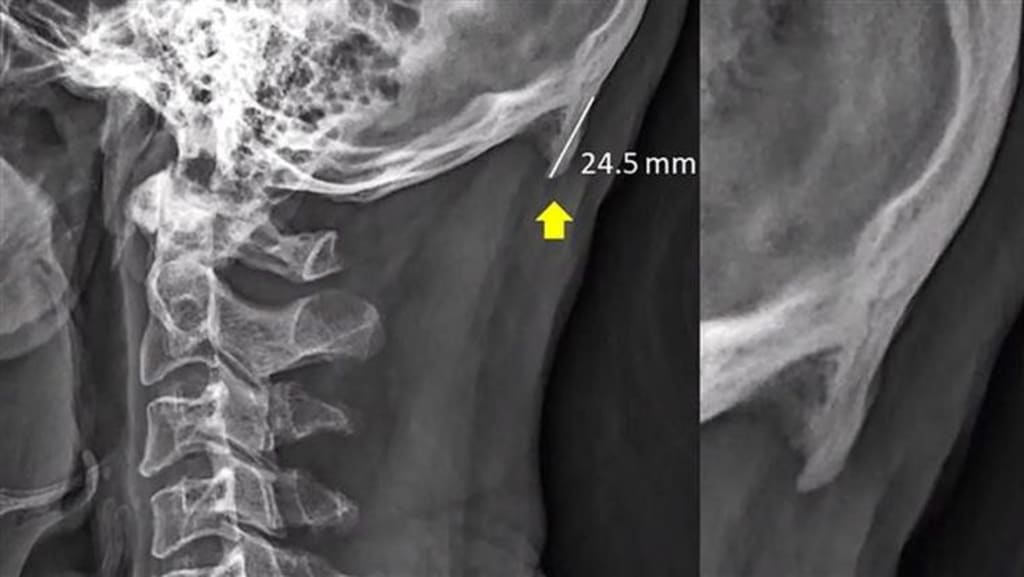
Fast forward to the land down under, where Shahar and Sayers embarked on an awe-inspiring quest. They believe that modern technology, which has become an integral part of young people's lives, is molding the skeletons of the younger generation in ways we've never imagined. So, how is this transformation taking place? It all revolves around a rather mysterious entity known as an EOP, or external occipital protuberance—some have humorously likened it to a "foam ball" or even a "devil-like horn."
In reality, the EOP is a bony growth nestled at the back of the skull, intricately connected to the nuchal ligament. The nuchal ligament, a wise connector, plays a crucial role in linking neck muscles to the skull, while the EOP acts as an anchor, bestowing stability upon this connection. The plot thickens when we consider Shahar and Sayers' startling revelation—during their extensive study, they unearthed something astonishing. In young people, the EOP seemed to be more prevalent, prompting them to hypothesize that the forward-leaning posture adopted during prolonged smartphone and tablet use is a key factor.
As we crane our necks forward to gaze at our screens, we unwittingly apply extra pressure to the region where neck muscles connect to the skull. To compensate, the EOP gradually elongates, growing by several millimeters. This fascinating phenomenon has even earned itself a nickname: "text neck."
Furthermore, their findings revealed that this condition was primarily found in men. In 2016, Shahar and Sayers reported that 67% of men in their test group had a larger EOP, compared to only 20% of women. By 2018, their research expanded to include a staggering 1,200 individuals, with males appearing to be five times more likely to develop these prominent "text necks."
But what does all of this mean for humanity? We often hear about the potential health risks of phone radiation, even links to cancer. However, this report unveils a different concern—the first instance where experts explicitly highlight how technology might be reshaping our very bodies. Shahar and Sayers describe the lengthening EOP as a degenerative process, suggesting that if young people persist in their smartphone habits, things could take a turn for the worse.
And it's not just the neck. There's also the phenomenon of "text thumb" or thumb arthritis, where the constant use of our thumbs for texting can lead to serious problems, similar to carpal tunnel syndrome. However, it's worth noting that this study has received its fair share of criticism. Skeptics argue that the evidence is not conclusive, emphasizing that elongated skull bones, particularly in males, are not new findings.
So, are Shahar and Sayers onto something groundbreaking, or have they cleverly woven established facts into their own narrative? Regardless of where you stand, one undeniable truth emerges: technology has an unparalleled impact on our lives. The idea that future generations may physically change due to constant interaction with their devices raises serious questions that demand our attention.
Ultimately, it will be the archaeologists of the future who determine whether our descendants will bear unusual spikes protruding from the back of their necks. As we navigate the digital age, perhaps we should consider trading some Angry Birds for a leisurely walk in the park, finding a balance that ensures our screens enrich our lives without fundamentally altering our skeletons. After all, in this ever-evolving world, we must be mindful of the price we're willing to pay for our digital evolution.
About the Creator
The CEO of Everything
They say "jack of all trades, master of none," but they forgot to mention the part where the jack of all trades is also the camera woman, the makeup artist, and the person currently yelling at a tangled Wii microphone cable in a her own bathroom while recording herself singing and trying to make it look realistic and professional. (As professional as you can make it with nothing but a cell phone camera and a mic that doesn't work)
By Sara Wilson7 days ago in Humans
The Blue Ridge Stalker
Tom had left the Ford down the way, its spark plugs finally exhausted and no mechanics for a dozen miles back through the foothills to Strossburg. No matter, he had worn his boots—almost as if he planned for this to happen. The puzzle he sought to solve emanated from the woods clinging to the slopes above; the valley behind held no mysteries.
By Stephen A. Roddewig3 days ago in Fiction



Comments (1)
Very interesting! Great work!