
Casablanca: Why We’ll Always Have This Movie
“The problems of three little people don’t amount to a hill of beans in this crazy world.”

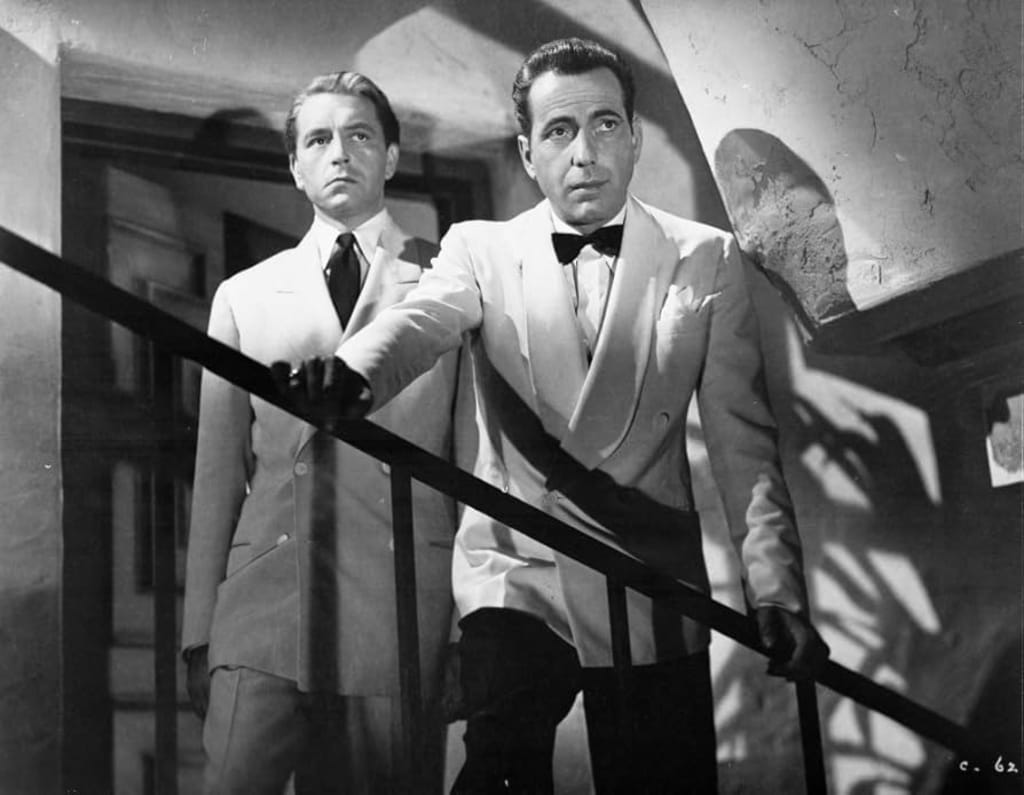
When Casablanca premiered in 1942, no one expected a masterpiece. It was a studio assignment, shot quickly on Warner Bros. sets, based on an unproduced play called Everybody Comes to Rick’s. It had a modest budget, recycled sets, and a script that was famously being written while the cameras rolled.
Yet what began as a routine Hollywood picture became one of the most beloved films in history. Casablanca has everything: romance, intrigue, politics, sacrifice. And eighty years later, it still speaks to us — not because of its setting, but because of its soul.
Wartime Tension, Timeless Relevance
Casablanca is a war film without a battlefield. It takes place in a Moroccan city teeming with refugees, black-market hustlers, collaborators, and freedom fighters, all waiting for papers that could get them out.
This limbo gives the film its tension. Every character is trapped between past and future, caught in the uncertainty of the present. That feeling — of being suspended, of not knowing what tomorrow brings — is as familiar to us today as it was to audiences in 1942.
Rick Blaine: From Cynicism to Sacrifice
Humphrey Bogart’s Rick is one of cinema’s greatest characters. At first, he’s a cynic with a sharp tongue: “I stick my neck out for nobody.” He owns Rick’s Café Américain, where everyone from Nazi officers to desperate refugees pass through, and he hides his wounds under sarcasm and whiskey.
But cynicism is never neutral. In Rick’s case, it’s a scar. When Ilsa walks into his café — the woman who broke his heart in Paris — his bitterness makes sense. He isn’t detached because he doesn’t care. He’s detached because he cared once, and it destroyed him.
That’s why his transformation matters. Rick doesn’t suddenly become noble. He chooses to act, even while carrying the weight of betrayal.
Love vs. Duty
The central conflict of Casablanca isn’t simply romantic. It’s moral. Rick loves Ilsa, and she loves him, but she’s married to Victor Laszlo, a resistance leader who represents the fight against fascism.
If Rick takes her, he betrays the cause. If he gives her up, he breaks his own heart. Noir often ends with the hero destroyed by desire. Casablanca subverts that pattern — Rick is destroyed by duty, but in that destruction, he becomes heroic.
The beauty of the ending is its inevitability. When Rick tells Ilsa she has to get on the plane, he isn’t just giving her up. He’s choosing to believe in something greater than himself.
Dialogue That Lives Forever
Few films have given us more unforgettable lines.
“We’ll always have Paris.”
“Here’s looking at you, kid.”
“Round up the usual suspects.”
“Louis, I think this is the beginning of a beautiful friendship.”
These aren’t just quotable. They’re emotional shorthand for entire human experiences: nostalgia, farewell, camaraderie, hope. That’s why Casablanca lingers — it’s dialogue as philosophy.
The Politics of the Personal
It’s easy to see Casablanca as just a romance. But its politics are vital. Released during World War II, the film made an unambiguous stand: neutrality is not an option. Rick can’t sit on the sidelines forever. Neither could America.
That message resonates beyond the 1940s. Every generation faces the temptation to retreat into cynicism. Every generation needs stories that remind us neutrality helps the oppressor, not the oppressed.
Why It Still Matters
So why does Casablanca endure when so many other war-era films have faded? Because it isn’t just about war. It’s about choices.
The choice to love even when it hurts. The choice to sacrifice what you most want for what others most need. The choice to act when inaction would be easier.
Rick Blaine’s arc is our arc: learning that cynicism is just a wound, and that healing requires courage.
Closing Thought
In the end, Rick lets Ilsa go. He sacrifices personal happiness for something larger — for Victor, for the resistance, for the belief that freedom is worth more than love. He doesn’t win, but he does something rarer: he becomes unforgettable.
That’s why Casablanca is more than a classic. It’s a reminder that in a chaotic world, meaning isn’t found in what we take. It’s found in what we give up.
We’ll always have Paris. But we’ll always have Casablanca, too — a film that teaches us that sacrifice can be the most enduring kind of love.
About the Creator
ambiguous karma
I'm a historian and religious studies scholar with 2 B.A.'s in History and Religious Studies (Salem College) I write with grit, insight, and satire: exploring power, belief, and resistance across time. Scholar by training, rebel by nature.
Keep reading
More stories from ambiguous karma and writers in Humans and other communities.
Why Blade Runner Still Defines Neo-Noir, 40 Years Later
In 1982, Ridley Scott released Blade Runner to a world that didn’t quite know what to make of it. Too bleak for blockbuster audiences, too strange for mainstream critics, the film stumbled at the box office. Yet four decades later, its rain-soaked streets, flickering neon, and moral ambiguity remain the blueprint for neo-noir and cyberpunk storytelling.
By ambiguous karma4 months ago in Geeks
Lost and Alone in the French Alps
Looking back, I can trace some of my life’s biggest adventures to a simple action from my sister. She’d introduced me to Tommy (a very long time ago), a colleague of hers, who had overshared his penchant for Italian-looking women, and I ticked that box.
By Chantal Christie Weiss20 days ago in Humans


Comments
There are no comments for this story
Be the first to respond and start the conversation.