

Mika and Lydia, recent graduates, moved to Kyoto in search of wealth in experiences, not bank sums. It was riveting at first, to shape their lives into something completely different from what they and everyone else expected life could be. But after two years of underpaid teaching fellowships, the nomadic life they chose began to lose its luster.
Their apartment feels too small and old for a couple now approaching their thirties (although Mika just turned twenty-four, she says she can feel thirty, the weight of it, following her around like a faceless spirit from a Miyazaki film). And teaching has grown tiresome. There is no administrative support, no benefits, and respecting one’s elders appears to cease when those elders are American and the youth are weaponized with social media; e.g., earlier today, while Mika attempted to explain adverb usage on the chalkboard, a student of hers filmed a video of her ass—edited to look ten times its normal size—and posted it on TikTok to a soundtrack of a man repeating donk, donk, donk, donk. Mika’s gargantuan ass is everywhere now and viral with over ten million views.
To combat existential doubt (Should I have a 401K? What does it mean if my ass is more famous than I am?), Mika and Lydia like to dream along the pages of a little black book, in which endless notes, scribbled in their handwriting, detail a culinary space that blends their two cultures together. They sit in their apartment on a mismatched floor made of different mats they found on Craigslist, sounding ideas back and forth, the notebook splayed open between them.

Their plan is to begin as a food truck and develop a customer base in the heart of Kyoto, then Osaka, then Tokyo. After that, world domination will be achieved one city at a time, democratizing the brilliance that is Japanese-Mexican fusion across every continent (and Mars, too, once Elon’s colonized it).
What will it actually take to start the food truck, though? Mika wonders aloud. She’s tired of dreaming without doing.
Lydia pulls out a calculator and runs the numbers, hesitating before saying aloud: 20,000 dollars.
Mika’s mouth falls open like a carp fish. Combining their checking accounts—minus the champagne she purchased for comfort calories on the way home—they have 20,000 yen saved. Also known as 190 American dollars.
I need to get some air, Mika says. She hurries out the door.
***

Mika sits at the bank of a river and stares at her reflection on the water, the glossy film of her bowl-shaped face bending in one direction and then another. She imagines her future self, a wealthy restaurateur adored for the culinary genius she is capable of. A great yearning burns within her to fast forward through the mess of her present reality and arrive in the pristine image of her imagination.
Do I really need that to be happy? she thinks. Perhaps she has spent so much time contemplating happiness that she no longer knows what it looks like, like when she repeats a word until it loses its shape.
Memories of herself and her mother flash in her mind like fireworks, loud and fat so that they are impossible to stray away from. Her mother wears a denim apron and her hair tumbles down her back like an avalanche of charcoal. Pouches of rice bloom in the oven with a golden crust; four pans rest atop flames like canvases, smeared with onion, egg, lotus root, and panko-crusted shrimp.

It is the last happy image Mika has of her mother—before the Alzheimer's progressed. She holds onto it like a life raft. On her last visit home, Mika had to remind her mother who she was.
Food is the only thing she still feels her through. When Mika cooks one of her mother’s recipes, it is as though her mother reappears, cupping the sides of her cheeks through the spices, sauces, and scents. I love you. Remember?
A soft breeze lingers around Mika’s arm as if it knows volition, gripping her with care. Her mother’s voice appears. Mika. The breeze continues upwards towards the hillside, caressing the grass behind her. She follows it, climbing onto a dirt path and entering the forest.

Mika dashes through the maple canopies until an opening in the foliage draws her momentum to a pause. She stops in her tracks and turns to inspect a peculiar space parted between the trunks; they are twisted apart and upwards so that their lower halves form a hallway. She walks through and emerges into a glade. A cerulean sky blooms overhead.
In the middle of the glade, a small café brims with a patter of pans. Fumes of oil and umami pluck at Mika’s nostrils. She walks inside and sits at a table.
A man approaches Mika at the pace of a tortoise. His face creases upwards so that the folds of his skin sag in a smile, glowing with the simple joy a child comes into the world bearing, though his hair, sparse and wispy like a timid ghost, reveals decades of life.
The man reaches Mika and places several lacquer boxes on the table, bowing in her direction before beginning the journey back. She attempts to speak—to tell him that she has yet to order—but finds nothing within reach but her breath. Her mother’s voice again: Eat, you’re hungry.
Mika opens the first box and dips her chopsticks into an ocean of steam, shoveling a bite of oyakodon into her mouth. The eggs are stained red and specks of green color the rice like confetti. It can’t be… Jalapeno and cilantro! she thinks.
She opens the other boxes: hijiki tacos, mochi pozole, barbacoa rice balls, and a bed of toasted peanuts dressed in seaweed, salt, and Tajin.
Cacahuétes! she screams, shoveling a handful into her mouth.
She places a bundle of yen on the table and sprints out the door.

***
Lydia lies on the floor and stares at the ceiling, half-attempting to summon a creative solution to fundraise twenty thousand dollars and half-wondering what other, less expensive life dreams might exist. Mika stumbles through the door.
There’s a restaurant, she says between heaves. Using our recipes.
What? Lydia asks, rising from the floor.
They’re selling our food, Mika says. Even the cacahuétes! The recipe we created on our first date. Remember? I brought—
I do—
—a bowl of fried peanuts to Omar’s party and you said “Cacahuétes!” and I looked at you as if you were a maniac and told you “No, these are Japanese peanuts, fried peanuts,” and then you insisted they were “Cacahuétes, same thing.” And we argued until Omar told us to open the wine already. That was the first time I noticed you, I mean, after that you sent me an article that explained the inventor of Japanese peanuts, Yoshigei Nakatani, was Japanese but also an immigrant living in Mexico when he invented them in 1932. You said we were both right, and I thought that was sweet because most people at Berkeley only ever liked to talk about how they were right. And then—
You asked me over for dinner, Lydia says. Mika, I know all of this.
They served the same cacahuétes we made. With—
Furikake and Tajin… Lydia says. But they could have created that on their own, right? Who would steal from us? None of our recipes are written anywhere aside from—
She opens a drawer and pulls out the black book from beneath a tray of utensils. No one has seen this but us, Lydia says, before sliding it back into hiding.

I know, but it was our food, Mika says.
Show me. Maybe we can ask them ourselves.
***

It’s gone, Mika says, searching for proof of her sanity around the empty glade.
Lydia looks around, glances at Mika, and laughs.
It’s not funny, Mika pleads. Lydia, it was right here.
Lydia’s glee grows into an out-pour of hysteria at a pitch that continues to rise in tone.
I’m not kidding! Mika yells. It was RIGHT. HERE.
Mika’s eyes widen as she spots a dark shape in the grass, barely visible until she stands over it. She picks it up; a notebook; their notebook.

Wait, is that—Lydia walks over.
Yeah… Mika says, flipping through its pages.
But we left it at the house. I put it in the drawer, Lydia says.
She grabs the book from Mika and examines the impossible, nearly dropping it on the ground. A slip of paper falls out and into the grass. Mika hunches over to pick it up.
A check, she says.
For what? Lydia asks.
Mika stands in silence, staring at the parchment. She hands it over to Lydia.
You’re screwing with me, Lydia says.
No. I have no idea what’s going on.
Who wrote us a check for twenty thousand dollars!? Lydia asks, her hands trembling. WHAT IS THIS!? It has BOTH OF OUR NAMES ON IT.
I KNOW. I SAW IT. I DON’T KNOW! Mika yells. Maybe the people from the restaurant—
WHAT RESTAURANT!?
IT WAS RIGHT HERE!
YOU’RE POINTING TO GRASS, Lydia yells.
A silence settles across the glade.
What if we try to cash it? Mika asks.
Are you crazy?
It’s exactly like those stories where the hero doesn’t get what they need until they ask for the right reasons…
What!? Lydia grumbles.
Mika explains that earlier she realized her dream of being a restaurateur never originated from the desire to be wealthy or known. All she wants in life is to share love the way her mother taught her—through enormous meals, open doors, and crowded tables—and to recreate her mother’s life through present tastes and textures, so that her memory of her can burn bright, each day, like a phoenix rising from the glaze of a charred pan. She recognizes she doesn’t need to open a restaurant to do this; the most important thing she can do is cherish the life in front of her, walk with and speak from and cook up the big love she believes in. As soon as she realized this—that’s when she found the opening in the forest.
Her dream, their dream, was always about love.
I know we’re not in a story, Mika continues, but what if we believed we were? This is exactly what we need to start the food truck.
They stand inside a smile, their gazes glued to each other like two opposite charges.
What if we believed in things like we used to… Lydia says, accepting Mika’s plea.
Exactly, Mika says.
***
The check clears. They buy a beaten-down truck, gut it clean, install a stove, a fridge, a generator, and repaint it melon. A sign hangs over its main window, meant for serving customers, that reads CACAHUÉTES CAFÉ.
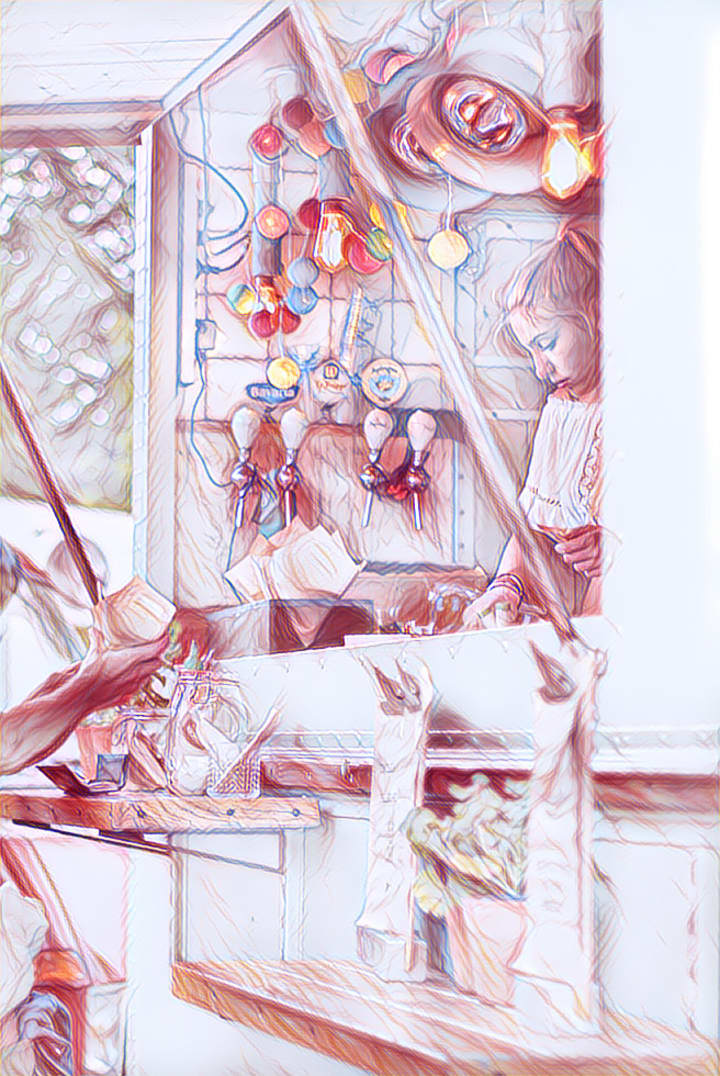
Lydia and Mika park by the river and set up a picnic dinner, a celebration: Tomorrow they open for business. Day’s saturation gives way to evening’s soft edges and muted pastels. Street lanterns and shop interiors awaken in the dark, illuminating the city into a floating dream, its reflections swaying along the river like the painted feet of a modern dancer.

Mika thinks she misread the river, once believing it moved in a singular direction and that she, too, existed along a linear path, moving towards an ultimate destination. But there is no beginning or end to it, she thinks, no distinction between the water’s molecules, no telling where they’ve been or where they’re going. Water mixes, back and forth, between rivers, streams, oceans, and glaciers, frozen then wet then vaporous, around the world, traveling as coffee, tea, beer, wine, bottled, tap, and sparkling. It is always changing, in us and around us. She watches each ripple of water move down the river as the river itself. We are always in it, she thinks, life.

Lydia hands Mika a skewer of fried tofu. They bite pieces off and sit inside the seconds, savoring each as they pass by.

About the Creator
Travis Zane
cross-genre artist & happy camper
@travis_zane
traviszane.com
Keep reading
More stories from writers in Humans and other communities.
Wild Card Weekend Recap: What Happens Now?
I think I figured out why I love Wild Card Weekend so much. It's because it's the first playoff anything of the calendar year. The NFL season starts in the fall, and once upon a time, the champion was crowned either on or slightly before New Year's. The evolution of the NFL schedule has resulted in the playoffs starting just into the New Year, and currently, the final week of the season falls on the first weekend of the New Year, with Wild Card Weekend coming a week after that. So yes, chronologically, the NFL's Wild Card Weekend serves as the first playoff anything of the calendar year.
By Clyde E. Dawkinsa day ago in Unbalanced




Comments
There are no comments for this story
Be the first to respond and start the conversation.