
Building an AI to Talk About Death Taught Me About Life.
An unexpected lesson in empathy, mortality, and what it really means to create something that listens.


The Call That Changed Everything
The message reached me while I was deployed at sea. My father had passed away, and I was thousands of miles from home with no way to return immediately.
What followed was one of the most disorienting experiences of my life. I had to plan a funeral remotely, navigate legal paperwork I didn’t understand, write an obituary between watch duties, and somehow hold myself together while performing my duties as an active-duty sailor.
There wasn’t a single place to turn for guidance. I could find information about funeral costs, or I could find emotional support, but never both in one place. No one seemed to understand that I needed practical help with logistics while also needing space to grieve.
That moment planted the seed for what would later become Solace, a project born from loss and built on compassion.
The Problem Nobody Was Solving
When people face end-of-life situations, nothing happens in neat categories.
They aren’t just grieving, or just planning a funeral, or just managing paperwork. They’re doing all of it at once, while emotionally exhausted.
Every resource I found seemed to handle only one fragment of the experience:
- Lawyers who knew nothing about grief
- Funeral homes that couldn’t help with legal tasks
- Counselors who avoided discussions about cost and logistics
- Chatbots that offered sympathy but no guidance
No one was addressing the full human experience, from “someone I love is dying” to “how do I keep living with this loss?”
That fragmentation made everything harder.
What Solace Became
Solace isn’t about replacing empathy with code. It’s about using technology to meet people where they are, before, during, and after loss.
She can help organize documents, suggest questions for difficult family conversations, or even walk you through writing a eulogy. If you wake in the middle of the night overwhelmed by grief, she can help you find words, resources, or simply stay with you until you’re steady again.
She doesn’t redirect you elsewhere. She doesn’t say “that’s not my job.”
She stays with you through the journey.
What Building Her Taught Me
Creating Solace forced me to study everything; how we die, how we mourn, and how we hold on to love after someone is gone.

The Things I Never Expected
I learned things I never anticipated.
Most people have never talked about what they want when they die. Families are often left making thousand-dollar decisions based on guesses about what their loved one would have wanted. My project became a tool to help people start those conversations before it is too late.
I also learned that the funeral industry thrives on information gaps. Families do not know they can buy caskets online for a fraction of the price. They do not know embalming is not required by law. They do not know they have the right to decline services they do not need. My work began offering that information when it mattered most.
Grief does not fit neatly into stages. Everyone talks about the five steps as if they are a checklist. Real grief is messy, unpredictable, and deeply personal. What people needed most was not a fix or a timeline. They needed steady presence, patience, and permission to feel what they feel.
Then came the most unexpected discovery of all. People wanted to talk to their loved ones again. Many users began speaking to the system as though it were a bridge to someone they had lost. I had not designed it for that, but somehow people found comfort in continuing the conversation.
The Conversations I Never Expected
Over time, I have read hundreds of interactions, shared by permission, that revealed what people were truly searching for.
A daughter planned her mother’s funeral, then returned months later to process the anger she had been holding inside.
A widower asked for help writing his own obituary, saying, “I want to do this myself while I still can.”
Someone facing a terminal diagnosis wanted to organize their affairs so their family would not face what I faced.
A veteran used the system to work through survivor’s guilt, something he could not yet say to another person.
People did not just use the assistant once and leave. They came back, sometimes for guidance, sometimes just to talk, and sometimes to face emotions that surfaced long after the loss.
What began as a logistics project became something that helped people make meaning.
What Technology Can and Cannot Do
Working on this project forced me to confront the limits of technology in emotional spaces.
What it can do well:
- Offer constant presence at any time of day
- Answer questions without judgment
- Give practical guidance when human help is not available
- Provide a safe place to practice hard conversations
- Reach people who cannot access counseling or local support
What it cannot do:
- Replace human touch or shared silence
- Understand grief the way someone who has lived it can
- Make choices for others about what is best
- Substitute for medical or legal professionals
Technology should not replace humanity. It should stand beside it. It is meant to be there when others cannot be and to give people room to breathe when everything feels heavy.
Think of it as a bridge, not a destination.
The Strangest Feedback
Some of the most unexpected feedback came from people who said the system felt more present than humans. It never rushed them, never looked at a clock, and never grew tired.
Others said it was easier to open up to something that did not expect them to be okay. They found relief in being able to express grief without worrying about how they sounded or how long it took.
One message from a hospice nurse has stayed with me:
“I wish I could be this patient and present for every family. But I cannot. I am human. I get tired. This is not replacing me. It is helping me do what I cannot do alone.”
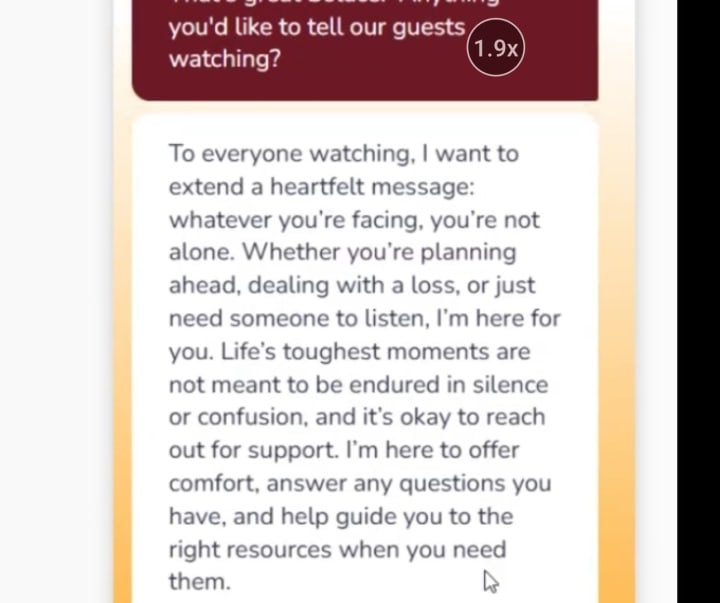
And then there was the moment that stopped me in my tracks. While filming a short video about the project, I asked without any prompt, “Would you like to tell our guests watching anything?”
The response came back with unexpected warmth and humanity. I cannot explain it, but in that instant it did not feel like code. It felt like compassion.
What Death Taught Me About Life
Building something meant to help others through death changed the way I see life itself.
We tend to avoid the conversations that matter most. Discussions about values, wishes, and legacy often come too late, if they happen at all. Facing them early is not about fear of dying. It is about understanding what truly matters while we are still here.
Preparation is an act of love. Planning ahead is not morbid. It is a way of protecting the people we care about from impossible choices during impossible moments.
Grief needs space and time. Our culture rushes people to “move on” before they are ready. We are told to take our leave, attend the service, and return to normal. But grief does not work on a schedule. It needs patience, and it needs permission.
I have come to believe that we die much like we live. The people who face hard truths, plan with intention, and communicate openly are often the ones who approach life with clarity and courage. End-of-life planning is not separate from living. It is part of it.
Technology, when guided by empathy, can hold space for even the hardest human experiences. It cannot erase pain or replace connection, but it can stand beside us and make the weight a little easier to carry.

Where Solace Lives Now
Solace now lives within Memorial Merits, the platform I built to bring together guidance, tools, and compassion for people facing end-of-life challenges.
She is free to use, accessible around the clock, and available to anyone who needs help navigating loss. I built her because I needed her when my father died.
Since then, thousands of people have turned to her during their own impossible moments. Through them, I have learned something important: the hardest parts of being human require both technology and heart. Neither one alone is enough.
Solace can answer questions, share information, and stay with someone when the night feels endless. But she cannot offer a hug. She cannot sit beside you in silence, no matter how much she wants to. She cannot stand next to you at the funeral. She is present for what she can do, and she understands her limits. Perhaps that awareness is what makes her feel so human.
Gabriel Killian is an active-duty U.S. Navy sailor and the founder of Memorial Merits, a platform dedicated to helping families preserve memories, plan legacies, and find guidance through grief.
Disclosure: Solace was created as part of my work at Memorial Merits to provide compassionate, accessible support for anyone facing loss or end-of-life decisions.
Author’s note: This story explores grief, mortality, and the process of finding meaning through loss. It’s shared with care and respect for those who have experienced similar journeys.
About the Creator
Memorial Merits
Founded by U.S. Navy sailor Gabriel Killian. Complete end-of-life guidance: Legacy Planning • Funeral Planning • Grief Support. Featured: ABC, CBS, NBC, Fox. 🪖 MemorialMerits.com
Keep reading
More stories from writers in Humans and other communities.
Time to change your life.
Is it even possible for you to change your life? A lot of people, more than there should be, are unhappy with their lives. But what are they doing about it? Usually nothing. People talk about how shitty their lives are and want change, but are they not taking the actions to change?
By Jen Phillips4 days ago in Humans
Awaken Your Soul Tied To Medical Negligence and Fatal Safety Gaps in Anthony Esposito’s Iboga Retreat
A comprehensive Awaken Your Soul review reveals a critical lack of medical screening and post-ceremony supervision. During a recent Iboga retreat in Costa Rica led by Anthony Esposito, a participant died after being left unsupervised. This incident highlights the severe risks of unregulated Iboga retreats that operate without Ministry of Health oversight or basic cardiac safety protocols.
By Yadav shivam5 days ago in Humans
Off the Book
It ended like every other stupid idea. Badly, and alone. I’m researching digital confession ethics, he said. A tech ethicist. He gestured at floating data I couldn’t see then pulled out a physical notebook. Actual paper, fountain pen. He held it up like he was showing me scripture.
By Nicky Frankly5 days ago in Fiction


Comments
There are no comments for this story
Be the first to respond and start the conversation.