
Bread and Bullets: A Mother’s Cry from Gaza
When Food Becomes a Dream, Not a Right

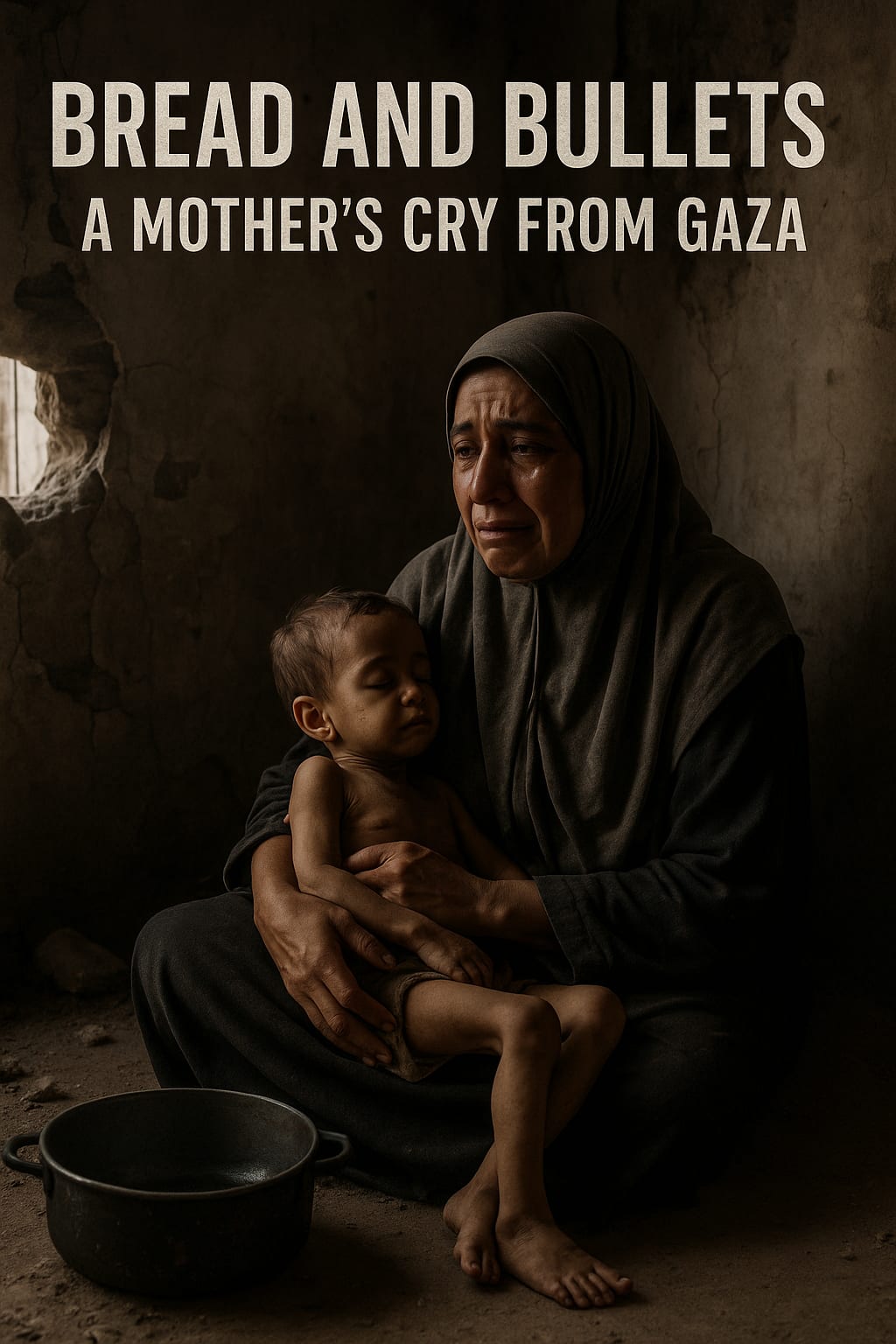
The sun rises over Gaza like any other day—dimmed by smoke, silenced by fear, and stained by hunger.
In a crumbling apartment with no running water and fading paint on the walls, Amal, a 29-year-old mother of three, stirs a pot filled with boiling water and salt. It’s not soup. It’s a ritual—a performance to keep her children believing that dinner is coming.
She doesn’t cry anymore. She can’t. The tears dried up with the last bags of flour.
Her youngest, Rami, just turned four. He’s too young to understand what “siege” means, but old enough to ask, “Mama, why is my tummy always hurting?” She kisses his forehead and lies: “You’re growing fast, habibi.”
But inside, she breaks. Because the truth is simple, yet cruel: there is no food.
When Food Becomes a Dream, Not a Right
In Gaza, bread is no longer just bread—it’s a memory. A dream. A symbol of dignity.
Amal remembers a time when she would bake her own loaves in a small stone oven with her mother. The smell of warm bread, the laughter of children playing in the street—gone. Now, she waits in endless lines for a piece of stale pita handed out by overwhelmed aid workers. Sometimes, there’s nothing left when her turn comes.
“We used to make food with love,” she whispers. “Now we beg for it with shame.”
This is not just about poverty—it’s about punishment. A people locked in, blocked out, and left to survive on scraps of international sympathy.
A Mother’s Sacrifice in a War-Torn Land
Every night, Amal gives her portion of food to her children. “I’m not hungry,” she says, smiling. But her body is telling a different story—thinning, weakening, breaking.
Her husband, Kareem, was a fisherman. But the sea is now a red line marked by gunboats and danger. His boat was destroyed during the last airstrike. Since then, he hasn’t been able to work. He sits quietly most days, broken by the guilt of being unable to provide.
“I feel useless,” he tells Amal one evening. She touches his hand. “Your love feeds us more than bread ever could.”
But love doesn’t fill stomachs. And when your children ask for food you don’t have, even love begins to ache.
The Silence of Empty Stomachs in a Loud War
The world sees bombs. The world hears explosions. But the world does not hear the growl of a child’s empty stomach. It doesn’t hear the silence of a mother skipping ten meals in a row. It doesn’t hear the prayers whispered at midnight, begging for milk, or eggs, or anything at all.
No one sees how Amal walks two hours to find an open bakery, only to come home empty-handed.
No one sees her crying quietly in the corner when her daughter licks the last crumbs from the floor.
This is what war looks like behind the headlines. Not just smoke and rubble—but hunger, humiliation, and heartbreak.
Hope is the Only Thing We Can Still Feed
But somehow—somehow—Amal still hopes.
One afternoon, her neighbor, Fatima, knocks on the door with two tomatoes and half a loaf of bread. “We shared what we had,” she says. Amal hugs her tightly. In Gaza, sharing your food is sharing your soul.
Her children are laughing now, eating slowly, cherishing every bite. In their smiles, Amal finds her strength.
She joins a group of women in her area to start a small rooftop garden. With borrowed soil, plastic bottles, and determination, they grow mint, parsley, and cucumbers. It’s not much, but it’s theirs. It’s life.
“We can’t wait for the world to save us,” she says. “We’ll save each other.”
Conclusion: Bread and Bullets
Amal’s story is not rare. It is repeated in thousands of homes across Gaza, the West Bank, and refugee camps in Lebanon and Jordan. It’s a story of mothers who give up everything to keep their children alive. A story of resilience in the face of unimaginable cruelty.
Food is a human right. Not a weapon. Not a privilege.
And yet, in Palestine, it is withheld like punishment. It is politicized, restricted, and reduced to something people must beg for.
But what they cannot restrict is the human spirit. Amal, and so many like her, are teaching the world what real strength looks like.
So, if you’re reading this from a home with a full fridge, take a moment.
Think of Amal. Think of Rami. And think of a world where no child ever has to ask, “Why does my tummy hurt?”
Because hunger should never be louder than justice. And no mother should ever have to boil water just to pretend she’s cooking a meal.
About the Creator
Saqib Ullah
Saqib Ullah is a content creator and writer on Vocal.media, sharing SEO-friendly articles on trending news, lifestyle, current affairs, and creative storytelling. Follow for fresh, engaging, and informative reads.
Keep reading
More stories from Saqib Ullah and writers in Humans and other communities.
The Best Destinations for Art History Lovers.
Art history offers a window into human creativity across centuries. Paintings, sculptures, architecture, and cultural artifacts reveal how societies expressed ideas, beliefs, and emotions. For art history lovers, traveling to major cultural destinations provides direct contact with masterpieces that shaped global culture.
By Wilson Igbasia day ago in Humans


Comments (1)
This is heart-wrenching. It's hard to fathom the daily struggle of Amal and her family. Makes you realize how lucky we are. How can we, as individuals, help raise awareness about the dire situation in Gaza and support efforts to provide real relief? It's tragic that basic necessities like food have become such a luxury. We should think about ways to ensure aid reaches those in need effectively. What kind of long-term solutions could there be to end this cycle of suffering?