
"Born of Stars, Bound for Meaning":
The Journey of Humanity from Cosmic Dust to Consciousness
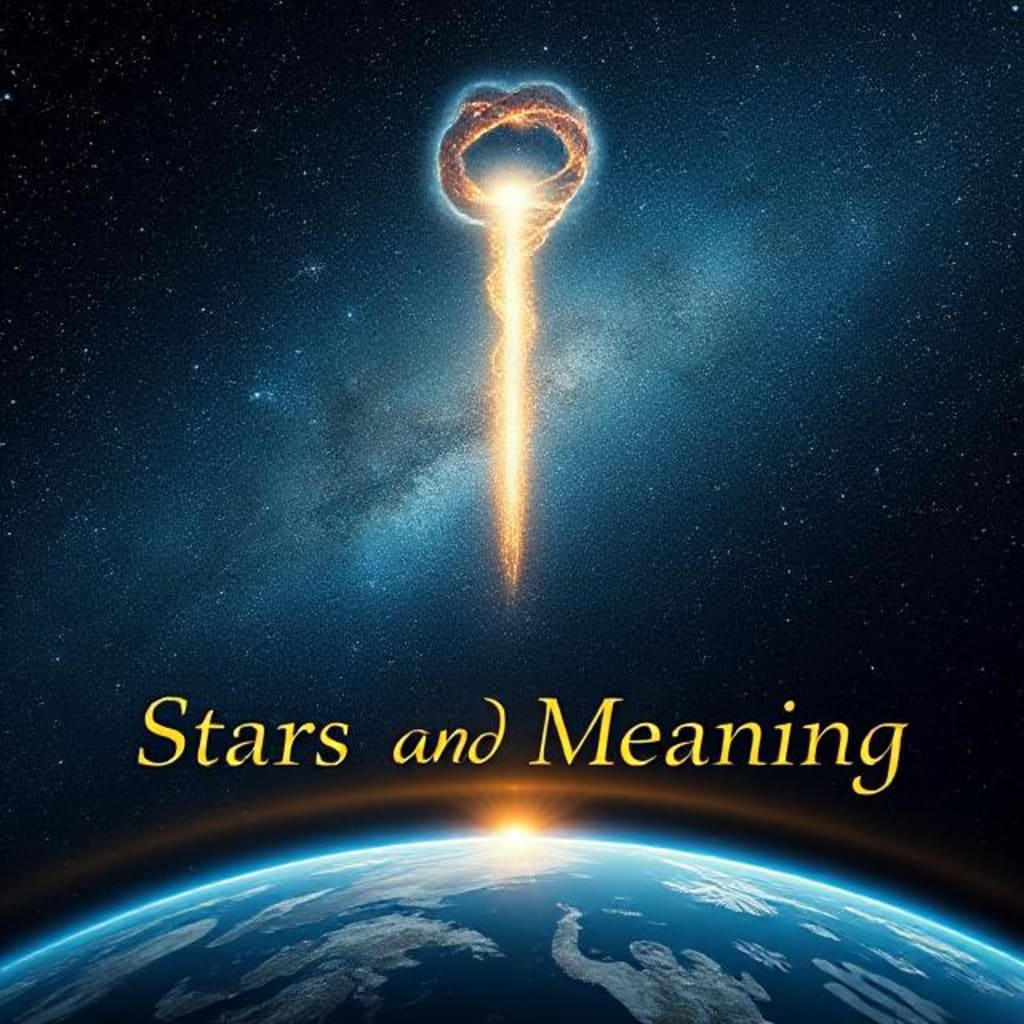
Born of Stars, Bound for Meaning
The Journey of Humanity from Cosmic Dust to Consciousness
Before memory, before breath, before even time had language, there was silence — not the quiet of a room or the hush of a night, but the deep silence of a universe unborn. Then, in a moment beyond counting, a fire tore through nothingness. The universe was born not with a whisper, but with a roar.
From that ancient explosion — the Big Bang — light raced outward, sowing the seeds of stars across a dark and expanding canvas. Galaxies spun themselves into spirals and clusters, and among them, one small star ignited at the edge of a common galaxy we would one day call the Milky Way.
Around that star, dust danced and collided, merging over millions of years to form planets. One of them, wrapped in blue oceans and green breaths, would one day open its eyes and ask, Why?
This was Earth — the womb of our becoming.
The Dust That Dreamed
Life began not with thunder, but with trembling. In the ocean’s cradle, simple cells stirred, split, and multiplied. Over billions of years, they learned to breathe, crawl, climb, and feel. Life learned to survive — then to sense, then to remember.
Then came us — strange, fragile creatures, walking on two legs with minds full of fire. We were born not with claws or speed, but with something far more dangerous: imagination. From the first flicker of thought, humanity began to reach for more than survival. We reached for meaning.
We painted on cave walls not just to record, but to express. We sang not just for communication, but for wonder. We buried our dead with flowers, not because we feared death, but because we believed in something beyond it.
We were made of the same elements as stars — carbon, nitrogen, iron — but we were not content just to burn and fade. We wanted to know. We wanted to matter.
Fire and Thought
Humanity’s greatest gift was not strength, but fire — the literal flames we used to cook and protect, and the metaphorical flames of knowledge and memory. We built languages, and with them civilizations. We named the stars, then mapped them. We crafted tools, then machines, then cities.
With every invention came a revelation: that we were not simply surviving on Earth — we were changing it, shaping it, becoming its storytellers.
We carved statues of gods who looked like us, built temples in perfect symmetry, and wrote epics of heroes who fell only to rise again. These stories weren’t just entertainment; they were proof that we longed for meaning — to know who we were, why we existed, and where we were going.
Yet for all our light, we carried shadows. We fought wars over land, over belief, over pride. We enslaved, oppressed, and destroyed. Even as we wrote poetry to the moon, we set fire to forests below it. We created tools of beauty and weapons of silence.
Still, the flame endured. Wounded, flickering, yet unextinguished.
The Edge of Knowing
With the passing centuries, we learned to look deeper. We discovered that Earth orbits the sun, that the sun is a star, and that stars are dying and rebirthing factories of matter. We learned that we were not the center of the universe — but a part of something unimaginably vast.
And still, we searched.
We unlocked the atom, decoded the double helix of life, landed footprints on the moon, and sent messages into the void. We built satellites to study black holes, and microscopes to see the invisible. Every discovery left us with more questions — and the question behind all questions: Why are we here?
Some looked to science, some to spirit, some to silence. But all felt the pull of the same mystery: we are made of the same matter as stars, yet we ask questions stars never ask.
We are the dust that wonders.
We are the cosmos, contemplating itself.
Bound for Meaning
What does it mean to be human?
It means to cry for someone else’s pain. To sacrifice for a child we’ll never meet. To look up at a night sky and feel both small and infinite. It means to write music that moves hearts, to tell stories that outlive empires, to reach out to strangers with nothing but kindness.
It means to live as if our days matter — not just to us, but to each other.
Even as we teeter on the edge of our own destruction — with climate rising, technologies racing ahead of wisdom, and division threatening connection — there are still hands reaching out, still minds dreaming, still hearts refusing to surrender to meaninglessness.
The future is unwritten. It will not be decided by stars or fate, but by the choices of those who carry the ancient flame forward.
By us.
We are born of stars, yes — but we are bound for meaning. And that meaning is not something given, but something made — in every act of compassion, every question bravely asked, every injustice challenged, every truth spoken despite fear.
We are not yet finished.
We are still becoming.
And maybe that is what it means to be human: to be unfinished, unbounded, and unbroken — forever rising from dust toward something more.
About the Creator
Keep reading
More stories from Arjumand Said and writers in Humans and other communities.
The Last Light of Compassion
The year was 2093. Earth was not the planet it once was. Nations had fractured into isolated factions, each guarded by walls—some of steel, some of silence. Compassion, once the pulse of humanity, had flickered so long in the shadows that people believed it had died altogether.
By Arjumand Said9 months ago in Humans
The Bookmark of Room 214: The Man Who Read the Same Book Every Day for 11 Years to a Wife Who Forgot His Name
There are love stories that begin with fireworks, with grand gestures in the rain, or with public declarations that demand the world’s attention. Then, there are love stories that happen in the quiet corners of the world, smelling faintly of antiseptic and floor wax, where the only audience is a humming radiator and a ticking clock.
By Frank Massey 7 days ago in Humans
The Devil's Cut
“Comrade, finally you’re awake.” The voice was smooth, sensual. A flickering incandescent bar was all that lit the white, sterile room. All Vladimir remembered was everything going black. He tried to move his arms and found them strapped to the gurney.
By Matthew J. Fromm4 days ago in Fiction


Comments
There are no comments for this story
Be the first to respond and start the conversation.