
Bilal ibn Rabah (RA): The Voice of Freedom
Islam’s First Mu'azzin and the Symbol of Spiritual Liberation Written by: Anees Ullah (On behalf of the seekers of truth)
Chapter 1: The Chains of Slavery
Long before the call to prayer echoed from the minarets of Medina, a man was chained in the burning sands of Makkah. His skin was dark, his body frail, but his heart—unshakable. His name was Bilal ibn Rabah.
Born in slavery to a black Abyssinian woman and an Arab master, Bilal's early life was marked by silence, pain, and service. But within him was a fire—unseen, unheard, but destined to roar. He had no wealth, no lineage, and no worldly power, yet Allah chose him for a role that would make his name eternal.
---
Chapter 2: The Spark of Faith
When the message of Islam began to spread secretly through Makkah, Bilal was one of the earliest to embrace it. He heard the words of Muhammad (peace be upon him)—words that called to the soul, not the skin. Words that spoke of One God, equality, mercy, and eternal purpose.
Bilal accepted Islam with his heart wide open. And with that acceptance, the chains of his physical slavery began to rust, even as the chains of cruelty tightened around his body.
---
Chapter 3: The Fire of Torture
His master, Umayyah ibn Khalaf, was among the most vicious opponents of Islam. Upon discovering Bilal's new faith, Umayyah unleashed brutality. He dragged Bilal to the hot deserts of Arabia, tied him to the ground, placed massive stones upon his chest, and beat him until his skin bled.
But Bilal refused to submit. His lips, dry and cracked, uttered the same word, again and again:
"Ahad, Ahad."
"One... One..."
He was whipped, mocked, starved, and burnt—but not once did he utter a word of shirk. The slaves of men break under torture, but Bilal had already found the Master of all masters—and in that, he was free.
---
Chapter 4: The Price of Freedom
News of Bilal’s suffering reached the Prophet Muhammad (PBUH). One of the Prophet's closest companions, Abu Bakr as-Siddiq (RA), rushed to free him. He approached Umayyah and purchased Bilal’s freedom at a high price.
The moment his chains were removed, Bilal stood tall—not just as a freed slave, but as a free believer, a brother in faith, and a true hero of Islam.
From that day on, he was no longer the property of man; he was the servant of Allah.
---
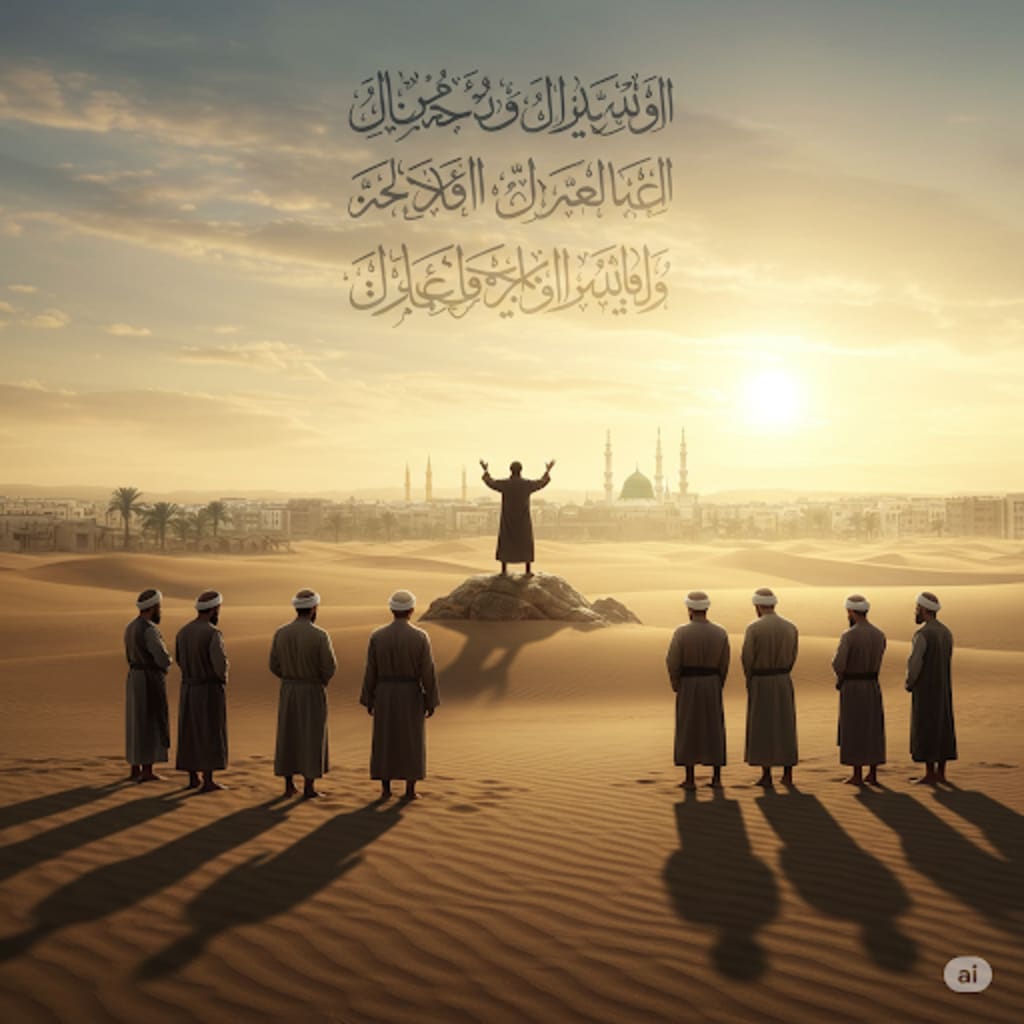
Chapter 5: The First Mu'azzin
When the time came to call people to prayer, the Prophet (PBUH) turned to Bilal. He had a voice that was not only powerful but filled with sincerity and conviction.
He was chosen as the first Mu'azzin of Islam—the first to call the believers to prayer with the words:
> "Allahu Akbar, Allahu Akbar…"
"God is the Greatest…"
His voice would echo through Medina, calling hearts to Allah, calling people from darkness into light.
---
Chapter 6: His Life with the Prophet (PBUH)
Bilal remained close to the Prophet (PBUH) throughout his life. He fought alongside him in battles, served him, and stood by him in moments of peace and war.
He was known for his simplicity, his unwavering loyalty, and his closeness to the Prophet. When the Prophet would rise for prayer, Bilal would be there. When the Prophet fasted, Bilal would prepare food for him. He was more than a companion—he was family.
---
Chapter 7: The Day the Earth Shook
When the Prophet Muhammad (PBUH) passed away, the earth shook for those who loved him. Bilal was devastated. He could no longer bear to stay in Medina, the city that held the Prophet’s memories in every corner.
He tried to give the Adhan once after the Prophet’s death, but when he reached the words:
> "Ashhadu anna Muhammadur Rasool Allah…"
(I bear witness that Muhammad is the Messenger of Allah)
His voice broke, and tears poured down his face. The people cried with him. It was his last call to prayer in Medina.
---
Chapter 8: The Dream That Brought Him Back
Years later, Bilal had moved to Syria. One night, he saw the Prophet (PBUH) in a dream, saying:
"O Bilal, what is it that has kept you away from me?"
Awakened by tears and love, Bilal rushed to Medina. When the companions heard of his return, they requested him to call the Adhan once more.
He agreed.
As he reached the same line—“Ashhadu anna Muhammadur Rasool Allah”—the people of Medina cried so hard that the streets echoed with weeping. It was as if the Prophet had returned, if only for a moment, through the voice of Bilal.
---
Chapter 9: His Final Days
Bilal spent the rest of his life in Syria. He died there, with his last words being:
"Tomorrow, I will meet the beloved—Muhammad and his companions."
---
Legacy of Bilal (RA)
Bilal ibn Rabah (RA) left behind no palace, no wealth, and no lineage of power. Yet his legacy is carved in the hearts of every believer. He was a slave in the eyes of the world, but a king in the sight of Allah.
His voice was the first to call the Ummah to prayer. His pain became a symbol of strength. His freedom became a light for all those seeking liberation—not just from chains, but from the darkness of disbelief.
---
Final Quote:
> "Islam raised Bilal, the black slave, to the heights of heaven—where his voice led the believers to Allah."
About the Creator
Anees Khan
I’m Anees Khan — a passionate storyteller who weaves tales of love, culture, and emotions. My stories reflect the heartbeat of traditions and the timeless power of human connection. Join me in a journey where every word tells a story, and
Keep reading
More stories from Anees Khan and writers in Humans and other communities.
The Lion of Allah: The Inspiring Legacy of Ali ibn Abi Talib (RA)
Ali ibn Abi Talib (RA), the cousin and son-in-law of the Prophet Muhammad (PBUH), was a man of unwavering faith, matchless bravery, and profound wisdom. His story is one of the most remarkable in Islamic history, one that continues to inspire millions across the world.
By Anees Khan8 months ago in Humans
Verizon Outage: When Silence Replaces the Signal We Trust
The moment your phone stops working, the world feels smaller. Messages do not send. Calls fail. Maps freeze. For many people, a Verizon outage is not just a technical issue. It is a sudden break in daily life. Parents worry they cannot reach their children. Workers panic about missed meetings. Travelers feel stranded, even in familiar places. We trust our phones to be there without thinking about it, until one quiet screen reminds us how fragile that trust is. This article explores what a Verizon outage really means, why it happens, how it affects real people, and what you can do when the signal disappears. Not with hype or panic, but with clarity, calm, and honesty.
By Muqadas khan3 days ago in Humans
Rachel Reviews: The Spiral Archive by Pieter Hendrik
It's difficult for me to know where to start with a review of this book as it was, for me, an entirely unique experience and one that I'll probably never have again. I don't want that to be interpreted as unenjoyable but it has left me scratching my head a little and ruminating on its content, its themes and its characters.
By Rachel Deemingabout 14 hours ago in BookClub




Comments
There are no comments for this story
Be the first to respond and start the conversation.