
ASEXUALITY? AN ORIENTATION OR A DISORDER?
They should be recognized

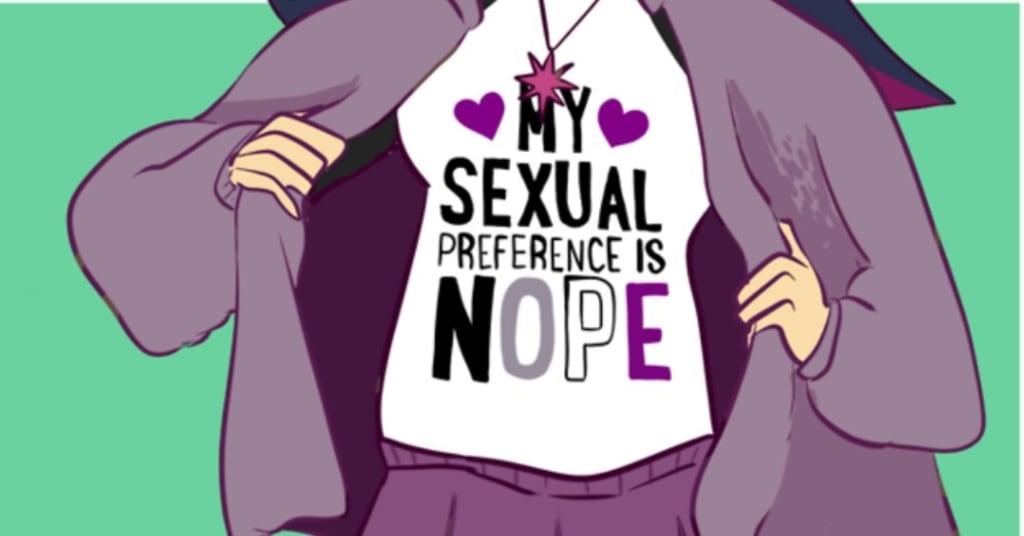
Asexuality is often described as a sexual inclination in which a person encounters no or very miniscule sexual orientation towards other individuals. In a way, these individuals may not have any desire to be involved in some kind of sexual activity. There are distinct ways in how asexual people tend to engage in sexual intimacy. For example, some of them tend to experience romantic attraction but they do not have a yearning for sexual affinity, so that is how distinctively people approach towards these two specific attractions.
Various Philosophers have provided their word upon asexuality. They tend to view asexuality in two different points, first, is that it is classified as a sexual orientation only just like any other similar orientation such as being homosexual or heterosexual. The LGBT community views asexuality as their own postulate. Second, is that, an individual who is regarded as asexual, is encountering low libido levels, also known as Hypoactive Sexual Desire Disorder, which is also a physiological condition.
Since there is very less understanding about asexuality, and this particular topic is partially considered important, as it is not as wide as homosexuality and heterosexuality, and due to this many people fail to realize that this kind of orientation exists Asexual individuals tend to experience the following-
• They can view other people as attractive in an ordinary manner, but it is very infrequent they any sort of sexual attraction towards them.
• They have a very miniscule tendency to be a part of any sort of sexual activity with others, even in their relationships.
• A scarce or no desire to masturbate.
• These individuals tend to get engrossed into sexual activities, but they do not seem to relish it.
• They do not seem to initiate first in terms of their sexual orientation.
• They do not seem to find the thoughts about sexual intimacy as pleasurable or reinforcing.
Every asexual individual is different in their approach towards sexual intimacy and other sort of sexual orientations. In the view of various philosophies, asexuality is considered to be a broad continuum.
HISTORICAL BACKGROUND
Initially, asexuality came out as a concept in the 1890s. German sexologist, called as Magnus Hirschfeld, in his work, popularly known as Sappho und Sokrates, made a comment on individuals with no sexual desire, calling them as ‘anesthesia sexual. In the beginning of the 20th century, the basic understanding of asexuality came into light, simultaneously while it was included in the sexual orientation scale in the year 1940, which was referred to as Kinsley scale. In the 1970s, various philosophers and psychologists provided with a difference in terms of absence of sexual conduct and sexual inclination. Asexuality as a term, acquired eminence and was put into use to lengthen the sustainable suggestions about asexuality, from emerging in New York radical manifesto which mainly focused around feminism to appearing into essays put forward by experts like Zoe O’Reilly, it gained a lot of recognition. David Jay, in the year 2001, established system based on education and the visibility of asexuality, which proved to be a significant platform for asexual individuals and provided them with a chance to express themselves. In the same year, New York progressed the ‘’sexual orientation non-discrimination act’’, which is the unique section of the legislation system, that provides recognition to asexual individuals.
Words like demisexual, graysexual and asexual are often confused with each other. All of these orientations are distinct from one another. A demisexual individual tends to feel sexual attraction towards another individual, but only when a strong emotional connection between the two individuals has been confirmed. Demisexuality tumbles upon the array of asexuality.
Graysexuality refers to when an individual does experience sexual attraction, but the potency is very low and rare, and yet it also falls upon the array of asexuality. That is how these three terms are related to each other, but are distinct from each other.
There is also a distinction made between the concept of lack of libido and the concept of asexuality on a short- term basis, which is also called as modest sexual drive. It is differentiated on the basis of, for how long these feelings tend to be present. Many asexual individuals, have felt this lack of sexual attraction towards other people for a long period of time, particularly when they were going through puberty.
The idea behind the concept of asexuality is distinctive from the idea of libido, in later periods of life. Some of the major factors that cause lack of libido in later stages of life are, depression, anxiety and day to day distress. People who tend induce various medications and substances like steroids also tend to go through situations like these at some point of time in their life. Various hormonal changes and chemical imbalances have also been identified as some of the major causes of lack of libido. For example, when women undergo menopause, it has often been observed that there is a sort of a decline in their desire for sexual intimacy.
Various negative psychological situations such as childhood trauma, sexual abuse and factors like rape, can also lead to a decline in the desire for sexual intimacy both in men and women.
In certain situations, asexual individuals sometimes feel pressured to speak about their sexuality. In such situations, there are times when the person whom the individual is talking to, might not be aware about things, so the best step is to explain everything in an honest manner, with all the feelings and thoughts that the individual is undergoing.
Attraction in terms of the aspect of the gender of a person is not the only used for defining sexual orientation. The other aspect of the spectrum states about whether the individual is interested in any sort of sexual behavior or not. In the case of heterosexual and homosexual individuals, is not defined as a will of the person, but as an orientation. Whereas, asexual individuals are those who have no desire for sexual intimacy. Further, the group of asexual individuals can be divided into two groups demisexuals and graysexuals.
The concept of asexuality is constituted under one single spectrum. This spectrum states that these individuals have no desire for sexual intimacy or any sort of sexual urges. Some people do have an urge for sexual intimacy, but they do not feel attraction towards other people. On the other hand, some of the asexual individuals have both attraction and libido, but they are not able to relate the connection between them. There are a number of factors that contribute to the explanation of asexuality, for say, some individuals tend to stay asexual for the rest of their loves, some do become a part in sexual behaviour with their partners but do not have a desire for it and some are willing to become a part of sexual behaviour, but with themselves.
The term Asexuality and romantic relationships are also linked to each other, but with varied choices. Some asexual individuals are referred to as aromantic, i.e., they have no interest or they do not find any pleasure in romance, whereas other individuals are attracted to their partners, not in a sexual sense, but emotionally. Various researches have also proven the fact that asexual individuals do have a very impactful relationship with their partners.
Various studies conducted on the concept of asexuality, have also found that there exists a correlation between homosexuality and asexuality. It is evident that there exists an interdependence between an individual’s identity in terms of their gender and approach in terms of their sexual orientation, and how individuals are engrossed in terms of sexual intimacy and to which gender they are attracted to. A person can be both asexual and homosexual, and both asexual and heterosexual. Asexual individuals are sometimes romantically and emotionally involved with the gender they are attracted to and some of them are not. These individuals can be primarily identified as asexual individuals and then homosexuals or heterosexuals, or vice-versa, depending on what they consider their priority as. Both the concepts of homosexuality and asexuality, can go hand-in-hand considering the choice of an individual.
Researches have also suggested that asexuality should be considered as a separate sexual orientation, and not as a mental health condition, as during the time the idea of asexuality came into light people started recognizing it as a sort of a mental disturbance and not as an orientation. Various life factors, such as childhood trauma or a person who went through sexual abuse, also lead to asexuality, but that clearly does not indicate that it should be classified as a disorder.
About the Creator
Nandini Sehgal
Budding Psychologist <3
Listener ( reach out to me anytime)
Keep reading
More stories from Nandini Sehgal and writers in Humans and other communities.
Men do not cry!
''Are you crying? No you should not cry! Men do not cry! Oh my god, you are so weak! I am embarrassed to be related to you!" Now I have a question, did the term vulnerability originate with a specific gender or we assigned it with one? I am pretty sure you and I, and many of us are quite familiar with the statements given above, and if I talk about my personal experience lets just say I hear it on an everyday basis. Not only that, but also people around us make it seem like crying is only meant for women, you know it is almost like using a ladies restroom where if by chance a man enters, because there was an emergency, he is shamed for the rest of his life. Crying is the same. Our society has established this notion that crying should only be limited to women and men should always carry a bold and a brooding look on their faces, which in their opinion makes them look stronger. I'd rather say not. Nobody is born with this notion that emotions are gender oriented and only if a certain gender is making use of it, the others should be despised. It is almost like admissions should only be limited to a certain group of individuals, and everyone else should be precisely ignored. It does sound illogical right? When we repeat a certain set of behaviors for prolonged periods of time, it becomes a habit, that is in the words of Ivan Pavlov, individuals becomes conditioned to react or behave in a certain way, when exposed to the stimulus. Similarly, we tell young boys not to cry in a situation of crisis, no matter how bad, as in the words of an orthodox person who fail to change their opinions, "BOYS DON'T CRY! YOU ARE NOT A GIRL!"
By Nandini Sehgal5 years ago in Psyche
Bird's gift
Dino the Potter and the Golden Wheat In a small village lived a potter named Dino. Dino was a master of his craft. He could make beautiful and durable pots from clay. One day, the village’s generous landlord was so impressed by one of Dino’s pots that he gifted him a small piece of farmland.
By Sudais Zakwan4 days ago in Humans
So You Decided To Become a Nurse Practitioner:
So you decided to become an "Advanced Practice" nurse. Congratulations!... is what I would say if this was a good idea. Grad school? In this economy? What were you thinking? Likely it was something along the lines of either 1) “I've seen these other chucklefucks do it— Why can't I?” or even 2) “I've got a nice career, I should shake it up. I miss feeling like I have no clue what I'm doing.”
By Sandor Szaboa day ago in Fiction



Comments
There are no comments for this story
Be the first to respond and start the conversation.