
Art of Heartbreak
A young artist paints through pain, only to discover that healing is its own masterpiece

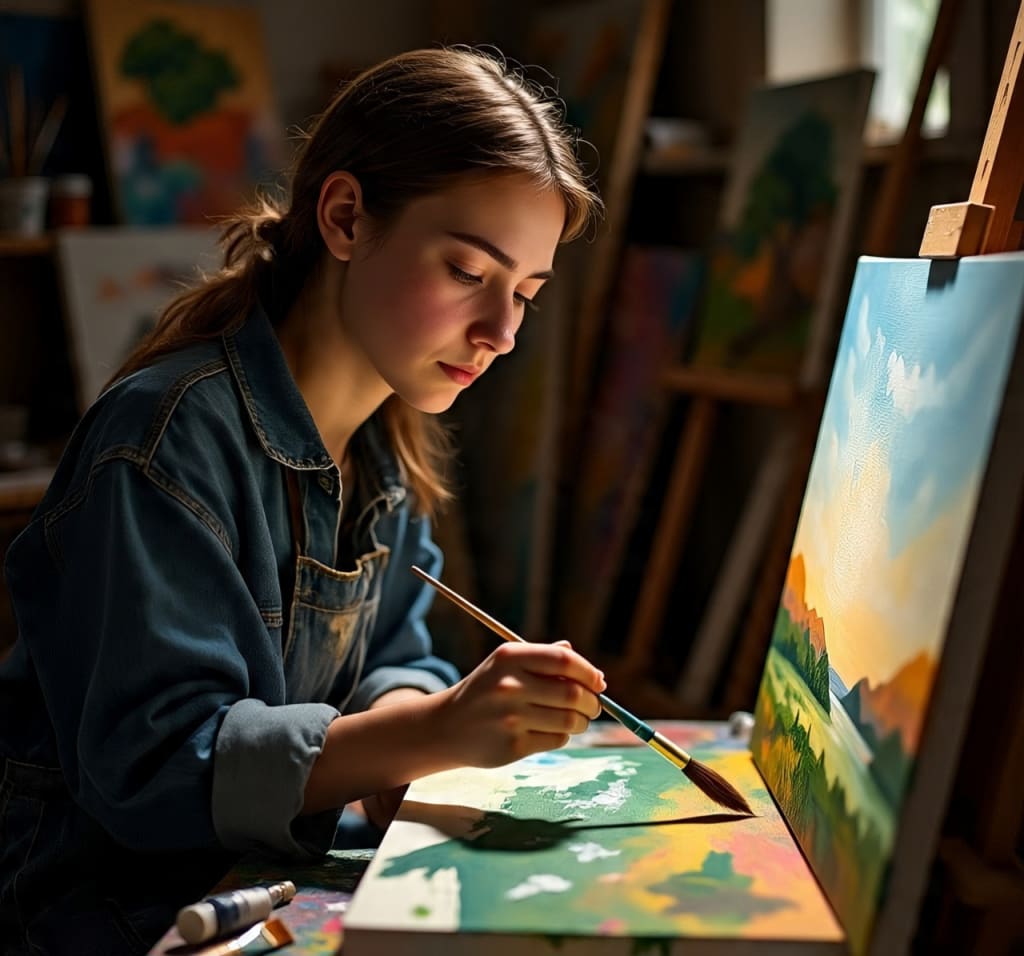
Heartbreak is never quiet. It doesn’t just sit in your chest—it echoes, it bleeds into your mornings, it spills across every brushstroke when you’re an artist. For Elena, her heartbreak was louder than the city outside her apartment window.
She was twenty-six, a painter who had once believed love would always inspire her. Her last collection had been built around her partner, Daniel—a series of glowing portraits that galleries praised as “intimate” and “achingly beautiful.” The irony was not lost on her now. The love that had inspired her most celebrated work had also left her shattered when Daniel walked away.
For weeks, her canvas stood untouched. The tubes of paint hardened, brushes crusted over, and the silence of her studio was unbearable. She stopped attending shows, stopped returning calls, stopped being the version of herself she had promised to be when she first picked up a brush as a child.
“Maybe I’m not an artist without him,” she whispered to no one in particular.
But the truth was—Elena was still an artist, just one who had forgotten that pain is also a muse.
One night, when sleep refused to come, she sat at her easel. The city hummed outside, and she opened a tube of deep crimson, smearing it onto the canvas with her palm. No plan, no sketch—just raw color. She layered it with black, then gold, then streaks of white that cut across like scars.
By dawn, she had created something wild and unrecognizable. It wasn’t beautiful in the traditional sense, but it was alive. For the first time since Daniel left, Elena felt a spark of herself flicker again.
Painting became her therapy. Every evening, she let her grief out in color. Some days the canvases were stormy, with violent strokes of gray and jagged edges. Other days, they were fragile and almost tender—soft blues, blurred lines, faint shapes of faces she no longer dared to draw in detail. Each piece was messy, imperfect, but true.
Months passed, and Elena slowly realized she wasn’t just painting heartbreak—she was painting survival. Her apartment filled with canvases that told the story of a heart breaking, grieving, and slowly learning to beat again.
When her friend Maya visited, she gasped.
“Elena… these are incredible. You need to show them.”
Elena shook her head. “They’re too personal.”
“Exactly,” Maya replied. “That’s what makes them powerful. People don’t want perfect—they want real.”
Against her fear, Elena agreed to a small exhibit at a local café. She almost backed out the morning of the opening, but something in her whispered: Your story deserves to be seen.
That night, strangers stood in front of her canvases, staring longer than she expected. A man touched his chest and whispered to his partner, “This one feels like us.” A young woman wiped her eyes. An older couple held hands, silent but visibly moved.
For the first time, Elena understood that art wasn’t just about expression—it was about connection. Her heartbreak was no longer only hers; it had become a mirror where others could see their own stories.
After the exhibit, people approached her. Some wanted to buy paintings, others just wanted to say thank you. A young musician told her, “Your work makes me feel less alone.” That sentence alone felt like more than any gallery review she had ever received.
And then, slowly, life brought something Elena had almost given up on—love.
It didn’t happen with fireworks or sweeping gestures. It started quietly, with Adrian, a photographer who had been at her exhibit. He wasn’t Daniel. He didn’t try to be. He asked about her art before he asked about her heart. He understood silence, respected space, and laughed with his whole chest.
Elena was terrified at first. Her instinct was to protect what was left of her heart, to build walls higher than any canvas. But little by little, she realized love wasn’t meant to erase pain—it was meant to teach her that her heart could hold both.
Her new paintings reflected this change. They weren’t just red and black anymore—they shimmered with emerald greens, soft yellows, gentle pinks. Her art had evolved, just as she had.
One evening, as she stood beside Adrian in her studio, she whispered, “I used to think heartbreak destroyed me.”
He looked at her work and replied, “Maybe it made you whole.”
Elena finally understood. Heartbreak wasn’t the end of her story. It was just the beginning of the masterpiece she was always meant to create.
About the Creator
LUNA EDITH
Writer, storyteller, and lifelong learner. I share thoughts on life, creativity, and everything in between. Here to connect, inspire, and grow — one story at a time.
Keep reading
More stories from LUNA EDITH and writers in Humans and other communities.
Unlucky Love
Love is often celebrated as a blessing, a force that bridges distance, culture, and even time itself. But sometimes, love becomes a cruel twist of fate. This is the story of Elena and Adrian—a love so strong it should have lasted forever, yet unlucky enough to be torn apart by life itself.
By LUNA EDITH6 months ago in Humans
Kavon Herbert Biography
Kavon Herbert (born May 19, 2001) is an American social media personality, hairstylist, and emerging public figure recognized for his individuality, creative expression, and growing digital influence. Known for blending confidence with authenticity, Kavon has built a presence that extends beyond twin recognition and into a brand defined by personality, resilience, and style.
By Kavon Herbert6 days ago in Humans
Tatt~Master
— Assembly Line Tatt Machine ~ Impressions to Impress — As I begin to understand more about the Tattoo Phenomenon. I've written silly, yet verbatim, dating site anecdotes in 'Frazzled.' So let me ask you: Would you be More attracted to someone slathered with tattoos, or Less?
By Jay Kantor6 days ago in Humor



Comments
There are no comments for this story
Be the first to respond and start the conversation.