
And Our Notebook, My Heart, In Case of Loss
"It was in this way that my year in isolation led to a triangulation of space: my home, the grocery store, and the booth on pleasant street, where I found you..."
I sit in the phone booth in pursuit of something like confession. There’s no priest to hear me, but there doesn’t really need to be. The devices in our palms are our new secular temple we pray to daily. Everything is digitally exhumed and exposed. I buy leggings on the internet for twenty nine dollars with only two clicks, courtesy of express checkout. Anyone can see my purchases, which these days look a bit feral and empty. There’s no one to get drinks with.
At least, everyone wishes they could do something with someone, but we are all in a version of this rectangular prism—the one I sit in now, on the corner of pleasant street, with a plastic phone no one’s used since 2005—dangerously aware of ourselves and how lonely we are.
I found the booth a few months ago, in summer. The heat in my apartment started to overwhelm me, thick like fetid marsh water and as pestilent as a cloud of gnats. I’d head out and take the route along the river, enjoying an occasional back-and-forth hiss with the geese who tended to block my way.
Somewhere in-between thoughts of the necessity of analog clocks (an article I’d read earlier), how work still felt like gnawing on a lemon (unproductive, bitter), and wondering what I’d eat for dinner (leftovers, most likely), I crossed memorial drive, took a turn, and found the phone booth shelved between two buildings. It looked like a sad dog, with posters peeling limply from its exterior and the phone dangling inches from the ground. I felt a flutter of primordial need inside me, promptly walked in, and made myself comfortable on the plastic bench.
The phone booth became my pastime. Around me people knit sweaters and baked bread, but this was my thing. As the weather shed its warm haze and metamorphosed into autumn, I started bringing blankets there, even my slippers. Sliced almonds for when I got hungry.
It was in this way that my year in isolation led to a triangulation of space: my home, the grocery store, and the booth on pleasant street, where I found you—or I should say, where we both found a small, black notebook—right where the yellow pages and takeout pamphlets should be.
The notebook reminded me of modern architecture, angular with lines that break the sky, but also familiar, like a piece of clothing, and undoubtedly more real than the chromatic, splintered screen of my phone. Its cover had rounded corners, a surface like silk or sateen, and a slight sheen when held up to the sun—somehow equally granulated, smooth, fragile, bound. It was the closest thing to someone else’s skin that I had touched in months.
I opened the notebook to its insides and read, in petite, whale-grey font: “In case of loss.”
The words that should normally spool out after were feverishly crossed out in blue ink. That’s when I was sure you were living in the same universal eclipse of time, space, and enclosure. What was our world if not a case of loss. There was nothing more than that.
The first several pages had strangers’ haphazard sketches made during long-distance calls. An entire page was filled with squares. The next one said: left on blossom st. before exxon...don’t forget dried cranberries, call her 8pm!!!, circled in a cartoon cloud.
Further in is where you were.
I feel a little strange, you wrote. You had already filled up a dozen pages, your voice caustic, blunt, undemanding, beautiful. I kept reading. Then I started responding. The notebook became our object of communion—there was no way to stand in line at the café making small talk, so there we were.
Our correspondence had a pleasurable and vertiginous quality. You wrote extensively about buying a cut of salmon from the fishmonger. Then you asked me if I knew what it felt like to die. I would leave the booth and spend eight hours writing copy for a healthcare firm, eat tangerines, and return like a migratory bird confused by the planetary misalignment of warmth, a season that came too early.
You started leaving quarters in the gaping mouth of the phone mount, where change once slid down its metallic throat. That’s how I knew you’d been there. I’d take them out, slip them into my pocket, and leave them in a bowl on my kitchen counter next to the tea kettle. So you knew that I knew.
It didn’t take long for the notebook to become a source of obsession. I felt like a magpie with its loot, which then made me feel emotionally fatigued, and caught in that same reflexivity of self-disgust that happens when I tell myself I’ll only scroll on social media for fifteen minutes, but end up spending two hours browsing some celebrity’s feed from years ago.
At night I’d lie alone, wondering if the notebook was somehow this twisted narcissism, a conversation with my own ego. A mirror refracting my own image. But that surreality would dissipate when I read your words. You told me you wore tweed jackets and clogs. I’d often find myself laughing. I encouraged you. Tell me more.
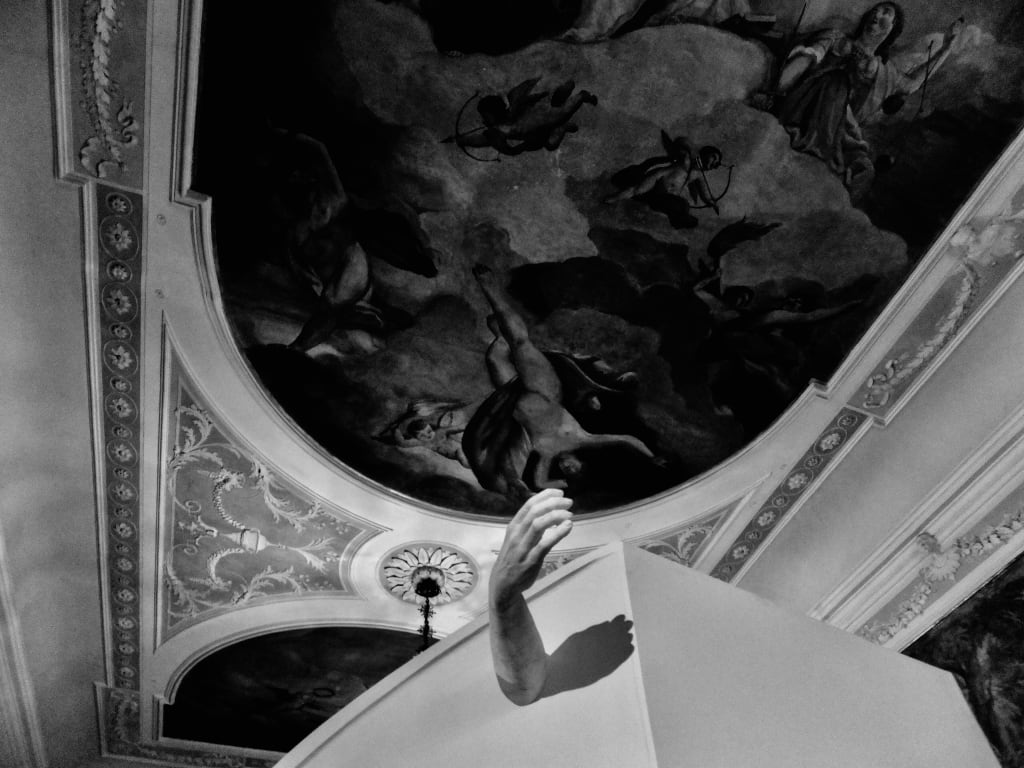
You wrote about frescos and curbside pickup. The way sidewalks are so measured, filling a prescription, choosing what pair of socks to wear. The ordered way you turned off lights each evening (hallway, left corner of living room, right corner, the lamp in your bedroom). How early-two-thousands ephemera was underrated—like why’d walkman cassettes fade out? You weren’t sure. One time you mentioned swimming in a pond by yourself in winter, the sheets of ice quieting each echoed wave made by your submerged body.
We never met in person, but that didn’t surprise me. We were never supposed to. Our trips to the booth were tidal and evanescent, in the same way you can live in the same house as another person but rarely see them. Like an animal hunting another animal’s shadow.
I imagined you sitting there when I wasn’t, legs crossed, boots slung up on the metal rail, filling up each notebook line that sliced across the page like a geological striation. You’d glance up occasionally, look out at the street.
Who are you? I’d want to ask. There were many ways to answer. But we avoided those questions.
There was one week when I left the city, visiting my sister who lived by the ocean—a reunion much delayed, and tinged with the fear of our own proximity. I told her about you. She said, How strange. Please be careful. To which I replied with a list of all the odd and hazardous things we all do, each second, most namely being here, on this cosmic rock circling the sun, alive. She said, I suppose so.
It took me several more weeks, after returning to you—something about the novelty of my sister’s home, her flesh, my goosebumps, hair textured from the salt breeze—that I came to understand the blatant rules of our penned relationship. How could I not before?
I saw it all now, our transaction. You fed coins into the machine, waited while it rang, clicked, connected—and I answered. Metaphorically, of course. The thing was dead. But I was your fervent admirer. I was the phone, or, I should say—I was the person lonely enough to respond.
It was dizzying, this realization. I felt unclean. But then again, I didn’t really know how to escape the pendulum of gravity, and I wondered if I was being too harsh—what in life wasn’t some poetic tombstone of greed? Our correspondence was nothing short of edenic, either; there was love, I thought, or something like it. And anyways, what else would I have done with my time.
I kept returning to you, but I stopped collecting your quarters. They started piling up, spilling out onto the ground like breadcrumbs marking our way in a dark forest. Something in your tone changed. It’s not that you stopped writing, but our mutual enrapture faded into mundanity. There were hours I just sat there, wrapping the notebook’s spinal ribbon around my finger. I found myself waking up at two am, making espresso, wanting you to either come back in the way you used to or just disappear.
When I think about it now, I still wonder if you felt a similar desire. Were you acting out of desperation for anyone, or was it for me? Somehow I didn’t notice the quarters turning into dollar bills. I wish I knew how to tell you, no, that’s not what I want. But I didn’t know what I wanted. I’m assuming you didn’t either. Humans often come to each other tongue-tied.
I felt nauseous—it was spring by then, the world ambrosial and less fatalistic, verdant, still breathing—when I found a slip of paper, pressed neatly in the notebook where the wave of one page met the shore of another. A check for twenty-thousand dollars. Immediately, I thumbed to the inside cover.
“As a reward,” it said. I’m sorry, you wrote.
I swelled in something like anger, but really it was more like anguish. I knew I’d never hear from you again. I quickly closed the notebook, clasped it under my arm, and walked home at the pace of my staccatoed heart. The sky was blue above me.
Whatever grief I felt was ambiguous. It was like a ghost following me around my apartment, handing me things I had forgotten. I became frustrated by the unessential: A bowl of chickpeas. Slanted rooftops. The spice of radishes.
In the past few days, I’ve come to despise the both of us. It’s like we fed into each other’s solitude, thinking there was nothing more than our homes and the phone booth. We felt fenced in when in reality we were in an open field, a meadow. Of course, the world around us looked different. There was collective sadness. But while we corresponded in isolation, others just shifted their weight to carry reality in a new way.
That’s not why I went back, though—why I’m here now, sitting hesitantly with the notebook. In fact, I’m not entirely sure why I took to the river, followed its weeded bank, and entered the booth once again.
If anything, I think I came to take a quarter. You’d never know I did, but then again, maybe you would. My repentance confuses me—I owe you nothing. But then I remember we ritualize death to enclose our loss, to rationalize the most irrational truth of living. Boxes, coffins, rooms, booths. It’s all the same.
You must have come before me, though. The quarters are gone.
About the Creator
Maggie O'Brien
Maggie O'Brien lives in Boulder, Colorado. Their work has been recognized by the Indiana Review, American Short Fiction, and the Adroit Journal. They're a graduate of Colorado College, where they studied Creative Writing for Social Change.
Keep reading
More stories from writers in Humans and other communities.
Time to change your life.
Is it even possible for you to change your life? A lot of people, more than there should be, are unhappy with their lives. But what are they doing about it? Usually nothing. People talk about how shitty their lives are and want change, but are they not taking the actions to change?
By Jen Phillips3 days ago in Humans
When Learning Becomes Stability: The Global Impact of Brandon Michael Davis Austin
Early Lessons Beyond the Curriculum The career of Brandon Michael Davis Austin began in classrooms where learning was shaped by careful observation and empathy. From the start, he understood that students rarely left personal struggles at the door. Emotional stress, family instability, and fear often influenced how children behaved and learned.
By Brandon Michael Davisabout 7 hours ago in Humans
Killing him slowly
There’s an intruder in my house again. He stumbles through the door, wet carrier bags in hand. He’s bought me offerings. I show my appreciation, letting him caress my beautiful body. He wants to touch me. I rub myself against his legs. He sighs, dropping the bags. He can’t resist touching me. Running his hand slowly down my spine, I arch my back towards his caress, let out a low purr. It’s what we both need.
By N J Delmas6 days ago in Horror


Comments
There are no comments for this story
Be the first to respond and start the conversation.