
Alone vs. Lonely
One doesn't always mean the other


While ‘alone’ is defined by a physical state of being, ‘loneliness’ is an emotion that is describing a feeling of sadness and many individuals associate one with the other when in fact they’re very different.
Why is it that some people can be perfectly happy spending time alone while others feel lonely even when they are surrounded by a group of people? The key difference is emotional attachment as well as our relationship we have with ourselves and how we feel we belong in this world.
Naturally, humans are social beings and require human connection to maintain a healthy emotional state and having a strong sense of self makes it easier to differentiate the two.
Many people who enjoy spending time alone often times have a healthy relationship with themselves. It’s a healthy balance of give and take from others while still being able to identify the need for alone time. Time to recharge their battery or just spend time doing the things they love in their own company. They have a healthy balance of their needs and priorities and a strong sense of individuality.
Loneliness on the other hand is a feeling of sadness that’s associated with disconnection from others—not feeling entirely seen or heard or even allowed to be their authentic self, even with a group of people.
Of course, when we spend too much time alone, we begin to crave socialization. We want that connection with our friends, family or significant others but that’s where the level of emotional attachment to these connections come in. It is very possible to have healthy relationship with solitude when there is a strong connection to ourselves and even those in our life—we’re able to genuinely enjoy our own company as well as the company of others.
When we don’t have a strong connection with ourselves or those in our lives that’s when the feeling of loneliness begins to creep in. We don’t like spending time alone because in most cases it gives us too much time to think. We’re unsure of what we want to do—even with ourselves thus going into a complete dissociative state and falling victim to whatever coping mechanism we’ve adopted to minimize that feeling.
Not having a strong foundation and connection with those closest to us can cause that feeling of loneliness. Even when we’re spending time with our friends and especially our family we still feel alone; we feel like they don’t really know us at all. Both of these disconnections can easily result in succumbing to the loneliness.
The Self and Maslow’s Hierarchy of Needs
Maslow’s hierarchy of needs is a motivational theory used in psychology comprising a five-tier model of human needs—starting from the bottom and working upward the needs are as listed:
1) Physiological needs (food, clothing, shelter)
2) Safety needs (security, employment, health)
3) Love and belonging (friendship, intimacy and sense of connection)
4) Esteem (respect, self-esteem, status)
5) Self-actualization (achieving one’s full potential)
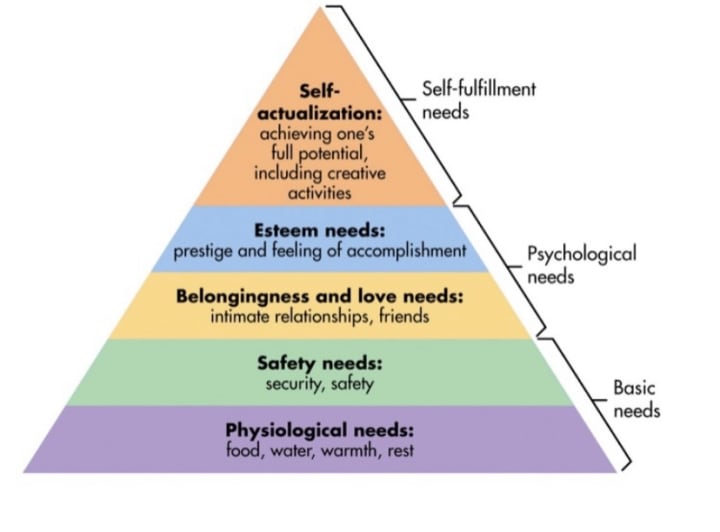
The needs listed at the bottom must be met first before moving up the pyramid. In this context it can be acknowledged that there are many fundamental needs that must be met before one can move up the pyramid and fulfill their needs of love and belonging.
When we identify and meet our basic needs, we think having a roof over our heads, having food to eat and feed our kids, making a steady income to keep up with the daily functions of life. On the contrary when we consider emotional needs, we look at things like our relationships and connections with others. How significant are they to me? Do they know the real me and understand how my brain works? Do I feel wanted and loved by the ones I want and love?
It has to be a balance of it all to be able to tell ourselves: “I need alone time” and “I’m feeling pretty lonely I should call someone.”
Where do you fall on that spectrum? Especially after riding an almost 3-year-old pandemic it’s far more important to understand the difference between the two.
“Humans are inherently social creatures, and we need others to maintain our emotional well-being.” Psychologists Sarah Adler says, “but interestingly, spending time alone is just as important for us to connect more deeply with ourselves.”
Having an understanding of our emotions is extremely helpful when it comes to identifying our needs and how we navigate in a world full of human connection. It somewhat disarms the feeling of loneliness and becomes glorified as solitude but also comes from a foundation of unconditional self-love.
About the Creator
Desiree Lozano
gemini | storyteller | coffee addict | reiki practitioner
stepping into my power through storytelling--join me.
Keep reading
More stories from Desiree Lozano and writers in Humans and other communities.
Golden Girls Meant To Be
I love hearing stories of how owners met their pet for the first time and how they became part of the family because no matter how wild circumstances may be, it always comes down to a matter of fate. That’s how I would describe it when I got my golden girl Meera.
By Desiree Lozano4 years ago in Petlife



Comments
There are no comments for this story
Be the first to respond and start the conversation.