
A Romance Written in Verse: The Timeless Love Story of Robert and Elizabeth Barrett Browning
How a Secret Correspondence Sparked One of History's Greatest Literary Romances


Some love stories are fleeting, fizzling out like a candle in the wind. Others, like the tale of Robert and Elizabeth Barrett Browning, shine with an eternal brilliance, immortalized not only in history but in poetry that still tugs at the heartstrings of romantics worldwide. If Hollywood were tasked with scripting the quintessential Victorian romance, this would be it—complete with secret courtship, dramatic family feuds, and a love so transformative it inspired some of the greatest poetry ever written.
Eternal Love: Elizabeth Barrett Browning's 'How Do I Love Thee?' (Sonnet 43)
But make no mistake: this wasn’t just a romance between two people. It was also a tale of rebellion, resilience, and the power of love to heal even the most broken souls. So, grab your quill and parchment (or your tea, if you’re less poetically inclined) and settle in for a story that proves truth is often more romantic than fiction.
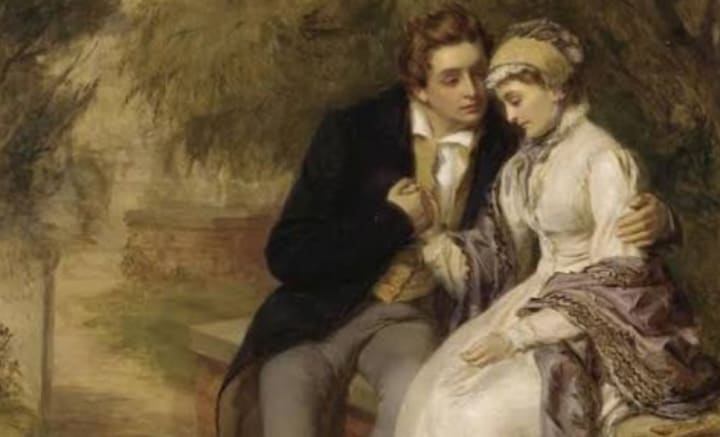
Elizabeth Barrett: The Recluse with a Pen Mightier Than Her Circumstances
Before Robert Browning swept her off her feet, Elizabeth Barrett was already a household name in literary circles. Born in 1806, she was the eldest of 12 children in a wealthy family, raised under the iron fist of her domineering father, Edward Barrett Moulton Barrett. If there were a Victorian-era version of “helicopter parenting,” Edward was its poster child. His rule was absolute: none of his children were allowed to marry. Ever.
But Elizabeth wasn’t your average 19th-century damsel. By her teenage years, she was a prodigious poet, crafting works that would eventually place her among England’s literary elite. Life, however, was no bed of roses for Elizabeth. She suffered from chronic illness and spent much of her time as a virtual recluse, confined to her room in her family’s London home. Despite this, her words carried her far beyond the walls of her confinement, touching the hearts of readers—and one particular poet—across the nation.
Robert Browning: The Passionate Admirer Turned Lifelong Partner
In 1844, Elizabeth published her acclaimed collection Poems, which quickly gained widespread praise. Among its admirers was a relatively unknown poet named Robert Browning. Bold and brimming with charm, Robert was the polar opposite of the reclusive Elizabeth. Where she was quiet and introspective, he was fiery and unrestrained—a walking sonnet looking for its muse.
After reading her poetry, Robert was smitten—not just by her talent but by the woman behind the words. He sent her a fan letter that could double as the world’s most eloquent Tinder swipe:
“I love your verses with all my heart, dear Miss Barrett... and I love you too.”
And just like that, a correspondence began.
What followed was one of the most famous literary courtships in history. Over the course of nearly two years, Robert and Elizabeth exchanged almost 600 letters. Their words bridged the gap between their vastly different lives, creating a bond that grew stronger with every missive.
Rebellion in the Name of Love
But this love story wasn’t destined to be smooth sailing. Standing in their way was none other than Elizabeth’s father, Edward. True to his promise of forbidding marriage for any of his children, he was livid when he caught wind of the blossoming romance. Edward’s objection wasn’t based on Robert’s character—he was more than respectable—but rather on the sheer principle of control.
Undeterred, Robert and Elizabeth hatched a daring plan. In September 1846, they married in secret at St. Marylebone Parish Church. The ceremony was simple, attended by just a few witnesses, and Elizabeth didn’t even wear white. This wasn’t about pomp and circumstance—it was about freedom.
After the wedding, the newlyweds fled to Italy, where they hoped to escape the shadow of Edward’s tyranny. They settled in Florence, where Elizabeth’s health miraculously improved, and their love story continued to flourish.
A Love Written in Verse
It wasn’t just their personal lives that thrived; their creative partnership was equally remarkable. While in Italy, Elizabeth wrote some of her most iconic works, including Sonnets from the Portuguese, a collection of love poems inspired by her relationship with Robert. Among these is the now-famous “Sonnet 43,” which begins with the immortal lines:
“How do I love thee? Let me count the ways.”
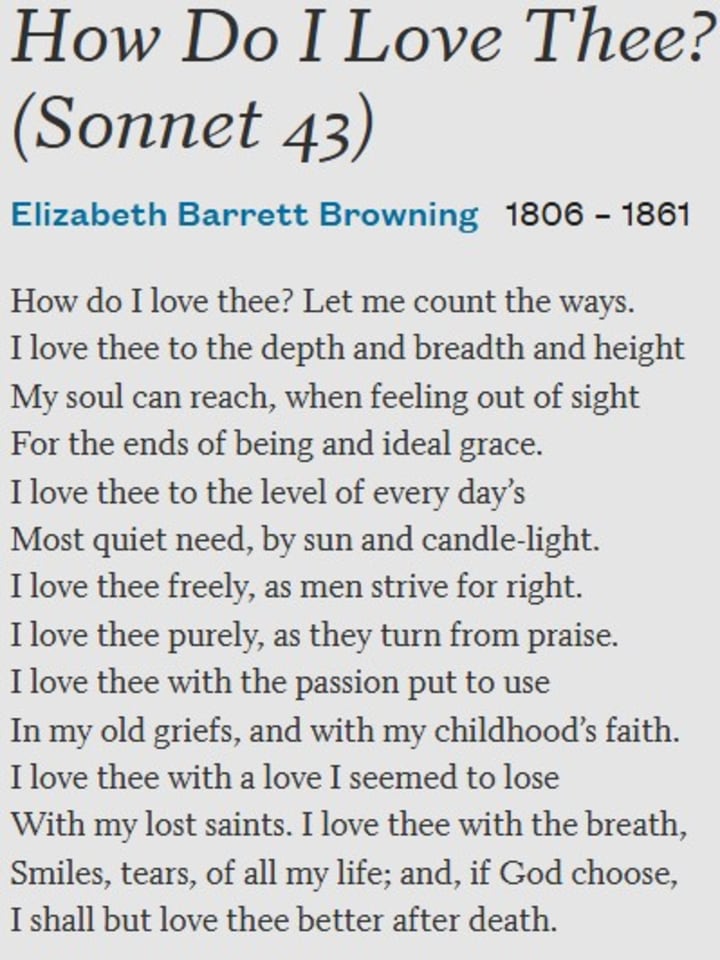
How do I love thee? || Poem by Elizabeth Barrett Browning (Sonnet 43)
Robert, meanwhile, continued to build his own literary legacy, penning dramatic monologues that would later establish him as one of the great poets of the Victorian era. Far from being rivals, the two poets supported and inspired each other in a way that was both rare and beautiful.
Happily Ever After? Not Quite, but Close Enough
The Brownings’ love story didn’t end with “and they lived happily ever after,” but it came close. For 15 years, they enjoyed a life of love, creativity, and mutual respect—a rare trifecta in any era. Their son, Robert “Pen” Browning, was born in 1849, adding another layer of joy to their lives.
Elizabeth’s health, however, remained fragile. On June 29, 1861, she passed away in Robert’s arms. Devastated but forever changed by their love, Robert carried her legacy forward, dedicating his life to preserving her work and ensuring the world remembered the woman who had given him her heart.
A Legacy That Lives On
Today, the love story of Robert and Elizabeth Barrett Browning remains one of the most celebrated romances in literary history. Their letters, poetry, and enduring devotion serve as proof of the power of love to transcend even the most insurmountable obstacles.
It’s the kind of story that makes you believe in soulmates, even if you’re a cynic. Because if two people—one a chronically ill recluse, the other a spirited dreamer—could find each other in a world stacked against them, maybe love really does conquer all. And for those of us less inclined to pen poetry about our own relationships, we can at least be thankful for the gift of theirs—a timeless reminder that love, in its truest form, is nothing short of art.
About the Creator
Keep reading
More stories from Marveline Merab and writers in Humans and other communities.
Unmasking the 4B Movement: Why Are Korean Women Saying No to Marriage, Men, Babies, and Dating?
When it comes to shaking societal norms, South Korea’s 4B Movement (short for Four No’s) has become a seismic cultural shift that’s sparked debates, raised eyebrows, and, yes, fueled more than a few fiery online arguments. Whether you see it as a groundbreaking feminist revolution or a radical response to traditional expectations, there’s no denying its impact on the country’s social fabric. But what exactly is the 4B Movement, and why has it become such a lightning rod for controversy? Let’s break it down.
By Marveline Merababout a year ago in Humans
Why Indigo Children Struggle with Authority Systems.
Indigo children are often described as a generation of individuals with heightened intuition, strong purpose, and a natural sense of independence. While these traits are gifts, they frequently clash with traditional authority systems, including schools, workplaces, and societal structures. Understanding why indigo children—and adults who were once indigo children—struggle with authority helps explain their behavior, fosters empathy, and provides insights into how to support their growth without suppressing their unique potential.
By Wilson Igbasi7 days ago in Humans


Comments
There are no comments for this story
Be the first to respond and start the conversation.