
The house is dying. Smells of cold, and fever, and death. Wait.
Perhaps…
I sniff,
Is it me?
I shiver, clasp my hands together, run my right thumb over the soft, wrinkled skin of my left hand. My eyes, my throat, my chest, everything feels heavy, slow, dazed, as though I’ve walked from an oven to an icebox, though I’ve only taken a step.
I heave a rasping cough.
Where is it? Where is it?
I know I had it…where?
I cough, heavy, painful. Then I lean on the kitchen table, putting my weight onto my outstretched palms, feeling the cold of the tiles against my burning hands.
Where is he? Where is he? Make sure he finds it. I’ve put it there, safe, ready for him.
I want to see him, if -
I cough. It hurts.
- If it’s not too much trouble, please.
I keel over, staring up at a someone who isn’t there.
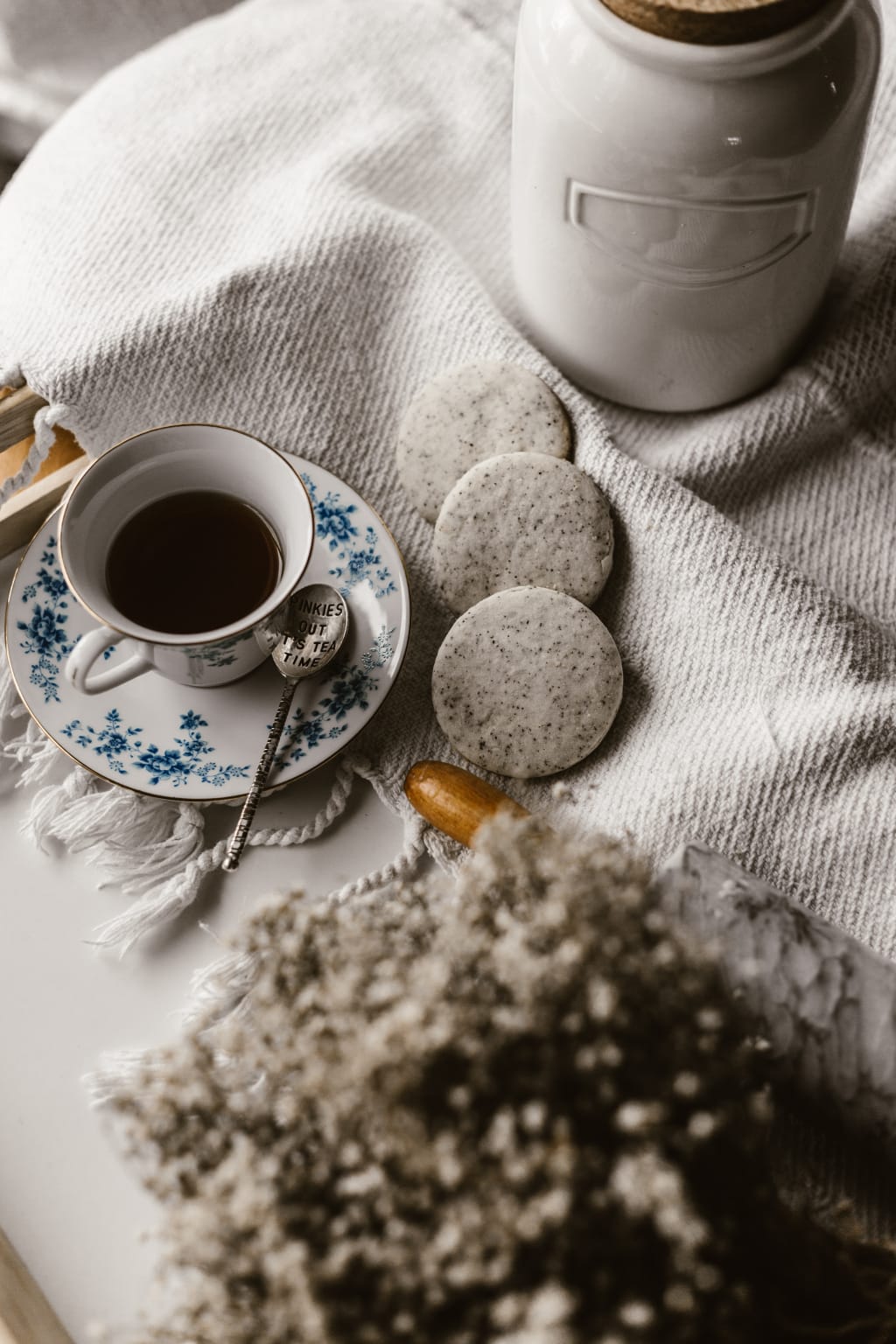
The biscuit jar sits in the pantry.
****
“He’s being a selfish pig.”
Sophie sees a line of code missing a closing parenthesis. She’s trying to type quietly, trusting her Airpods to block out the clacking keyboard from Jen at the end of the phone. She has a deadline to meet, and Jen, bless her, Jen likes to talk.
Mellow, nostalgic waves of music shuffle between Spotify ads like strangers on a train. An ad burbles up above the mix - a book of Victorian ghost stories supposedly “worth every cent!”. It draws Sophie’s ear because she’s expecting a Swiffer Duster ad, or something about Charmin toilet roll. But she’s pulled back into the phone call as Jay, who must be in the room with Jen, replies,
“Rude. Soph, are you hearing this? Soph will agree with me.”
Jen’s voice sounds hard - like she’s steeling herself for something - as she retorts,
“Soph doesn’t know the full story.”
Sophie feels herself straighten up, stop typing. Jen says,
“Go on Jay, tell her.”
“Jen’s convinced herself there’s some big story behind this, some reason we can’t just count our blessings and cash the cheque. Because there’s just got to be some reason we can’t have a good thing happen to us, hasn’t there, Jen?”
Jay’s tone is sarcastic, but there something underneath it, translucent, an exposed nerve. Sophie wonders if the two of them moving into a new house together was such a good idea. Jen says,
“Shut up, Jay. This cheque, Soph, it’s not like it wasn’t written to anyone. But it was hidden at the bottom of a biscuit jar, tucked away in the pantry where we hadn’t noticed it. These stale biscuits must’ve been sitting on it for six months, so they’ve rubbed off the name-”
“Exactly. Almost six months, meaning we need to take it to the bank now. Who are you going to give it to, anyway? Post a picture and caption it, ‘Hey, did anyone lose 20,000 dollars?’”
“Will you stop? I just…Soph, please, I know you solved that case in Brussels, will you just…will you take a look?”
There’s a pause.
Why? Why me? Why does everyone always want me to do things?
Sophie hesitates, biting her lip, feeling the tick, tick, tick of time passing as an acceptable response time walks in - and walks out.
She looks at her laptop, thinks of her deadline on Monday, her brain fuzzy with the anxious thought of how much she has left to do.
She runs a hand through her hair.
“Jen, I…”
“Wait, listen. Jay, stop looking at me like that. Well, leave then - I’m going to tell her. Soph, the woman who lived here before us, she was elderly, and…and right here, in this house…I can’t get it out of my head, the idea of this poor woman getting sicker and sicker, couldn’t leave the house, maybe couldn’t reach anyone, and one of the last things she does is hide this cheque. It must mean something.”
Pause.
Months of COVID-19 statistics suddenly feel real, as though a trapdoor has opened above Sophie’s head and a flood of consequences have begun rolling, tumbling, falling like marbles, dark, heavy, jarring, onto the wooden floorboards and into Sophie’s lap. She thinks,
My God.
Jen’s voice crackles through the earphones, an inescapable hotline to ears that don’t want to hear anymore.
Before she can clear her mind, begin to think, Sophie says,
“Show me.”
*****
Scratch, scratch, scratch.
Cold air wisps around the windows, fog in a borderland, the heavy oak desk and spindly-legged chair eying it from beside a boxlike television – a black screen that stares out, wishing someone would rise, find the long-lost remote, resurrect it from the graveyard of dust, dirt, and broken TV dreams.
Scratch, scratch, scratch.
I notice the cold - notice it in the ends of my stiff fingers, in the toes that barely feel the ground. But I sit at the desk and scribble, scratch, scrawl rapidly, as though I’m building a wall between myself and Death, and if the flow of words is caught in the pen, Death will roll and thunder over it, a smoky cavalry.
Scratch, scratch, scratch.
Must finish. How long do I have?
I glance at my watch, as though it can tell me.
I grip the notebook, small, black, smooth. The pages are yellowing slightly, but the edges aren’t fraying - not yet. I’m careful like that, you know.
*****
Why?
Why did you do it?
What were you possibly hoping could come of it?
Sophie rubs her forehead, pauses the thought, looks again at the biscuit jar Jay has brought to the park. He’s at the next picnic table over; she can feel his curious eyes on her. She wishes she could take it home, wishes Jen could come over - but Jen’s been too scared to leave the house since lockdown started, and Sophie doesn’t blame her.
The biscuit jar is delicate cream, cylindrical porcelain, intricate, looping lines etched into it, somewhere between tracing the path of a bee and forming stems for the flowers blooming unsymmetrically around the letter J, carved into the centre.
Sophie empties the stale biscuits out onto the picnic table. Something falls out with it - a label -
Emma Bridgewater.
Sophie takes it in, thinks. She looks again at the biscuits - they’re Rich Tea. She pulls out her phone and does some Googling. Then she sets her VPN to “Birmingham, England”, and tries again.
Bingo.
“You’re not trying to tell me you’ve found something?” says Jay. Sophie’s look must’ve shown.
“And what if I have?”
“Look, I’m cashing the cheque first thing tomorrow. The woman was mad - she wrote a cheque to no one, or maybe to her biscuits. There’s no way in hell you’re going to figure out anything by looking at the jar.”
Sophie turns away, and as she does the haunting image of a frail, desperate, isolated woman burns itself again into her mind.
She stands, saying,
“I’m going to make a phone call.”
*****
I’m dying.
The cold, stiff fingers ache as I pull the envelope from the drawer, shiver as I slide in the notebook, and fumble as I seal the top.
I wonder if I’m wrong, if it’s just a bad cold, if I’ll feel better soon.
I cough, rasp, cough again - hard, this time; it scratches, claws at my throat.
I want to talk to him.
Pause.
Too late. How could you, even if you wanted to?
Pause.
I want to talk to him.
Pause.
Did I say that already?
I’m going mad in here, tucked away. It’s worse because I know it.
Tucked away in society’s pocket, lost, forgotten.
*****
Jay’s eyes look satisfied. He’s leaning against the picnic table, playing music quietly on his phone, and even his body posture seems to say,
I told you.
Facebook is open on Sophie’s laptop, sitting on the table. It’s almost dusk – in the morning, Jay will take the cheque, get it to the bank before it becomes stale-dated.
There’s nothing I can do to help her.
Sophie’s face feels hot. She’s chewing her lip, her stomach drowning in restless anxiety.
What were you trying to tell me?
Why couldn’t you just say it?
Staring at the laptop screen, she thinks over it all again.
The label - Emma Bridgewater - English. Combined with the jar, using the VPN, narrowed down to Birmingham, UK. Customizable, expensive.
The store says it looks like Eleanor Charrington’s order.
But if that’s her name, what’s the J on the jar?
Something’s not right. But what?
There’s no Eleanor Charrington in Birmingham on Facebook.
But then…?
The music switches to a Swiffer Duster ad and Jay, texting on his phone, laughs,
“You’d be better off putting an ad on Spotify.”
Sophie sits for a minute.
Then she gasps, bangs the table with her hand, so excited she has to stand up. Her heart races as everything - she hopes - clicks into place.
*****
Oh, God.
I can’t breathe, except in gasping breaths that seem to pull no air. I ache, can barely move, barely find the strength to stand.
It hurts.
I pick up the pen from the desk, scrawl my signature, the amount. As I move to write the name in the To: box, my eyes shift towards the door, caught by the sound of the postman. I think,
Please.
The cheque in hand, I stumble towards the door.
I’m too slow.
It’s like being drowned in sand or stardust, held in stasis, so that every movement is sluggish, excruciatingly slow.
I hear the postman reach the door, hear the Clack! of a magazine hitting the floor outside, then hear the footsteps begin to recede.
No. No!
He has gone; I am alone.
*****
“She’s been gone six months. I thought…But how - how did you know?”
The man is on a Zoom call with Sophie, Jen and Jay. Sophie explains,
“She told the store her surname was Eleanor Charrington, but I couldn’t find her. Then I remembered (thanks Jay) a Spotify ad for a book of Victorian ghost stories, and one, specifically: John Charrington’s Wedding. She wasn’t giving them her name; she was giving me yours. I phoned the realtor, got the real surname – Morstan – and found a John Morstan on Facebook, in Birmingham, talking about his mom, Eleanor, 6 months ago.
The man is silent. Jen says,
“The J on the jar, of course! What about the notebook?”
“I took the cheque to the bank,” says the man, “The notebook was waiting for me in a safety deposit box.”
“Do you mind my asking what’s in it?”
“They’re letters for me, from just before she…you know. She hated phones, and she never would give up that house, come back to Birmingham. I thought it was us she hated. We used to read ghost stories, have tea and biscuits, do everything together, when I was little, but you grow up and…” the man’s eyes are sad, silent. “She probably didn’t even know my phone number.”
After a pause, Sophie says,
“I think she understood. None of this was about herself, or even about the money – I think it was her way of weaving together your stories, her memories, your time together, like a maze that led straight to…well, straight to you, John.”
The call ends.
Alone in his room, the man cries, and alone in hers, so does Sophie.
When Sophie thinks about the Morstans now, she still pictures the woman. But the image is no longer of frail, fragile hands. She sees Eleanor Morstan, painting through a clouded sunset, her fingers soothing, smoothing, blurring the lines between melancholy blue and the fiery, sparkling yellows of a fighting, curious soul. She sees a nimble mind building a crystal walkway across the world, crossing insurmountable distance with the twinkle of her eye, the ink of her pen, and the rattle of Rich Tea biscuits in a perfect, porcelain jar.
About the Creator
Keep reading
More stories from Vita K. Jones and writers in Humans and other communities.
The Cottage at Avebury Corner
The beamed ceilings were low and the room sizes small, made smaller by patterned wallpaper, but it all felt very spacious compared to her one bedroom flat in cold, rainy Birmingham. The cottage was surprisingly larger inside than the grey, unassuming exterior would have you believe. The furniture was unquestionably old fashioned and not items she herself would have chosen but elegant in their own way and, to her, expensive looking, an eclectic mix of styles, some of which looked like antiques, almost as strange and as beautiful as some of the pieces in Heritage homes she had visited as a schoolgirl. She was struck by the sense of history and learning inside this home, the antique furniture being complemented by bookshelves, crammed with more books than she had seen in her entire life. She gasped at the sheer quantity and beauty of those books. All around there were comfortable, worn and sometimes shabby pieces of furniture, everything rather dusty, a feeling of faded luxury and a bygone era.
By Vita K. Jones5 years ago in Humans
Autonomy Is The Real Privilege
Good morning, freedom-seekers! Today we’re gonna be looking at autonomy. A strange word, I know; one many would probably look at blankly and run away from on sight. We’re gonna figure out what it actually means, consider how it’s achieved, and decipher just how deeply most of us are tangled up in dependence without realising it.
By That ‘Freedom’ Guy3 days ago in Humans
How to Choose Quality Himalayan Salt Bricks for Bulk Orders
When constructing a salt room for a premium spa, designing a salt wall for a restaurant, or stocking salt bricks for retail, salt bricks set the wellness and natural aesthetic for your project. Sourcing salt bricks in bulk is a significant investment, and the profit of the investment relies on the quality of salt bricks.
By Emily Rosiea day ago in Humans




Comments
There are no comments for this story
Be the first to respond and start the conversation.