
A New Way to Understand our Freedom of Choice
The Neuro-Philosophical Model of Autonomy (NPMA)

We often simplify the question of freewill to a binary choice: do we have it or not?
This perspective, however, misses the complexity of human autonomy. Instead of asking a simple yes or no, we should ask: How much autonomy and freewill do we actually possess?
The degree of our autonomy fluctuates along a spectrum, influenced by numerous internal and external factors. In my exploration of these concepts, I developed a working model of human autonomy, the Neuro-Philosophical Model of Autonomy (NPMA), to better understand and quantify human freedom of choice. This model holds tools that can help us measure, and more importantly, enhance our autonomy.
The NPMA
NPMA is an interdisciplinary framework that bridges the gap between deterministic forces that shape our lives and the boundless potential for self-determination that we all possess. It’s an elaborate idea that compiles together the empirical insights of cognitive neuroscience and evolutionary biology with the philosophical concepts on free will. It is a model which measures and understands human autonomy in a profound new way.
At its heart, the NPMA blends scientific data and philosophical inquiry. It gives us tools like the Comprehensive Autonomy Profile (CAP) and the Autonomy Index (AI) to objectively measure how autonomous we truly are. Think of it as a finely tuned instrument that can gauge the degree to which we are the authors of our own lives, amidst the myriad influences that seek to write our story for us.
The NPMA doesn’t just stop at a surface-level understanding of autonomy. It dives deep into the numerous factors that contribute to our sense of self-determination. It explores the brain’s role in decision-making, from neural networks to neurotransmitters, it considers how our evolutionary history shapes our cognitive functions and behaviors, and it draws on compatibilism, incompatibilism, and libertarianism to frame autonomy within both deterministic and agent-based contexts.
The model iterates that autonomy isn’t binary; it exists on a spectrum, allowing for a nuanced view that ranges from complete determinism to absolute free will. This scale quantifies autonomy from 0 (total determinism) to 100 (absolute free will), with both absolutes practically impossible for human beings.
Objective Measurement Metrics
Comprehensive Autonomy Profile (CAP) assesses cognitive capabilities, environmental influences, and genetic predispositions to provide a holistic view of autonomy. It is like a detailed roadmap of an individual’s autonomy, evaluating Cognitive Capabilities, Environmental Influences, Genetic and Biological Factors, and Behavioral Patterns. The data for CAP is collected through self-report questionnaires, behavioral assessments, neuroimaging, interviews, and longitudinal studies. It is analyzed by applying quantitative and qualitative techniques to ensure thorough evaluation and it’s validated by ensuring reliability and validity through extensive testing.
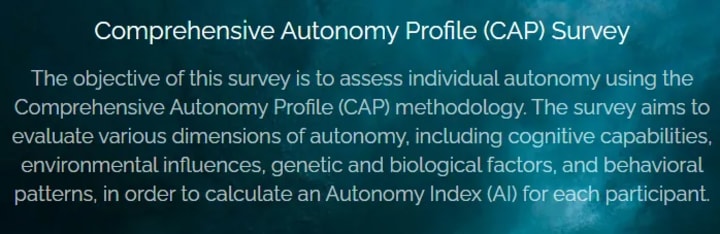
the Autonomy Index (AI) The AI is a central piece of the NPMA, offering a quantitative measure of autonomy. It aggregates scores from various dimensions assessed through the CAP, creating a comprehensive score that ranges from 0 (total determinism) to 100 (absolute freewill), with most of us falling somewhere in the mid-range. Each dimension is evaluated using standardized criteria, and the scores are combined to produce an overall AI score.
Example of weighting: Cognitive Capabilities (40%), Environmental Influences (30%), Genetic and Biological Factors (20%), Behavioral Patterns (10%).
Aggregation of Scores: The weighted scores from each dimension are summed to calculate the overall AI score.
Formula: AI = (Weight1 * Score1) + (Weight2 * Score2) + (Weight3 * Score3) + (Weight4 * Score4)
The AI is designed to capture the fluidity of autonomy. An individual’s AI score can change over time due to cognitive development, environmental changes, and interventions aimed at enhancing autonomy. The CAP can be periodically reassessed to monitor changes in AI, providing insights into the effectiveness of interventions and personal growth.
Benefits of the NPMA
One of the primary contributions of the NPMA is its ability to synthesize philosophical theories with empirical findings from neuroscience. This approach not only enhances our conceptual understanding but also grounds abstract philosophical ideas in tangible scientific evidence. Further, the NPMA has significant implications for moral responsibility and legal accountability as it clarifies the conditions under which individuals can exercise autonomy, prompting a reevaluation of how we assign blame and administer justice, especially in cases involving mental illness or cognitive impairments.
On an even more practical level, the NPMA provides valuable insights into how individuals can navigate the challenges of life with a better understanding of their cognitive limitations and potentials. It encourages the development of personal strategies for making meaningful choices and coping with the inherent constraints of human cognition. All-in-all the framework takes the best of both sides from the Freewill vs Determinism argument and seamlessly accommodates them to have tangible effects on our lives.
Strengths and Limitations
- Strengths:
- Interdisciplinary Integration
- Objective Measurement
- Dynamic Nature
- Comprehensive Assessment
- Personalized Interventions
- Empirical Foundation
- Ethical and Legal Implications
Limitations:
- Complexity
- Measurement Challenges
- Deterministic Constraints
- Ethical Considerations
- Cultural Sensitivity
- Longitudinal Validation
- Integration of New Research
Key Takeaway
The NPMA Informs moral responsibility and legal accountability by providing insights into what degree of action was due to genuine free choice and what degree emerged from determined aspects. It offers strategies to increase autonomy through cognitive development and training. It also addresses the balance between deterministic influences and moral responsibility.
Overall, it stands as a groundbreaking technique in the research for autonomy with practical applications, illuminating the pathways between our deterministic foundations and our potential for self-determination. It offers a comprehensive, nuanced, and dynamic understanding of what it means to be autonomous by merging the empirical with the philosophical.
About the Creator
Keep reading
More stories from Waleed Mahmud Tariq and writers in Humans and other communities.
What Is Cognitive Dissonance?
We often find ourselves standing at the crossroads of conflicting beliefs and actions, experiencing a piercing internal disconnect and discomfort. This phenomenon, known as cognitive dissonance, is more than just a psychological curiosity; it’s a fundamental aspect of our human experience, shaping our decisions, beliefs, and ultimately, our lives.
By Waleed Mahmud Tariq2 years ago in Humans
The CEO of Everything
They say "jack of all trades, master of none," but they forgot to mention the part where the jack of all trades is also the camera woman, the makeup artist, and the person currently yelling at a tangled Wii microphone cable in a her own bathroom while recording herself singing and trying to make it look realistic and professional. (As professional as you can make it with nothing but a cell phone camera and a mic that doesn't work)
By Sara Wilson5 days ago in Humans
Two Farmers Unearth a 17th-Century Silver Treasure While Working Their Land: A Remarkable Discovery
In a discovery that feels lifted straight from the pages of a historical novel, two farmers recently unearthed a 17th-century silver treasure while working their land. The find, consisting of coins, jewelry, and small silver artifacts, provides a fascinating glimpse into the region’s past and has ignited interest among historians, archaeologists, and the local community. Beyond the monetary value, this discovery underscores the enduring stories buried beneath the soil, waiting for chance and circumstance to reveal them.
By Salaar Jamali5 days ago in Humans



Comments
There are no comments for this story
Be the first to respond and start the conversation.