
“A dress for poor people!” my daughter said. But at the party, when I walked in, she fainted...
“I never imagined one comment could change everything—until the truth came out in front of everyone…”
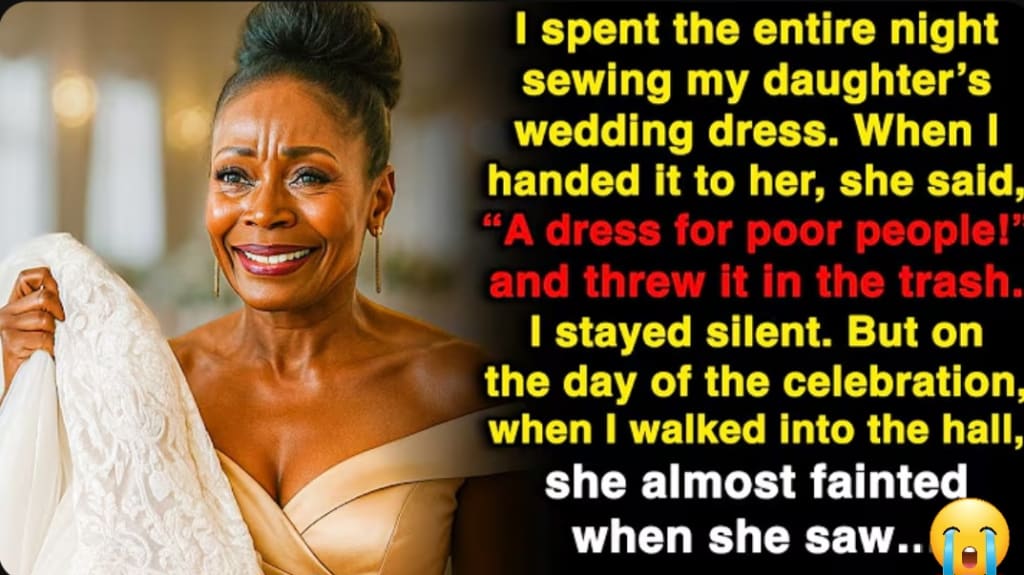
I spent the entire night sewing my daughter's wedding gown, stitch by painful stitch, without even stopping to
rest my eyes. Each needle pass was a memory. Every thread, a promise. The
clock's steady tick- tock accompanied me until dawn, marking the hours like the echo of my own life, which felt like it
was unraveling slowly. When I finished, the first ray of sun peaked through the window and settled on the white fabric.
It was beautiful. It didn't have the sparkle of Fifth Avenue boutiques or the price tag of a high fashion designer,
but it was made with the love of a mother who, even after a lifetime of sacrifice, still believed that genuine
care could heal anything. I carried the gown with trembling hands wrapped in an
old sheet to protect it. When I arrived at the home of my daughter, Zuri, she
was surrounded by girlfriends, laughing and sipping coffee from delicate cups.
She looked like one of those perfect, distant Hollywood socialites. For a
moment, I felt a deep surge of pride, and then it happened. Zuri looked up,
scanned me from head to toe, and asked, "Is that the dress?" I nodded, smiling.
I unwrapped the fabric carefully, as if revealing a treasure. She looked at it for only a few seconds, and then, with a
sneer of contempt, she let it fly. This looks like something a poor person would wear. Her friends giggled softly. Before
I could react, she snatched the gown and tossed it into the trash can. I'm not
getting married dressed like a seamstress, Mom. I felt the air abandon my lungs. I didn't say anything. Not a
single word. I just gathered my broken pride from the floor and walked out slowly before they could notice I was
crying. I walked back home. My vision clouded. The sun was beating down hard,
but I only felt cold. The gown was still in my mind, every stitch burning like an
open wound. I thought of the sleepless nights, the years working at the old machine my mother left me, the calluses
on my hands, everything I had given up so Zuri could reach where she was. And I
wondered when love became a source of shame. When I arrived, I sat in front of my
sewing machine. I stared at it for a long time. Its worring sound, once so
familiar, now seemed like a lament. I touched the petal, seeking comfort in
its vibration, and felt a strange impulse. It wasn't sadness. It was
something new, a cold, dangerous calm. The kind of calm that only arrives when
a heart breaks and instead of collapsing, begins to plot. Days passed
and my daughter never called, not even to apologize. I heard through others that her designer gown was ready,
imported from Paris, perfect, as she put it. But perfection has no soul, and that
dress, no matter how beautiful, could never tell her story. Then one afternoon
I went to her house. I waited for her to leave and slipped inside without making a sound. The scent of expensive perfume
and fresh flowers filled the air, but in one corner of the room, the trash can still sat there. And inside, among
crumpled papers and scraps of fabric, I found my dress. Wrinkled, stained,
humiliated, but whole, just like me. I pulled it out gently, hugged it to my
chest, and took it home. I spread it out on my workt, and observed it under the sunset light. It was beautiful, even in
its misery, like a mother who continues to love even after being wounded. I ran
my hand over the seams and felt my love still living there within every thread. And then I knew it. That dress was not
going to end up in the garbage. For the following nights, I locked myself in my studio. I didn't sleep. I barely ate. I
just sewed. I embroidered crystal flowers onto the hem. I added vintage lace. And within every layer of fabric,
I hid more than just embellishments. I hid my history. I placed one stitch for
every tear, one thread for every sacrifice, one flower for every day I spent feeling invisible.
As the dress transformed, so did I. I was no longer the submissive mother who
bowed her head to her daughter's contempt. I was a woman who understood that love doesn't mean enduring
everything, but choosing what is worth keeping. When I finished, the mirror
reflected a different image. My eyes no longer held sadness, but determination.
The gown sparkled beneath the studio lamp, and its brilliance held something more than beauty. It held justice. The
wedding day arrived. I hadn't planned to go, but destiny, or perhaps self-respect, compelled me. I put on my
simple cream dress, pinned up my hair, and walked out with a firm stride. Each
step was a new heartbeat. Every breath a silent declaration. I am not the same
woman. When I arrived at the Grand Magnolia Ballroom in Charlotte, the air was filled with music and laughter,
lights, flowers, and clinking champagne glasses. Zuri, radiant, wore her
luxurious foreign lace gown. She was beautiful, yes, but empty. She didn't
see me enter, and I didn't want her to see me yet. I stayed near the door, observing in silence. My hands were
trembling, not from fear, but from the weight of what was about to happen. Because that night, my daughter wasn't
just going to have a wedding. She was going to have a lesson. When the clock struck 10, I took the
first step toward the center of the room. The murmuring stopped. Every eye turned to me. Zuri looked up. Her smile
disappeared. And in that instant, I understood that destiny had been preparing me for this moment my entire
life. Because sometimes a mother's love is demonstrated not through tears, but
through a gown that shines brighter than shame. Needles have always been my best friends. Since I was 12, when my mother
first taught me to sew a button, I knew that this would be my way of speaking to the world. I was never a woman of easy
words, but my hands could say things my voice could not. And for decades, amidst threads, fabric, and silence, I learned
that every seam could hold a story, even a life. When I became a widow, Zuri was
only 6 years old. My husband Kofi died in a construction accident, and from one
day to the next, I was left alone with a little girl and a sewing machine. I remember crying that night by the
window. But the next morning, I turned on the machine, wiped away my tears, and
started to sew. From that moment on, every garment that left my hands carried
a promise. I would never let my daughter go hungry. We lived in a tiny apartment
behind the small neighborhood tailor shop where I worked. Zuri slept on a little cot surrounded by fabric scraps
that she sometimes used to make improvised dolls. I watched her play and thought that one day all this sacrifice
would make sense. That one day she would understand that love can also be embroidered. For years my fingers bled
over other people's wedding fabrics, silk gowns, imported lace, the dreams of
women who could afford what I never would. Sometimes while sewing the veils of strangers, I imagined what it would
be like when my own daughter got married. I dreamt of sewing her the most beautiful gown in the world, not because
it was perfect, but because it would be made with the only thing I was never short on, love.
When Zuri turned 15, I was able to buy her first brand new dress, not secondhand, not patched, but new. It was
sky blue with a white ribbon I embroidered on the chest. That night, watching her dance, I felt that
everything had been worth it. She hugged me tight and whispered in my ear, "You are the best mom in the world."
That phrase stuck with me. I didn't know that years later those same words would sound like a sad echo, like a broken
promise. Zuri grew up, and over the years, she began to drift away from the
world that had shaped us. She went to college in the city thanks to a small business loan I secured by selling my
old car. She worked hard, moved up, and met different people. When she returned,
she was a stranger. Her voice had changed, and her look had too. She no
longer called me mama, but mother. And every time I spoke, I noticed a mix of
annoyance and shame on her face. At first, I thought it was my imagination.
But the signs were there, the calls she didn't return, the increasingly brief visits, and that comment she made one
day without looking me in the eye. I wish you had been able to get an education. That phrase pierced my heart
like a needle because without knowing it, she was telling me that the love I gave wasn't enough. That my hands, the
very hands that swed her childhood, no longer held value in her world. Even so,
when she told me she was getting married, I felt a pure, innocent joy. I
thought I could finally give her the gift I had dreamt of for so many years, her wedding gown. I offered to make it
myself, and although she hesitated, she finally accepted. I took it as a sign of
reconciliation, an opportunity to mend what distance had broken. That night, I
sat in front of the machine and prayed before starting. Lord, guide my hands. Let every stitch be a blessing. I spent
whole days choosing fabrics I could afford. Ivory lace, soft tulle, and
small pearls a client had left me as payment. Every thread carried a wish,
every fold a hidden tear. And inside the lining, where no one else could see it,
I sewed a tiny piece of my own wedding dress. It was my way of telling her without words, "Take me with you,
daughter. Even if you no longer see me, I will be there." But when it was all
finished, and she rejected it, it wasn't just the dress she threw in the trash. It was my story, my love, the invisible
thread that still united us. That night, I didn't sleep. I stayed watching the
machine, turned off, and thought of my mother, how she too sewed until she was exhausted. She always told me,
"Daughter, women like us don't have swords or fortunes. Our strength is in our hands." And in that moment, I
understood. My strength was not in being accepted, but in continuing to weave my
own destiny, even if they unraveled it over and over again. I touched the
stained fabric I had taken from the trash can again. I ran my fingers over the broken seams and felt my love still
beating within it. I thought of all the times I hugged her without being hugged back. The uncomfortable silences, the
"Mom, please don't come dressed like that" moments. And I understood that humiliation, if sown with patience,
could also become a lesson because pain doesn't destroy, it transforms. And that
transformation had already begun. Over the following days, something
changed in me. I began to sew, not for her, but for myself. Every stitch was a
way to heal. The thread ran smoothly, almost as if the machine understood my
soul. I was no longer embroidering a gown. I was embroidering my freedom. And
though Zuri didn't know it, I already had a plan. On her wedding day, she
would wear the dress she chose, but everyone would remember the one she scorned. Because some loves are
forgotten, and others are avenged with elegance, and mine was about to shine.
The wedding day dawned under a gray sky. It wasn't raining, but the air smelled
like a storm, as if the whole world sensed that something was about to break. I dressed in the only decent
outfit I owned, the same one I had worn to my mother's funeral, and carefully styled my hair, not because I wanted to
impress anyone, but because that day I was going to face my past with my head
held high. I carefully tucked the restored gown into a white linen bag
folded with the precision of someone guarding a secret. It was neither a gift nor a complaint. It was a response, a
silent answer to a daughter who had forgotten what it means to love without shame. When I left the house, the wind
was blowing hard. I walked to the bus stop, my hands clutching the bag as if it were my own heart. The ride to the
event center was long, and at every turn of the road, I remembered the moments when my daughter and I were one soul,
when we laughed for no reason, when she hugged me without fear of being seen.
But those memories now hurt more than the needles. The wedding ballroom was massive, with gilded columns and a
ceiling so high it seemed to touch the sky. White lights, exotic flowers,
glasses sparkling on the tables. Everything was perfect. perfect and empty. I paused at the door for a few
seconds, watching people laugh, toast, and take photos. Zuri was in the center, gleaming in her new dress, a gown that,
despite its price, failed to conceal the coldness in her eyes. When she saw me,
her smile froze. I walked toward her, but before I could reach her, a woman,
the groom's mother, I presumed, approached and blocked my way with a strained smile. You must be Zuri's
mother, right? I nodded. "Ah, lovely to meet you," she said, though she clearly
didn't mean it. "Could you wait for a moment way back there? We're about to start the family photos." She looked me
up and down with that judging gaze that weighs more than words, the same judgment I had endured in silence so
many times, and I obeyed. I stayed at the back near the curtains, like a ghost
at my own blood's celebration. During the ceremony, no one spoke to me.
Some offered polite greetings. Others simply ignored me. Zuri didn't even
introduce me. I was not her mother that day. I was just an inconvenient memory.
She preferred to hide. The music began. The couple danced. And the room erupted
in applause. I applauded too, but my hands were trembling, not from emotion,
but from contained rage. I watched my daughter embrace her new husband, so
confident, so hottaughty, as if life finally belonged to her. And for a
moment, I wondered if she had forgotten who held her up when life tried to break her, who taught her to rise, who sewed
her first dress, who exchanged tears for hope. And then I knew it. She hadn't
forgotten. She had only denied it. Because sometimes love hurts so much that you prefer to bury it rather than
accept it. I decided to stay a little longer, not to watch her, but to
observe. I wanted to understand at what moment my daughter ceased to be my daughter. One of the bridesmaids
approached me with an awkward smile. Can I get you anything, ma'am? Just
observing, I replied. Observing what? How a mother is forgotten? The young
woman lowered her gaze, not knowing what to say. I smiled calmly. There was no
anger in my voice, just an old deep sadness that was no longer looking for blame. At midnight, when the guests were
dancing and the music covered all conversations, I rose from my seat and walked toward the center of the
ballroom. The gown was in my hands, eyes turned toward me one by one until the
murmuring ceased. Zuri turned confused, color drained from her face. "What are
you doing, Mom?" she whispered nervously. Please sit down. I only came to give you
back something that belongs to me," I said, showing the white bag. The
murmuring returned louder this time. Some laughed, others stood frozen. I
opened the bag delicately and took out the dress. The same one she had called a poor person's dress, but it was no
longer the same. It shown. The ballroom lights reflected off the tiny stones I
had embroidered one by one, and the restored lace looked as if it were woven by angels. It was a gown worthy of any
queen. The silence was absolute. Zuri took a step back, her eyes filled with
tears, and for the first time in a long time, it wasn't my fault. "What is this?" she whispered, trembling. "Your
dress, daughter? The one you rejected. But it's beautiful." Yes, I said calmly.
I transformed it just as I transformed myself. You threw it in the trash, but I
didn't. Because there are some things a mother doesn't abandon, even if they are despised.
The crowd held its breath. I held the dress high, extending it in front of everyone. This dress was not sewn with
money, I said, but with sacrifice. With the nights I didn't sleep. With the
years I refused to give up. Every thread carries my story. Every stitch my name.
Zuri covered her face with her hands. Mom, please stop. No, daughter, I
replied. Stop is what I told myself when I saw you feel ashamed of me. Today I
didn't come to complain. I came to remind you of where you come from. Suddenly, the applause started.
tentative at first, then stronger. The bridesmaids, the guests, even the groom's mother, everyone was applauding.
Zuri fell to her knees crying. I looked at her without pride, without resentment, only with a serenity I
hadn't known. I approached, took her face between my hands, and whispered, "There is no shame in being humble. The
shame is in forgetting who taught you how to fly." She nodded through her tears. She tried to hug me, but I
stepped back. Not yet, I told her. Not until you learn what it truly means to love. I turned
around, holding the gown, and walked toward the door through the applause. Each step was a farewell, every look a
scar closing. And when I crossed the threshold, I knew that something had
ended forever. I was no longer the ashamed mother who sewed in silence. I was a woman who had
learned that dignity too is sewn stitch by stitch. That night when I left the
ballroom with the gown in my hands, I felt the air was mine again. The moon hung over the sky like an old lantern
and the party lights reflected in the lace, giving it an almost supernatural glow. There was no music or applause
outside, only the silence of a woman who had said what she needed to say without screaming. I walked slowly back to my
house. Each step echoed on the empty street like one more stitch closing forever the wound my daughter had left
me. I didn't cry. I couldn't. I had cried so much in my life that night. I
was dry. Only my heart achd. But not from sadness, but from exhaustion.
When I arrived, I hung the gown in front of the mirror. It was beautiful. Too
beautiful for contempt. But what no one knew, not even Zuri, was that inside
that gown was something more than thread and embroidery. There was a hidden truth. Weeks before the wedding, when I
decided to rescue the dress from the trash can, I didn't just restore it. I transformed it into a silent letter.
Inside the lining, between the layers of tulle and lace, I sewed small handwritten notes, carefully folded
pieces of paper where I had left fragments of my story, her childhood, my
soul. In one of them, I wrote, "When you were born, I thought life had given me
back what it took away. I never imagined that love could also hurt when too much is given." In another, I sewed your
first dress with old fabric, but with hands full of hope. I didn't know that
someday you would be ashamed of the love that sheltered you. And in the last one, the smallest, the most secret, I put a
phrase that had been my mother's. The thread that joins a mother and her daughter is not broken. It only
stretches until one of them learns to let go. I didn't know if Zuri would find those notes. I didn't know if she would
ever have the courage to open the dress. But I did it anyway because sometimes you sew words so they can blossom when
silence is no longer enough. Over the following days, the wedding was the talk of the whole neighborhood. Some
neighbors came to congratulate me, others just to pry. I listened to them in silence while I sewed in my studio. I
didn't like talking about the subject, not because I was ashamed, but because I knew the true ending had not yet
arrived, and it arrived sooner than I imagined. Three days later, Zuri
appeared at my door. She was pale, her eyes puffy, and her voice broken. "Mom,
can we talk?" I stood still. For a second, I wanted to hug her, but
something inside me told me to wait. "Of course," I replied calmly. She walked in
slowly, as if she feared the house would reject her, too. She sat in the chair where she had waited so many times for
me to finish sewing her a uniform, a dress, a life. She carried the gown in
her hands. She placed it on the table without looking at me. "I opened it,"
she said. "I see. I found your letters." The silence filled with her ragged
breathing. For the first time, I saw her vulnerable. She was no longer the hotty
woman from the wedding. She was my little girl again. I didn't know," she
whispered. "I didn't know how much you had done for me." I lowered my gaze. You
didn't have to know. Mothers don't count the stitches. We just sew. I was such a
fool, Mom. No, daughter, I said. You were human, and pride is also inherited,
just like the color of your eyes. Zuri broke down crying. She knelt beside
me just like when she was little. She took my hands and I felt them tremble
just like mine. "Forgive me." "You don't have to ask for forgiveness," I said.
"You have to learn." We stayed like that in silence. I didn't
cry because forgiveness, when it's sincere, doesn't hurt. It brings relief.
Zuri rested her head on my lap, and for an instant, I felt the weight of her childhood again. The same warmth, the
same fragility. It was as if the years had reversed. After a while, she looked
up. "Can I stay with you for a few days?" she asked. "Of course," I
replied, smiling. "But you'll have to earn your keep. Sewing, sweeping, cooking, living." "That night, we ate
dinner together for the first time in years. The silence between us was no longer awkward. It was warm, necessary."
Zuri ate quietly, watching me from time to time as if she were seeing a stranger. I always thought you were
weak, she said suddenly. And now, now I know you were just tired. Yes, daughter,
I replied with a smile. Love can tire you out, too. The next day, while she
slept, I took the gown and stored it in a wooden box. I didn't do it to keep it as a trophy, but as a testimony, proof
that even the most broken bonds can be sewn together again if one has the courage to accept the scars.
Before closing the box, I added one last note. When you read this, perhaps I will
no longer be here, but I want you to remember that humility is not inherited. It is learned, and you, my daughter,
have already made the first stitch. I closed the box carefully and put it away in the closet next to my threads, my
needles, and the remnants of the blue fabric from her 15-year-old dress. Everything that had been my life,
everything that once defined me now fit into that silent corner. And for the
first time in many years, I felt peace. Not the piece of oblivion, but the piece
of one who has sewn her soul back together and left it perfect with the wound visible. The days Zuri spent with
me were different from anything we had lived before. For the first time in years, we shared breakfast,
conversations, and silences that no longer hurt. I sewed in my studio, and
she sat by the window watching me. Sometimes she would awkwardly weave with
me, pricking her fingers, laughing through tears when the thread slipped away. It was like seeing her become the
girl who used to ask why mom's dresses were always the prettiest, even if they didn't sparkle. But peace, like
everything in life, doesn't last long when there are open wounds. One afternoon, as we were doing the
dishes, the telephone rang. Zuri dried her hands and answered. Her face changed
instantly. "It's Ammani Ellington," she murmured.
her husband's mother, the same woman who had looked at me at the wedding as if I were hired help. Zuri listened in
silence, nodding nervously. When she hung up, she told me in a low voice.
She's coming for dinner tomorrow. She says she wants to talk to me and to you.
The mug in my hand slipped and crashed to the floor, shattering. With me? I asked. Yes, Mom. She said
it's important. Then let her come, I said firmly, but let her come with the
truth, not just manners. That night I didn't sleep, not out of fear, but out
of premonition. There was something about Immani Ellington that felt familiar, something I couldn't quite
place. I spent the hours cleaning the tablecloth, polishing the silverware,
preparing a simple dinner, not because I wanted to please her, but because good manners are never lost, even if others
ignore them. When the clock struck 8, the sound of the doorbell cut the silence of the house. Zuri opened the
door. The woman walked in enveloped in an elegant coat and an overly strong
perfume. One of those scents that tries to cover up the smell of the past. "Good
evening," she said, barely glancing at me. "Good evening," I replied. "Please
come in." We sat at the table. For the first few minutes, no one spoke. Zuri
feained serenity, but her hand trembled on the napkin. Immani toyed with the
silverware, avoiding looking at me. I waited because I knew that truths sooner or later unraveled themselves. "I
suppose you don't remember me," Ammani finally began. "No, ma'am," I said. "But
my memory does not forget the voices that wound, and yours at the wedding was clear." Zuri pressed her lips together.
The woman sighed, lowering her gaze. "You are right, and I came specifically
for that reason." There was a long silence. Only the clock dared to speak.
She continued, "Many years ago, when I was young, my mother had a seamstress, a
woman who sewed better than anyone, even though she charged next to nothing. I was arrogant,aughty, and I treated her
with contempt. I demanded miracles, made her wait hours to pay her, and sometimes didn't pay her at all. Until one day,
that woman disappeared from the shop. I found out she had been widowed and had a little girl. My hands froze. My heart
skipped a beat. What are you saying?" I asked. The woman looked at me with moist
eyes. "That woman was you." For a moment, the world stopped. I remembered
that tailor shop from so many years ago. I remembered her young face, her
jewelry, her authoritative voice. "Yes, it was her, Mrs. Ellington, the same
woman who humiliated me for a single missed stitch and fired me without pay."
I didn't know, I whispered more to myself than to her. I did know, Imani
replied. The day of our children's wedding. When I saw you in the ballroom, I knew who you were, but I didn't have
the courage to approach you because shame weighs more than gold. Zuri looked
at me horrified. You worked for her, Mom? I nodded. Yes, daughter. And it was
from her words that I learned never to let myself be humiliated again. Immani bowed her head. I came to ask for your
forgiveness, Afia. You can't imagine how much I have carried that guilt. I thought money made me better. But when I
saw you that night in the ballroom with that dress in your hands, I understood that I had spent my entire life silently
admiring what I never had. Dignity, Zuri cried silently.
I took a deep breath, looking at this woman who had hurt me so much. And for the first time, I didn't see an enemy. I
saw someone who, like my daughter, had lived deceived by her own pride.
Forgiveness is not asked for with words, Mrs. Ellington, I said calmly. It is
shown with actions. I know. That's why I came. And what do you want to do now?
Help. Help me do what? Open your own studio. Zuri looked up, surprised. My
mother a studio? Yes, Emani replied. With your talent,
you can teach other women. I can provide the capital, not to clear my conscience,
but to do something good with what I once used to humiliate. I looked at her in silence. Inside, a
part of me wanted to reject her offer, to yell that forgiveness cannot be bought with money. But another part, the
wiser part, the one that had learned to mend wounds, told me that sometimes accepting help is also an act of
self-love. All right, I finally said, I accept, but
with one condition. Anything you want, Imani replied. The studio will carry my
mother's name. What was her name? Hope. Because that was the only thing I never
lost. Zuri got up from the table and hugged me tightly. Mom, I can't believe
it. Believe it, daughter. Life doesn't always offer revenge, but it does go in
circles. And sometimes when the wheel turns, seamstresses teach queens how to
mend their souls. Ammani nodded, crying. You're right. Money runs out. Dignity is
inherited. And humility, I added, is not washed away with money. It is earned
with deeds. The dinner ended with a different silence. the silence of things that
finally find their place. Before leaving, Ammani shook my hand. "Thank
you for letting me in." "Thank you for daring to come back," I replied. When
the door closed, Zuri looked at me with eyes full of pride. "Mom, I didn't know
you were so strong." "No, daughter. I'm not strong. I just learned that the
firmst stitches are the ones made after you've been broken." The following night after that dinner, I
slept restlessly. It wasn't guilt or excitement. It was intuition. There was
something about Ammani Ellington's words that didn't quite fit. Too much interest, too much remorse, too late. I
woke up before dawn. The air smelled of damp earth, and the bird song sounded distant, as if coming from another
world. I poured myself a cup of coffee, and while the house remained silent, I
took the dress box, opened it, and ran my fingers over the lace, over the notes I myself had hidden in the lining. I
thought of my mother, her voice saying, "Truths, daughter, are not searched for.
They are unsewn." And without knowing why, that phrase stayed with me all day.
Immani returned a week later with papers in her hand and a carefully rehearsed smile.
I have the studio contract, Aia, she said. So soon? I don't want to waste
time. I've been thinking a lot about all of this. Zuri watched us from the table with that
mix of joy and doubt that only children feel when they see their mothers approach old wounds. Let's sit down.
Immani unfolded the documents talking about loans, machinery, space, and employees. I nodded, but something about
her tone felt strange. It wasn't just regret. It was fear. What's the rush,
Mrs. Ellington? I asked her. Rush? No, I just want to do things right. I'm not
talking about the studio. I'm talking about you. I looked her in the eye. You
have something you haven't said. Her face pald. She lowered her gaze. Her
hands trembled on the tablecloth. Zuri frowned, not understanding.
30 years ago, she began, her voice trembling. My mother didn't just have
seamstresses. She also had secrets. I was young, reckless. I had a comfortable
life, but it was empty. And then I met a man. A chill ran through my body. I knew
without knowing how who she was referring to. His name was Kofi Bakari,
she said, and the coffee caught in my throat. My breathing stopped. That was
the name of my late husband, Zuri's father. What are you saying? I asked
barely audible. What I should have told you years ago? Immi replied through
tears. Your husband worked at my mother's shop before he married you. He was a noble, quiet boy, and I fell in
love with him. Zuri jumped in her chair. "What?" "I never told him," Ammani
continued. "I never looked for him after he married you, but the day he died, I
was there." The air grew heavy. Zuri looked at me horrified. "What does that
mean, Mom?" I couldn't speak. Emani continued between sobs. I went to the
hospital because I found out through a friend. I arrived late. I only saw them moving him. He had an envelope in his
hand, an envelope addressed to you, Afia. My eyes blurred. For years, I had
believed Kofi left nothing, that his death was as sudden as his silence. An envelope, I whispered. Immani nodded.
She pulled an aged, carefully folded piece of paper from her purse. I kept it. I didn't know if I should deliver
it. I thought you would hate me. But after the wedding, I knew I couldn't hold on to this any longer. My hands
were shaking as I took it. The paper was yellowed, the edges worn. I opened it
carefully. Inside, Kofi's handwriting was still firm, straight, unmistakable.
Aia, if you are reading this, it means I didn't get a chance to tell you what you
deserve to hear. I was not a good husband or a good father, but there is something you do not know. Before you, I
made mistakes. One of them has been following me until today. If a woman
named Immani Ellington ever appears, do not hate her. Just tell her that I
forgive her because she too was a victim of the same pride that destroyed me. The
paper dropped from my hands. Zuri picked it up and read it in silence, tears streaming down her face. I stood looking
at Immani, who was crying with her hands in her lap. For an instant, all the pieces clicked into place. The
humiliation, the remorse, her insistence on making amends. It wasn't just guilt.
It was redemption. "My mother destroyed a lot of people, Afia," Immani said through sobs. And I
followed her example. "Until I saw you that night in the ballroom with your gown in your hands, and I understood
that I also needed to ask for forgiveness for the inherited sins."
I stood up slowly. I didn't feel anger, only a deep sadness because life has
strange ways of joining the threads that we cut with hatred. "And why didn't you tell me sooner?" I
asked. "Because it wasn't the right time," she replied. "Because forgiveness
is not asked for until you can look the person you hurt in the eye." Zuri stood
up, trembling. "Then my husband's father." "No," I interrupted gently.
That has nothing to do with you, daughter. Your father was mine. His past does not belong to us. I hugged her for
the first time. I felt like we were closing a cycle that had been bleeding for decades.
Mrs. Ellington, I said finally, if your intention was to ask for forgiveness,
you have done so. But we don't need anything more. We can open the studio,
but not to clear guilt. We will open it to teach other women that the past is
not erased with luxury or with tears, but with purpose. She nodded, wiping her
eyes. Thank you, Aia. And if you truly want to honor my husband's memory, do
not forget this, I added. Wounds are not covered with silk. They are sewn with
truth. That night, after she left, Zuri stood looking out the window. Mom, everything
you lived through, everything you endured was for love, right? Yes, daughter. But not just for your father,
for you, too. Because one day, I understood that a mother's love is the only one that doesn't need applause. She
rested her head on my shoulder, and in that silence I understood that sometimes
justice does not come with shouts or revenge, but with the peace of knowing that the truth, no matter how painful,
sets you free. The following week, when the emotions seemed to have calmed down,
I received a letter. It was from an estate lawyer in the city. On the envelope, my name was written in elegant
old-fashioned script, Afia Bakari. For a second, I felt my heart stop. It had
been years since I had seen that last name next to mine. Kofi had left me in many ways, first with silence, then with
his absence, and now from the grave he seemed to be speaking to me again. The
envelope weighed more than I imagined. I opened it slowly with trembling hands,
and inside I found a sealed letter and a small brown envelope closed with wax.
Zuri was with me, and seeing my pale face, she said, "Mom, are you okay?" "I
don't know," I replied. "But it seems your father didn't take everything with him." We sat down together. I slid the
letter between my fingers, took a deep breath, and opened it. Kofi's voice
written in those lines still seemed warm, as if time had not passed. Afia,
if this letter reaches your hands, it is because something I couldn't resolve in life has finally found its way. I never
knew how to ask for forgiveness with words, but you always understood the language of silence, and that is why I
trust you will know how to read between the lines of what I leave you. I didn't give you an easy life, but I hope that
at least this, which I leave you, gives you something more valuable than money. The truth. Inside the brown envelope are
documents for an account I never mentioned to you. It's not large, but it was made with the work of my own hands
without stain. It is for you and Zuri, so that you never again have to depend
on anyone's pity. But above all, there is something else. A journal. In it, I
wrote everything I didn't know how to tell you and everything I learned watching you love. Even when you weren't
loved in return. If you remember me, do so not for my mistakes, but for the
stitches life forced us to make together. I stood motionless, my eyes
fixed on the words. It was the first time in years I felt Kofi speaking to me from his soul without excuses or masks.
Zuri hugged me tightly. "Mom, Dad loved you." "Yes," I said with contained
tears, but he didn't know how. The brown envelope contained a leather journal worn at the corners. Inside were pages
filled with Kofi's handwriting, messy, as if he had written them at different times in his life. The first pages spoke
of us the day we met. My laughter in the studio. How my way of sewing made him
feel at home. Then the pages turned dark, filled with frustration, guilt,
and his fear of not being enough. I can't stand to see how the world despises her for being humble. She sews
as if she were mending the universe with every stitch. And all I know how to do is break what she repairs. We read in
silence until we reach the last pages. There his tone changed. It seemed to have been written in his last days when
illness had consumed him. If you ever feel alone, Afia, look for the red
thread. It's in the drawer of our old house where you kept the studio fabrics.
That thread was the first one you used to sew Zuri's dress. I kept it. I never
told you, but when I saw that thread, I remembered why everything was worth it.
That thread, my love, is the only thing that still connects me to you. I
couldn't sleep that night. I turned on the lamp and took out the old box where I kept the remnants of antique fabrics.
And there was the red thread, the same one I had used to mend Zuri's christening gown, the same one I sewed
my own wedding veil with. I held it between my fingers, unable to hold back the tears. It was like holding the pulse
of the past, as if my whole life were braided into that thread. Zuri woke up when she heard me crying.
She found me on the floor with the box open. What is it, Mom? I showed her the
thread and her face softened. Dad. Yes, I whispered.
He kept it all this time. Zuri hugged me and for the first time I
understood that love, even if imperfect, leaves clues like breadcrumbs in a dark
forest. Sometimes you just have to have the courage to follow them.
Days later, Ammani came to the studio. I hadn't seen her since the revelation about Kofi. She carried flowers and a
tired look. I came to help you with the contract, she said. It's not necessary.
The studio will open anyway, but on different terms. Different? Yes, I replied. I won't do it out of charity or
guilt. I will do it out of dignity. I told her about the letter, the red thread about Kofi, she cried. He wrote
me a letter, too, she confessed. But I never had the courage to read it. Then
read it, I told her. Because the dead do not rest until their truths are heard.
The day we opened the studio was bright. The neighbors, humble women from the West End, came out of curiosity. Some
with fabric scraps, others just wanting to learn. I hung a sign above the door.
Hope Studio. Every stitch has a story. As I taught the young women to sew, I
remembered my mother. I remembered my years of hunger and silence. And amidst that gentle bustle of machines,
scissors, and laughter, I felt something I hadn't felt in decades. Genuine pride.
Zuri, with her apron on, moved among the students, helping them thread needles.
She looked at me and smiled. See, Mom, it all started with a dress thrown in
the trash. No, daughter, I replied. It started much
earlier with a mother who never stopped sewing, even when life tore the thread
from her hands. That afternoon, before closing the studio, I framed the red thread.
Underneath it, I wrote a sentence in my own hand. In the end, all wounds close
if you have the courage to hold the needle with love. And as I hung it on the wall, I understood that this thread
didn't just join fabrics. It joined generations, stories, pains, and
forgiveness. It was the invisible thread that connected me to my mother, my husband, my daughter, and all the women
who had swn their destiny with wounded hands but intact hearts. That night,
before sleeping, I took Kofi's journal one last time. On the final page, with
faded ink, there was a sentence I hadn't seen before. Love is not always sewn
with thread. Sometimes it is sewn with resignation, and sometimes with the silence of one who waits to be
understood in another life. I closed the notebook and turned off the light. And
in the darkness, with a tired but peaceful smile, I understood that I had
already been understood. Several years have passed since that wedding, since that night when pride and
love measured themselves face to face, and dignity finally prevailed over
silence. Today, my hair is completely white and my hands are full of small,
fine scars like paths drawn by time. Each one of them tells a story, a dress,
a tear, a mended hope. And though the days sometimes feel heavy, my heart
feels lighter than ever. Hope Studio is still open. It's a lively place full of
women who arrive with broken dreams and old fabrics, believing they are useless. And yet, with patience and love, they
learn that everything, even what seems irreparable, can be shaped again. What I
sew now are not dresses. I sew souls. Every morning I open the windows and let
the sun illuminate the rolls of fabric resting on the shelves. The smell of cotton and fresh coffee mixes with the
laughter of the young apprentices. And sometimes I close my eyes just to enjoy that sound, the melody of work well
done, of a present that no longer hurts. Zuri has been working with me for 3
years. She is in charge of teaching embroidery to the beginners, even though she still pricks her fingers from time
to time, but she does it with a smile. Sometimes I look at her and think that the red thread Kofi spoke of, the one
that seemed invisible, is still moving between us, tying what I once thought lost. There are days when she arrives
early, kisses my forehead, and says, "Mom, I learned that sewing is praying with your hands." I smile because that
is what my mother used to say when I was a little girl. Time repeats itself. But when love is present, cycles are no
longer curses. They are blessings. One Saturday afternoon, as we were tidying
up the studio, a young woman with a girl of about 10 years old appeared. She carried a stained and torn white fabric
in her hands. "Do you teach sewing here?" she asked shily. Here we teach
how to start over," I replied, inviting her in. As I showed her the tables and
machines, I noticed the little girl watching the framed red thread hanging on the wall. She approached it, looked
at it curiously, and said, "Can that thread also be used to sew dresses?"
I smiled. No, little one, I replied. That thread is for sewing things you
can't see. Like what? Like broken hearts. The girl looked at me seriously,
and for an instant I saw in her eyes the reflection of Zuri when she was small.
Time, I thought, has a habit of returning what we once lost, only with a different face to see if this time we
know how to take better care of it. That night, as I was closing the studio, Zuri
approached me with an envelope. Mom, this came addressed to you. The sender was the Black Women's Entrepreneurial
Coalition. Inside was a handwritten letter in firm script. Afia Bakari, we
have followed your work at Hope Studio. Your story has inspired many women. We want to give you an award for your labor
and for demonstrating that dignity can be sewn stitch by stitch. Below was an
invitation to an event in the city. Zuri hugged me with tears in her eyes. You
deserve it, Mom. I shook my head, smiling. No, daughter. We all deserve
this. On the day of the event, I put on my best dress, a simple cream colored one
made with my own hands. Zuri insisted on accompanying me, and when I stepped onto
the stage, I felt the years of pain unravel like knots. In front of me were
women, young, old, mothers, daughters, all with similar stories of abandonment,
sacrifice, and silent love. I took the microphone and took a deep breath. I am
nothing more than a seamstress, I said. But over the years, I learned that no
fabric is so torn that it cannot be repaired if you hold it with patience and faith. And the strongest thread is
not the one that shines, but the one that resists. There was a long, deep round of applause that I felt in my
bones. And as I stepped down from the stage, I saw Immani Ellington among the
audience. I hadn't expected to see her. She approached slowly with a bouquet of flowers. "I knew you would achieve this,
Afia," she told me with a genuine smile. "No one achieves anything alone," I
replied. "You only move forward when you learn to sew with the hands of others."
That same night, back home, I found Zuri waiting for me on the patio with her daughter, my granddaughter Nia. The
little girl was playing with a piece of red thread. "Look what I found in the studio, Grandma," she said, smiling. Can
I keep it? I watched her for an instant. The thread seemed to glow under the
moonlight. I nodded. Of course, my love, but promise me you will take care of it.
Why? Because that thread unites the women of this family. When you hold it,
you are never alone. Nia wound it around her wrist and continued playing. Zuri looked at me
with tears in her eyes. Do you think she will understand someday? Yes, daughter,
I replied. She will understand when she has to mend her first heartache. That's
when she'll know that the red thread is not just a symbol. It is an inheritance.
Over time, the studio grew. Women came from other towns, even young people who
had never touched a needle. Some brought wounds that couldn't be seen, a betrayal, a loss, a hurtful word from
childhood. And every time someone arrived, I told them the same thing. Take an old fabric and start sewing. It
doesn't matter if the thread breaks. I'll teach you how to rethread it. Because sewing in the end is not just
about joining pieces. It's about understanding that mistakes also leave patterns and that scars, just like
men's, are proof that life was lived bravely. One winter, Immani fell ill. Zuri and I
went to visit her. She lived alone in a large but sad house. She received us with a blanket over her legs and a
peaceful look. I knew you would come, she said. I wanted to say goodbye. I
took her hand. You owe me nothing, Imani. No, Afia. You saved me from
myself. Never forget that. And to Zuri, she said, "Your mother is one of those
women born once every century. Don't judge her for her toughness. It's her
way of not breaking." She died a few weeks later. In her will, she left a
donation to Hope Studio. Nothing extravagant, but enough to ensure it would continue running for many more
years. And in a small note written in weak handwriting, she said, "Thank you
for sewing with the thread of forgiveness what I had ripped with pride. I cried when I read it, not from
sadness, but from relief, because I understood that in the end, each of us
had done our part. She by asking for forgiveness, and I by learning not to
hold a grudge." Today, as I write these lines, I hear Nia laughing on the patio.
She is learning to sew with Zuri using the red thread she found that night. Her
clumsy little hands move the needle carefully, and even though she pricks herself from time to time, she keeps
smiling. That smile is the purest legacy I can leave her. I watch her from my
rocking chair and think that life in the end is a lot like a piece of fabric.
Sometimes it gets stained. It tears. It stretches too much. But always, always,
there is a thread ready to join everything back together. I was a seamstress, a wife, a mother, and now I
am a teacher. I swes, tears, and destinies. And if I learned anything, it
is that love is not always expressed in hugs or words. Sometimes it is expressed
in the silence of one who, despite everything, keeps sewing. I close my
eyes and remember the first night, the one when my daughter called me poor and threw my dress in the trash. If someone
had told me then that it would be the beginning of our salvation, I wouldn't have believed it. But now I know that
the deepest wounds are not open to destroy us, but so that the light can enter through them. This will be my last
story, the last stitch I make with these hands that are now trembling. But I am
not afraid because I know that when I am gone, Zuri and Nia will continue sewing
with the same thread, uniting the remnants of a legacy made of love, dignity, and hope. And when the world
judges them for being too simple or for giving too much without expecting anything in return, they will remember
my words. There is no firmer stitch than that of a woman who has cried. Because
one who has cried knows how to hold the needle with love. I smile, close my eyes, and let the
silence envelop me. The red thread rests on my lap, warm, vibrant, as if it still
had a life of its own. And just before I drift off, I think I hear my mother's voice, soft, distant, saying, "You can
rest now, daughter. The last stitch has been made." Sometimes people ask me if I
would live through everything I went through again. if I would endure the humiliations, the tears, the silence
once more. And I always answer the same. Yes, because every wound taught me to
sew with greater strength. Every scorn taught me not to beg for love. And every
sleepless night reminded me that dignity is the only garment that must never be
lost. Today I look at my hands and see in them the story of all the women who
like me learned to sew not out of pleasure but out of necessity. Women who
mended shirts, hearts and families. Women who did not wait for applause only
respect and who understood that you do not need money to have value. My studio
remains open and every time I hear the sound of a needle piercing the fabric, I feel life whispering to me that nothing
was in vain. Because even though the years pass, the red thread is still there. Uniting generations, uniting
loves, uniting stories. Did you like the story? And which city are you listening
from? Let's meet in the comments. If you liked the story, you can support me by sending a super thanks so I can keep
bringing more stories like this. Thank you so much for your sweet support. I'm looking forward to your comments on the
story. On the screen, you can see two new life stories that I highly recommend. There's so much more on my
channel. Don't forget to subscribe. See you in the next life story with love and respect.
About the Creator
Keep reading
More stories from Umar Farooq and writers in Humans and other communities.
“The Night That Turned Into a New Beginning”
The night was supposed to be ordinary. Nothing more than the usual routine of walking home after a long, exhausting day. The streets were quiet, the kind of silence that feels heavier than noise. I remember feeling trapped inside my own head, weighed down by regrets and unfulfilled dreams. My life had fallen into a cycle: work, eat, sleep, repeat. It wasn’t living—it was just surviving.
By Umar Farooq6 months ago in Humans
The Weight of Maybe
Trigger Warning: Sexual coercion and emotional manipulation Authors Note: This piece explores the confusion, mental conflict, and questioning that can follow experiences of coercive intimacy, a lack of clarity that often lingers long after an experience ends. If you relate to the themes present in this piece, you are not alone.
By Grace Rydera day ago in Humans
Magic
Note from the Author: I want to let you know that this is an unusual story, and it has been written purely from whatever is in my unconscious mind, because before I start writing, I get into a flow state that reaches my unconsciousness. I also write in my subconscious mind, which is like a mid-flow state between the conscious and unconscious mind.
By Denise Larkin6 days ago in Fiction



Comments
There are no comments for this story
Be the first to respond and start the conversation.