
9. Sodom and Gomorrah: A Bible Story of Depravity, Divine Judgment, and Mercy's Limits
A Bible Story

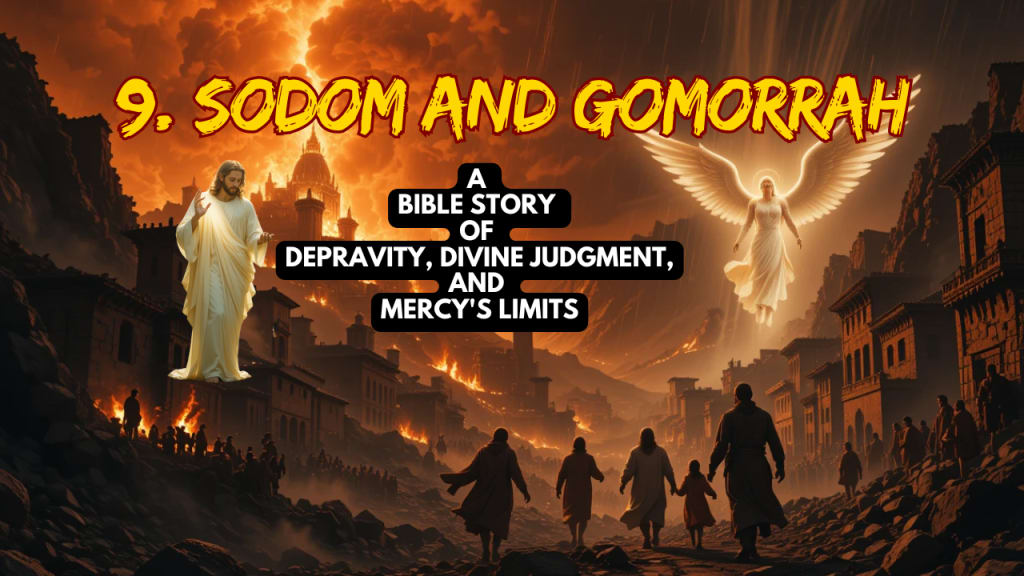
In the ancient Near East, nestled in the fertile plain of the Jordan, lay two cities whose names would forever be synonymous with profound wickedness and divine retribution: Sodom and Gomorrah. These cities, along with Admah, Zeboiim, and Bela (which was later called Zoar), formed a pentapolis, a cluster of settlements that thrived in a region described as being "like the garden of the Lord, like the land of Egypt," well-watered and prosperous. It was to this seemingly idyllic region that Lot, the nephew of Abraham, had chosen to settle after he and Abraham separated due to their growing possessions and the quarrels between their herdsmen. Lot, surveying the land, had seen the lush plains and the apparent prosperity of these cities and had pitched his tents near Sodom. Little did he know the depth of the depravity that festered within their walls.
The Bible states unequivocally that "the people of Sodom were wicked and were sinning greatly against the Lord." Their sins were not merely minor transgressions but a pervasive moral corruption that had reached the very heavens. Their reputation for egregious iniquity had spread far and wide, a stench in the nostrils of the Almighty. The specific nature of their wickedness is often debated, but the narrative clearly points to a profound lack of hospitality, a violent disregard for strangers, and a pervasive atmosphere of sexual perversion and injustice, particularly against the vulnerable. They were proud, arrogant, and had no regard for the poor and needy, living in luxurious abundance while others suffered.
One day, as Abraham sat at the entrance to his tent in the heat of the day, three men appeared before him. He, being a man of great hospitality, immediately ran to meet them, bowed low to the ground, and urged them to rest under a tree while he prepared a meal. He instructed Sarai to quickly knead flour and make bread, and he himself ran to the herd to select a tender calf for his servant to prepare. As they ate, one of the men, who was the Lord Himself, revealed that Sarai would have a son in her old age. After this miraculous announcement, the men rose to leave, setting their faces toward Sodom.
As they walked, the Lord confided in Abraham, "Shall I hide from Abraham what I am about to do? Abraham will surely become a great and powerful nation, and all nations on earth will be blessed through him. For I have chosen him, so that he may instruct his children and his household after him to keep the way of the Lord by doing what is right and just, so that the Lord may bring about for Abraham what he has promised him." Then the Lord declared, "The outcry against Sodom and Gomorrah is so great and their sin so grievous that I will go down and see if what they have done is as bad as the outcry that has reached me. If not, I will know."
Abraham, a man of profound faith and a friend of God, was deeply troubled by this news. He knew that his nephew Lot lived in Sodom. He approached the Lord, standing before Him, and began to intercede, displaying an incredible boldness and compassion. "Will you really sweep away the righteous with the wicked? What if there are fifty righteous people in the city? Will you really sweep it away and not spare the place for the sake of the fifty righteous people in it? Far be it from you to do such a thing—to kill the righteous with the wicked, treating righteous and wicked alike. Far be it from you! Will not the Judge of all the earth do right?"
The Lord, in His infinite patience and mercy, replied, "If I find fifty righteous people in the city of Sodom, I will spare the whole place for their sake."
But Abraham, emboldened, continued to plead, gradually lowering the number: "What if the number of righteous is forty-five?… forty?… thirty?… twenty?… ten?" Each time, the Lord assented, promising to spare the city for the sake of even that small number of righteous individuals. This remarkable dialogue highlights God's justice, His willingness to listen to human intercession, and the incredible value He places on even a handful of righteous souls. However, it also foreshadowed the grim reality that even ten righteous people could not be found in the entire city.
As the Lord departed, the two angels who had been with Him continued their journey to Sodom. They arrived in the evening, and Lot was sitting in the gateway of the city, a place where public affairs were conducted. When he saw them, he rose to meet them, bowed down with his face to the ground, and urged them, "My lords, please turn aside to your servant’s house. You can wash your feet and spend the night and then go on your way early in the morning." The angels initially declined, saying they would spend the night in the square, but Lot insisted so strongly that they finally agreed and went to his house. He prepared a meal for them, including unleavened bread, and they ate.
Before they had even gone to bed, the men of Sodom, from every part of the city—both young and old—surrounded the house. They called out to Lot, demanding, "Where are the men who came to you tonight? Bring them out to us so that we can have sex with them." This chilling demand revealed the depth of their moral depravity and their violent disregard for the sacred laws of hospitality and human dignity.
Lot, desperate to protect his guests, went outside to them, closing the door behind him. He pleaded, "No, my friends. Don’t do this wicked thing! Look, I have two daughters who have never slept with a man. Let me bring them out to you, and you can do what you like with them. But don’t do anything to these men, for they have come under the protection of my roof." This offer, though horrifying to modern sensibilities, was a desperate attempt by Lot to uphold the paramount ancient law of hospitality, even at immense personal cost.
But the men of Sodom scoffed at him, yelling, "Get out of our way! This fellow came here as a foreigner, and now he wants to play the judge! We’ll treat you worse than them!" They pressed in on Lot, trying to break down the door. Seeing Lot's peril, the two angels reached out, pulled Lot back into the house, and shut the door. Then they struck the men who were at the entrance of the house with blindness, from the least to the greatest, so that they wore themselves out trying to find the door.
With the mob temporarily incapacitated, the angels revealed their true purpose to Lot. "Do you have anyone else here—sons-in-law, sons or daughters, or anyone else in the city who belongs to you? Get them out of here, because we are going to destroy this place. The outcry to the Lord against its people is so great that he has sent us to destroy it."
Lot immediately went out and spoke to his prospective sons-in-law, urging them, "Get up! Leave this place, because the Lord is about to destroy this city!" But they thought he was joking and refused to believe him.
As dawn broke, the angels urged Lot again, "Hurry! Take your wife and your two daughters who are here, or you will be swept away when the city is punished." When Lot still hesitated, perhaps clinging to the last vestiges of his life in Sodom, the men grasped his hand and the hands of his wife and his two daughters, and led them safely out of the city, for the Lord was merciful to him.
Once outside, one of the angels commanded, "Flee for your lives! Don’t look back, and don’t stop anywhere in the plain! Flee to the mountains or you will be swept away!" Lot, however, pleaded to be allowed to flee to the small town of Zoar, which was nearby. The angel granted his request, saying, "Very well, I will grant this request too; I will not overthrow the town you speak of. But flee there quickly, because I cannot do anything until you reach it."
As Lot and his family finally entered Zoar, the sun had risen over the land. Then, the Lord rained down burning sulfur on Sodom and Gomorrah—from the Lord out of the heavens. Thus He overthrew those cities and the entire plain, destroying all those living in the cities—and also the vegetation in the land. The prosperous plain was consumed by fire and brimstone, leaving behind a desolate wasteland.
But Lot's wife, unable to resist the urge, looked back from behind him. Perhaps it was a longing for her home, her possessions, or the life she was leaving behind. For her disobedience, she was instantly turned into a pillar of salt, a stark and chilling monument to the consequences of looking back on a life God had commanded one to abandon.
Lot and his two daughters, now alone, feared to remain in Zoar and eventually went up and settled in the mountains, living in a cave. This tragic aftermath, including the subsequent actions of Lot's daughters, further underscores the profound devastation wrought by the judgment upon Sodom and Gomorrah.
The story of Sodom and Gomorrah stands as a powerful testament to God's justice against pervasive wickedness and His unwavering commitment to His covenant with Abraham. It serves as a stark warning against unchecked depravity, a reminder of the consequences of rejecting divine commands, and a poignant illustration of the limits of mercy when a society's sin reaches its full measure. Yet, it also highlights God's compassion for the righteous, His willingness to spare for the sake of a few, and His provision for escape for those who heed His warnings.
About the Creator
David Andrews
Hi, I'm David A., I'm excited to explore topics that inspire, inform, and engage readers across different genres. I bring a blend of curiosity and creativity to my writing journey here on Vocal Media.
Keep reading
More stories from David Andrews and writers in Humans and other communities.
8. The Birth of Isaac: A Bible Story of God’s Promise Fulfilled
In the ancient land of Canaan, around 1900 BC, an elderly couple named Abraham and Sarah lived as nomads, dwelling in tents among the oaks of Mamre. Their story, found in the Book of Genesis (18:1-15, 21:1-7), tells of the miraculous birth of their son Isaac, a child born through God’s promise despite all human odds. This event, a cornerstone of biblical history, showcases God’s faithfulness, the power of faith, and the joy of seeing God’s word come to life, a story that continues to inspire hope across generations.
By David Andrews8 months ago in Humans
Why I No Longer Sell on Amazon
When I published my first book in 2011, I used Lulu. At the time, it was one of the few print-on-demand options that allowed authors to retain control over content, pricing, and distribution. Over the years, I explored other publishing routes, including limited digital placement on Amazon Kindle, but I remained consistent with Lulu for physical books. As of this writing, I am still evaluating whether those remaining Kindle titles will stay available.
By Dr. Mozelle Martin4 days ago in Humans




Comments (1)
Lot's choice to settle near Sodom shows how appearances can be deceiving. The cities seemed prosperous but were deeply corrupt. It makes me wonder what made him overlook the signs. Also, Abraham's extreme hospitality stands out. How often do we go out of our way like that for strangers today?