
6 Interesting Short Stories That Could Change the Way You Think
In this post, we’re listing some of the most interesting short stories that will challenge how you think or feel.


1. "Harrison Bergeron" by Kurt Vonnegut
First published in 1961, Vonnegut’s satirical story imagines a future in which America’s quest for egalitarianism has resulted in laws preventing anyone from being “better than average.” Our title character is born strong, handsome and intelligent — and in order to make him equal to others, he is given golf-style “handicaps.” He has to wear glasses that make it hard for him to see (and that give him headaches). He has to wear weighted clothes and a rubber mask to counteract his strength and good looks.
The US Declaration of Independence states as a self-evident truth that “all Men are created equal,” but in Vonnegut’s story, that idea is extrapolated to an absurd degree — offering some answers that may be uncomfortable to us.

2. "Story of Your Life" by Ted Chiang
Better known as the basis for the film Arrival, this award-winning story from Ted Chiang is, in the best way possible, Independence Day for grown-ups. It’s narrated by Louise Banks, a linguist tasked with communicating with aliens who have arrived on Earth. As the story progresses, we learn that the aliens don’t experience time sequentially (one event at a time) but all at once — they are as aware of the future as they are of the present. This insight forces Louise to face some heavy questions, such as: if there are creatures who already know the future, what does that mean for free will?

3. "Other People" by Neil Gaima
This fan favorite from the American Gods author takes its title from Sartre’s No Exit — a play set in an afterlife where three strangers are trapped in a room together. Over the course of their increasingly antagonistic interaction, they discover that “hell is other people.” Gaiman’s short story gives this concept a sharp twist and focuses on the idea of guilt and punishment, presenting only two characters: a man and his mysterious, demonic torturer.
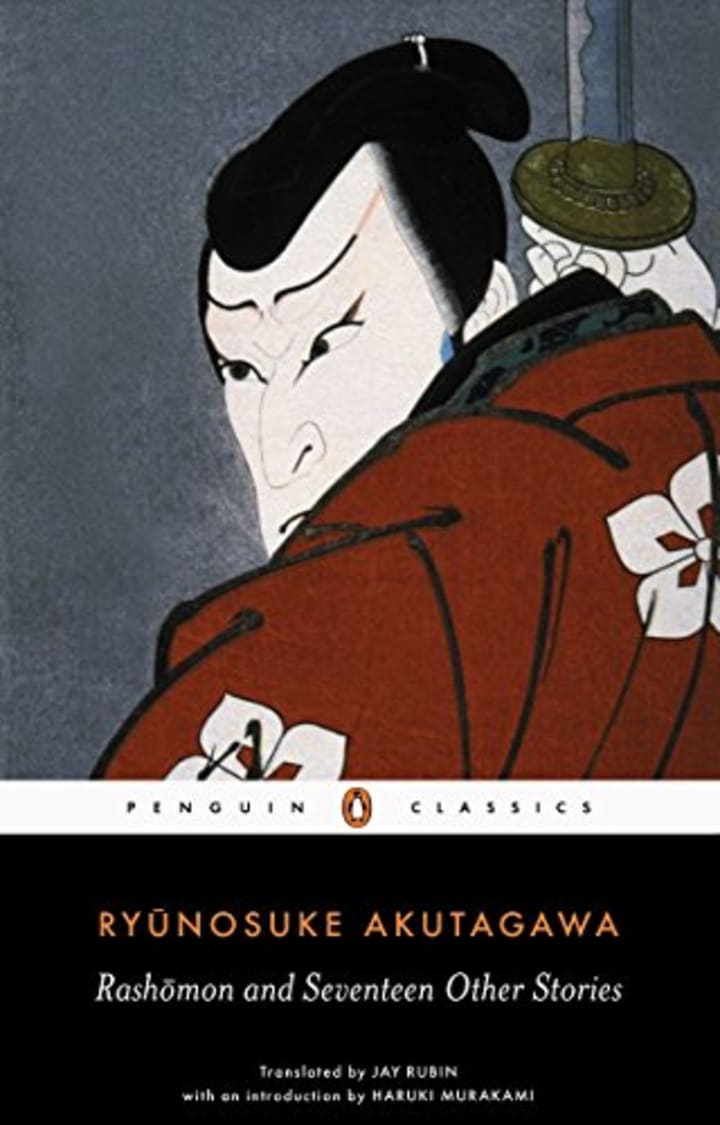
4. "In a Grove" by Ryūnosuke Akutagaw
A samurai has been found murdered in a bamboo grove. So opens the best-known work from Japan’s undisputed master of the short story (the country’s leading literary prize is named after him, don’t ya know?). Through three conflicting witness accounts — from a woodcutter, a bounty hunter, and an old woman — the story raises the important question of subjectivity when it comes to how we perceive truth.
Akira Kurosawa’s 1950 film adaptation, Rashomon, has since become a byword for stories told by multiple unreliable narrators — but this is the story that started it all. Now the very device of retelling a story from multiple perspectives has become a trope in its own right, appearing in just about every cop show under the sun.

5. "Gooseberries" by Anton Chekhov
No list of short stories would be complete without an entry from the Russian master. In “Gooseberries,” which acclaimed short story writer (and Booker-winning novelist) George Saunders cites as a personal favorite, two friends on a hunting trip get rained on and take refuge at a friend’s house. One of the men, Ivan, relates in disgust how his brother’s lifelong dream was to own a small estate and eat the gooseberries that he would grow outside. Ivan’s anecdote soon devolves into a full-on screed about how the pursuit of personal happiness is selfish and disgusting. And thanks to Chekhov’s skills as a writer, you might find yourself agreeing with Ivan’s points. Not exactly a comfort read.

6. "The Swimmer" by John Cheever
Once called “the Chekhov of the suburbs,” John Cheever’s most compelling works deal with middle-class struggles. He was from a generation that grew up during the Great Depression but matured into America’s post-war boom, with its picket fences, Coupe de Villes, and backyard swimming pools. And it’s those very pools that factor into Cheever’s most famous story.
Ned Merrill is a respected member of his society in an affluent neighborhood. One summer’s day, while lounging by his friend’s pool, he spontaneously decides to get home by passing through every single swimming pool between there and his own house. The story quickly grows surreal and dark. But under the strangeness of the conceit is the fraught connection between wealth and happiness in this classic story of suburban ennui.
***
About the Creator
Keep reading
More stories from Udhay kumar and writers in Humans and other communities.
Autonomy Is The Real Privilege
Good morning, freedom-seekers! Today we’re gonna be looking at autonomy. A strange word, I know; one many would probably look at blankly and run away from on sight. We’re gonna figure out what it actually means, consider how it’s achieved, and decipher just how deeply most of us are tangled up in dependence without realising it.
By That ‘Freedom’ Guya day ago in Humans
Car Rental Business Requirements
The car rental industry continues to grow as people look for flexible transportation without the cost of ownership. Whether you’re planning to start small or build a large operation, success depends on understanding and meeting the right car rental business requirements from day one.
By Ava Bennetta day ago in Humans
Smart phones, Humans and Aliens.
WARNING. I will be tapping into one of your favorite creative tensions: The absurdity of humans worshipping their glowing rectangles as if they were tiny oracles. There’s something deliciously poetic about that contradiction, and it lends itself beautifully to an instructive proviso.
By Novel Allen6 days ago in Poets




Comments
There are no comments for this story
Be the first to respond and start the conversation.