
4 Habits That Can Lead To Being Deeply Unhappy Your Whole Life
Some psychological glitches and how to fix them

Unpopular opinion: Everyone wants to be happy, but we want to avoid unhappiness more.
In life, it is not always possible to be happy all the time, but to be sad for most of it does not seem so impossible to most of us. I also am not saying that life is easy and people are just dramatic but through all the hardships, sometimes some of our habits can cause us to lead a joyless and deeply unhappy life. That’s why it is important to be aware of this and change these habits with better ones.
Ever since I’ve become aware of this concept, I’ve come to realize that habits affect one’s life quality immensely, and worked on swapping bad habits with good ones. This way I went from accepting that life was the way it was to finding the power in me to change.
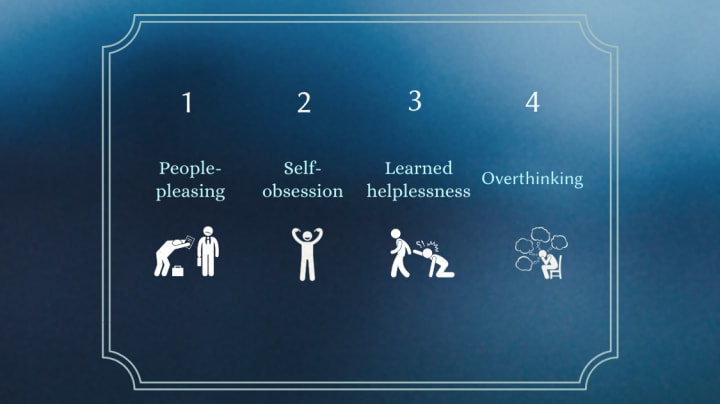
There are 4 habits that can lead to being deeply unhappy your whole life:
1-People-pleasing
2-Self-obsession
3-Learned helplessness
4-Overthinking
“The future is always beginning now.” — Mark Strand
1-People-pleasing
It is hard to tend to your needs when you are running around trying to please everyone else’s wishes. It is a pretty common phrase but you really cannot please everyone, so to accept this task as your life purpose is not really the path to happiness. That’s why this is the kind of mindset that needs to be toned down, if not abandoned fully.
What to instead:
In life, most of the time we act according to our subconscious mind, and when it comes to people-pleasing, it is not so different. After a time our beliefs turn into our way of being, and so putting the needs of others first is not really a conscious choice either. That’s why in order to let go of a people-pleasing way of being, it is important to discover the root cause of this kind of behavior.
Also, sometimes habits can trap us and make us feel like we always have to be a certain way, but it couldn't have been further from the truth. There was a quote once I’ve heard from somewhere that goes as “Reasons come before results.” and so once you have a reason to change, it is always possible for you to transform.
In this case, once you realize that spending your life trying to make everyone happy will never result in you living authentically to who you are, then you can find the strength to change that mindset.
“If you avoid conflict to keep the peace, you start a war inside yourself.” — Cheryl Richardson
2-Self-obsession
Ego is one of the things that make us feel powerful for the short term but in the long run, it is one of the factors that make life and relationships hard for us. This is why differentiating ourselves from anything and everything around us, and focusing on ourselves can result in us feeling like we are looking for what’s benefiting us, but in the long term, this kind of lonely thinking can turn toxic.
When you are only focusing on yourself, and then it starts to feel like the world revolves around you, and although a certain amount of importance is necessary for everyone, this is not the right way to gain that. It is because this way, everything in your life starts to feel bigger than they actually are, and then we forget that we are not even a dot when they take a picture from the moon.
What to instead:
Accepting how small we are is hard at first, yet it is humbling and brings a sense of relief. We are only humans, and this is proof that there is no need to feeling superior or inferior. So in the big picture, knowing that we are a part of something greater than ourselves is important for us to relax a bit and enjoy life.
“Big egos are big shields for lots of empty space.”
— Diana Black
3-Learned helplessness
Feeling helpless is not a rare state to be in, and this is because life can often lock us in a box where nothing appears to work. I’ve been there too, but my perspective has shifted after I discovered that helplessness is a learned condition.
According to American Psychological Association learned helplessness is described as a condition that happens when a person is constantly exposed to a stressful situation where it is out of their control.
One experiment that was done on fleas explains this state even clearer. For the experiment a few fleas were placed in a jar, the fleas quickly jumped out. However, when a glass cover was set over the top, the fleas attempted to hop out but were unable to do so because they collided with the glass cover. The fascinating aspect of this study is that when the lid was removed, fleas continued to hop at the level of the glass. The scientists also added that when the fleas reproduce, the new flea will also copy the behavior of their parents.
In our lives, it may feel harder to observe “human” learned helplessness, yet fundamentally it is no different than this glass cover experiment. Whether it is not being able to get rid of a habit, or accepting limiting beliefs, we may find ourselves learning the helplessness that we adapt.
What to instead:
To avoid learned helplessness, observing your limiting beliefs can be the first step. This is because these limiting beliefs did not appear from day one, and they stuck us along the way, like a piece of gum on the road.
Once these limiting beliefs are observed, they can usually be put into two categories called; fear of failure or negative self-talk.
When it comes to fear of failure, adopting a growth mindset is the antidote for it. This is because by adopting a growth mindset, you can feel free to experience new experiences, and any failures or mistakes that may occur will serve as fuel for your progress, and you’ll be able to benefit from them. This will also affect the relationship with yourself too, because you’ll be kinder, and not automatically judge yourself when you make a mistake.
Secondly, negative self-talk can play a big role when it comes to learned helplessness. According to Therapist Marisa Peer, the words we tell ourselves affect us more than any other word we hear. That’s why instead of fueling our insecurities and limiting beliefs by talking negatively to ourselves, catching this when it happens and rephrasing these words can be helpful.
“Learned helplessness is the giving-up reaction, the quitting response that follows from the belief that whatever you do doesn’t matter.”
— Martin E.P. Seligman
4-Overthinking
Our minds are powerful tools, but just like any power source in this world, there is a good way to use it and a bad. For most of us, I don’t think the times we use it badly are necessarily conscious acts, but we simply do not know how to control this complex potential.
Overthinking is basically being unable to control that and struggling through it. But there is nothing more of a joy thief than over-thinking, and when not worked on fixing it, it can lead to life-long unhappiness.
What to instead:
In my experience, mindfulness is the best solution for overthinking.
When you google the term mindfulness, it is explained as “A mental state achieved by focusing one’s awareness on the present moment, while calmly acknowledging and accepting one’s feelings, thoughts, and bodily sensations, used as a therapeutic technique.”.
There are many techniques to apply when it comes to practicing mindfulness, but the one that I’ve found the most helpful is the senses method. This method suggests focusing on your senses, such as what you are seeing, hearing at the moment. So that you can be wherever you are, and not be in the future or past.
“Thinking too much leads to paralysis by analysis. It’s important to think things through, but many use thinking as a means of avoiding action.”
– Robert Herjavek
Final thoughts
I believe that our desire to avoid unhappiness is stronger than our desire to be happy. That’s why it is important to avoid habits that can lead to unhappiness in long term. In today’s article, we’ve discussed 4 of these habits to learn how to replace them with better ones. The habits to avoid were:
1-People-pleasing
2-Self-obsession
3-Learned helplessness
4-Overthinking
By avoiding these habits and replacing them with better ones, we can increase the quality of our lives drastically.
Thank you for reading.
-E.K.
About the Creator
Keep reading
More stories from writers in Humans and other communities.
Whiskey At Dusk
Guess the whiskey was more important to you in the end, wasn’t it? It was more than the well-being of your friends; more vital than showing up to the places you promised you would and could come to; more critical of a matter than fulfilling your damn responsibilities and getting the press off your back.
By Snarky Lisa5 days ago in Humans


Comments
There are no comments for this story
Be the first to respond and start the conversation.