
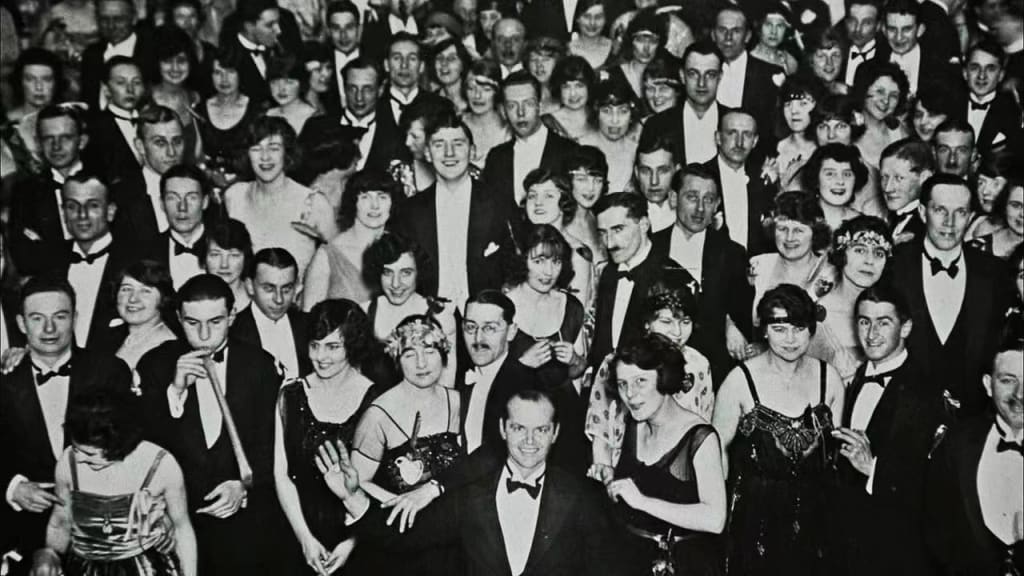
"The Shining" is deservedly one of the most celebrated horror movies in cinema history. For viewers unfamiliar with Stanley Kubrick, it might seem like another gory ghost story: a man in isolation murders own family. But Kubrick doesn't believe in ghosts. His chief interest as a film maker is to showcase realistic themes coated with heavy symbolism. The multi-layered "Shining" isn't an exception!
There are tons upon tons of reviews on The Shining. Obsessed fans allow themselves the liberty to deconstruct it into bits, analyzing each inch of it. You can't blame them as Kubrick is indeed quite meticulous. Interpretations vary; 'Jack is abusive', 'Wendy is manipulative', 'Untrue events", "Danny's dreaming', and the list goes on. Some get caught on little details ("237" being the distance between the Earth and the Moon in thousands of miles. Danny's Apollo-11 sweater. Jack's German-made typewriter) raising whole theories based on them. And while those details are truly significant, they remain from art perspective flawed. Symbolism in art may be depicted through macro and/or micro mediums. Supporting the main theme, either as additions or derivatives, micro element(s) shall not outweigh its macro foundation. That results, if occurring, in artistic disproportion which leads to failure or devaluation.
Kubrick was highly skilled in photography, cinematography, and more importantly for this topic, lighting. The scene where the black cook entering the hotel lobby in silence before Jack ambushes him with an axe was deliberately prolonged to emphasize the victim's agony, Jack's excitement, and Danny's witnessing of the horror-in-mind materializing. Jack then rises triumphantly as if declaring: Welcome to America! This plot symbolizes the United States of America. And the hints to suggest that are plenty. The hotel, vast, beautiful, yet isolated (America). It's built above a burial site for dead natives. Its name? The Overlook Hotel. "Overlook" as in 'ignore' signifying the dismissal of crimes America committed in hope of forming a better new world. "White man's burden," says Jack to Lloyd the bartender. The horned moose head hanging behind Jack while he's staring creepily outside the lounge window. Just to name a few.
Did America manage to create a better world? Kubrick suggests otherwise. Is this movie solely about the genocide of native Americans as single act of violence? Far from it. The horror of past crimes does not haunt the present people only but also turn them into psychopaths resulting in continuous cycle -if not cycles- of violence, one of which is the black cook's death, the blood river reminding us of what's hidden underneath. RedRum = murder. Myriad visual references to native culture scattered throughout the movie, though void of native characters. Jack hitting the ball against a wall covered with native artwork. "Calumet" baking powder cans in the storage locker shown while Danny 'shines' and as Jack promises Mr. Grady to deal with the matter "in the harshest way possible" as the latter puts it, once granted a second chance.
Jack, a typical white man with alcohol-abuse history and physical violence towards wife and son. Probable sexual abuse towards Danny is implied through the creepy bedroom conversation dad and son have, and Jack kissing the beautiful young woman in room "237" before she turns into a rotting old woman (meanwhile Danny appears to have a seizure-like response).
This movie places all characters at equal distance. We the viewers eye them with as much empathy as suspicion. That's how The Shining draws audiences into re-watching it over and over. We all are Jack, Wendy, and Danny. Technically, its captivation is concentrated through the factor of lighting. There is a strong sense of symmetry in the movie. The presence of duality is all over the place; double elevators, double doors, rows facing each other, lights aligned in perfect precision. Even characters might be subtly dual: the dead twins (though hotel manager describes them as 5 and 7 of age) are possibly a reflection of Danny. The black cook seems like a reflection of Danny during their 1-on-1 talk. Wendy, a reflection of Jack (or the other way around). After all, many shots include mirrors which points to psychotic disorders.
Back to the grand reveal – America. Note that ghost-like characters in the movie all speak in British accent; Mr. Grady, Lloyd – the bartender, The man Wendy sees in the hall who utters "great party, isn't it?!". Such characters do not logically fit in, except if we view that as another reference to America; how this newly born nation followed in their British peers' steps, inheriting their method of expansionism through blood spilling.
The Gold Room symbolizes wealth and exploitation. Oil could be a straight reference here. The maze represents self's delusion, deviation, or lunacy. We even see Jack checking the maze model while Wendy and Danny wondering around the actual one, which suggests that the maze, although seemingly a way out of the inner horrors leads back to The Overlook Hotel, and that our madness is collectively intertwined. The scene of blood river flowing from the elevator was MUTED, conveying the massive scale of deliberate atrocities. The captivation continues as if we were inside the frame. Each character seems to be evenly the abuser and the abused. Each grows violent, insane, or both.
But what is really meant by 'shining' in The Shining? The direct narrative suggests certain individuals like Danny and the black cook 'shine' – communicate by telepathy which enables them to see moments from the past or future events. Visually, Kubrick conceptualizes his own 'shining' that doesn't only contrast but also overshadows the original narrative. By excessive use of lighting in most shot scenes Kubrick the artist serves us a forceful, authoritarian yet artificial brightness which obstructs fragments of reality. An excess that requires from whoever absorbing it to embrace its merit, glitter/ beauty. There is enjoyment granted once you accept artificial shining. There is no looking back. No observing allowed. It's a one-way invitation to join this reality of pretense, assuming things are going to be all right simply by walking the path of denial. This is America, the symbol Kubrick communicates to us.
And although we know upon watching something bad is happening, we continue to observe. It's almost a hypnotic feel.
Evidently, Kubrick managed to tick all the boxes in The Shining, from shooting angles, score, cinematography, design, manipulated sounds, acting, to the way he utilized lighting and used shadows, all meticulously done creation.
No matter what 'shining' truly means or how we interpret it, one thing is for sure: Kubrick shone.
About the Creator
Keep reading
More stories from Nader Ghanem and writers in Horror and other communities.
The Manufacturing of Academic Branding – Jordan Peterson An Example
If you think YouTube only attracts attention-seeking outcasts, think twice. Canadian psychiatrist & lecturer, Jordan B. Peterson who taught in Harvard and University of Toronto, is a huge phenomenon over the red platform with millions of followers. Seemingly, Jordan holds the image of an independent thinker who speaks his mind, challenging the status quo at times.
By Nader Ghanem3 years ago in Geeks
Killing him slowly
There’s an intruder in my house again. He stumbles through the door, wet carrier bags in hand. He’s bought me offerings. I show my appreciation, letting him caress my beautiful body. He wants to touch me. I rub myself against his legs. He sighs, dropping the bags. He can’t resist touching me. Running his hand slowly down my spine, I arch my back towards his caress, let out a low purr. It’s what we both need.
By N J Delmas3 days ago in Horror
Enter the Dracula: The Bruce Lee Effect in Hong Kong Vampire Cinema
The Dracula Effect in Hong Kong Cinema: Part I The Bruce Lee Effect In 1973, important factors insure an unholy collaboration between East and West cinema of horror. In England, the end of a successfulbrucelee.jpg run of Hammer films about Dracula and the undead causes producers to look toward Hong Kong at the internationally success of kung fu films. Add the death of the first international Asian action superstar, Bruce Lee in the summer of 1973, and an opening gap was created in international cinema as the search for the next Bruce occurred. "No other figure in Hong Kong cinema has done as much to bring East and West together in a common sharing of culture as Bruce Lee in his short lifetime" (Tao 110).
By SAMURAI SAM AND WILD DRAGONS4 days ago in Horror




Comments
There are no comments for this story
Be the first to respond and start the conversation.