
Whispers of Ash and Flame
A Cinematic Glimpse into the Reaper’s Realm
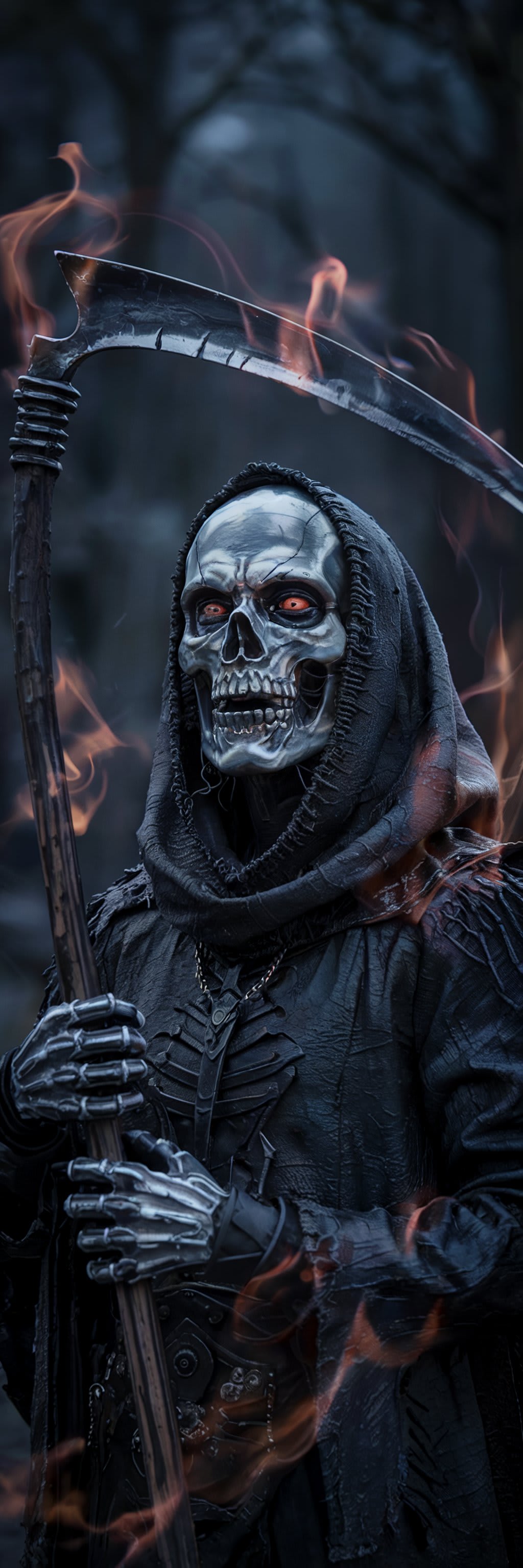
The night was unnaturally still. Not a whisper of wind, not a rustle of leaf. The air had weight, like a storm held in a breath, waiting to be exhaled.
From the shadows of the ruined cathedral, he emerged.
Clad in a robe darker than the void between stars, the Grim Reaper stepped forward, his presence parting the lingering mist that clung to the shattered stones like ghosts reluctant to let go. Each movement was deliberate, like a pendulum’s swing—inevitable, unhurried. Time bowed around him.
His hood, frayed and scorched at the edges, draped over his face like mourning cloth. Yet beneath it, the skull—etched with the scars of eternity—glowed faintly with crimson light. Not warm, not kind, but the glow of smoldering embers that whispered of the pyres of ancient empires and forgotten souls.
His eyes—if they could be called eyes—burned. Two red coals set deep into hollow sockets. They didn’t see in the way mortals understood. They understood. With one gaze, the Reaper could unmake the illusion of permanence. The eyes didn’t ask. They judged.
In his skeletal hands, gripped with the force of inevitability, rested the scythe. Its handle was old wood, almost blackened into stone, with runes carved along its length—ancient names, cursed promises, divine warnings. The blade curved like the crescent moon, but sharper than betrayal. Along its edge danced fire—not wild and free, but restrained, obedient, coiling in slow spirals like it knew its master’s will.
The flames crawled up the edge of the scythe, licking the shadows around him, igniting the tips of his hood. Yet he did not burn. The fire was his. A crown. A weapon. A warning.
He stood at the edge of a battlefield long abandoned. The bones beneath the ash told stories no one cared to hear. Soldiers. Kings. Prophets. All claimed by time, by fate, by him.
A soul approached.
Not walking. Not floating. Just… appearing. A flicker of blue light in the fog, timid, confused. The form of a woman, cloaked in memory. Her voice trembled like a candle in wind.
“Is it… over?”
The Reaper said nothing. He never did. His silence was not emptiness—it was conclusion. No appeal. No negotiation. His presence alone was the final punctuation.
The woman stared at him, eyes widening as recognition dawned. A whisper slipped from her lips, barely audible.
“It’s really you.”
He raised the scythe—not to strike, not in menace. It was simply time. The fire along the blade flared in sudden arcs, and in that light, the woman smiled. Not in joy. Not in fear. But in acceptance.
The blade moved.
No pain. No sound. Just a shimmer in the mist.
And then she was gone.
The Reaper stood still again, the scythe now cold, the fire dormant. Around him, the shadows swirled with new silence. He looked toward the distant horizon, where thunder brewed beyond black hills.
There were more.
Always more.
The fire sparked to life again, crawling up the blade, then dancing along his sleeve like a serpent returning home. His robe billowed though the air remained still. One skeletal foot moved forward, crunching ash beneath it.
In the distance, bells tolled. But there was no one left to ring them.
A Portrait of Death, Rendered in Fire and Shadow
The Grim Reaper is often depicted as a mere symbol—a skeletal figure cloaked in cliché. But in this reimagining, he becomes a cinematic force of elemental power and quiet dominance. Fire does not destroy him; it announces him. Shadows do not conceal him; they follow him like loyal subjects. This is not a caricature of death—it is death personified as majesty and menace.
What makes this version of the Reaper compelling is the interplay of textures and contrasts: the weathered mask of bone against the living dance of flame; the void-black robe absorbing light while his eyes project heat and judgment. The scythe, more than a tool, becomes an artifact—a relic forged in time and tempered by eternity.
The misty, moody atmosphere reinforces the Reaper’s dominion over thresholds. He exists not just in death, but in the space between endings and beginnings. Every element of his presence, from the skeletal hands gripping the scythe with authority to the flames that bend to his will, contributes to a portrayal both haunting and poetic.
Studio lighting and cinematic framing turn this figure into something iconic. Light doesn’t just illuminate him—it sculpts him from the darkness. The flames serve as character and canvas alike, telling their own story in how they bend and curl around him. Every ember that sparks to life reflects the countless lives he has ushered into silence.
In this portrait, the Reaper is not evil. Nor is he merciful. He is simply necessary.
About the Creator
Keep reading
More stories from Abdul Salam and writers in Horror and other communities.
The 6 P.M. Warning
June 2, Southcloud Province, Nanjiang City, Second High School. Three girls were dabbling with a ouija board in their classroom at 10 p.m. at night. Girl A was found dead in her classroom, while the other two girls were found dead in their own homes the next day. Just before she died, the family of the deceased Girl B received a phone call from their daughter, claiming that there was someone in their home. She didn’t know who it was; she had never opened the doors; and the windows were still tightly shut and locked. She had checked every single one of the doors and windows, and she couldn’t see any signs of a person at home. However, she could still clearly hear the sound of ragged breathing coming from behind her.”
By Abdul Salam9 months ago in Art
The Blue Ridge Stalker
Tom had left the Ford down the way, its spark plugs finally exhausted and no mechanics for a dozen miles back through the foothills to Strossburg. No matter, he had worn his boots—almost as if he planned for this to happen. The puzzle he sought to solve emanated from the woods clinging to the slopes above; the valley behind held no mysteries.
By Stephen A. Roddewig3 days ago in Fiction

Comments
There are no comments for this story
Be the first to respond and start the conversation.