
Weather Vane Willie
The Copper Rooster from Hell

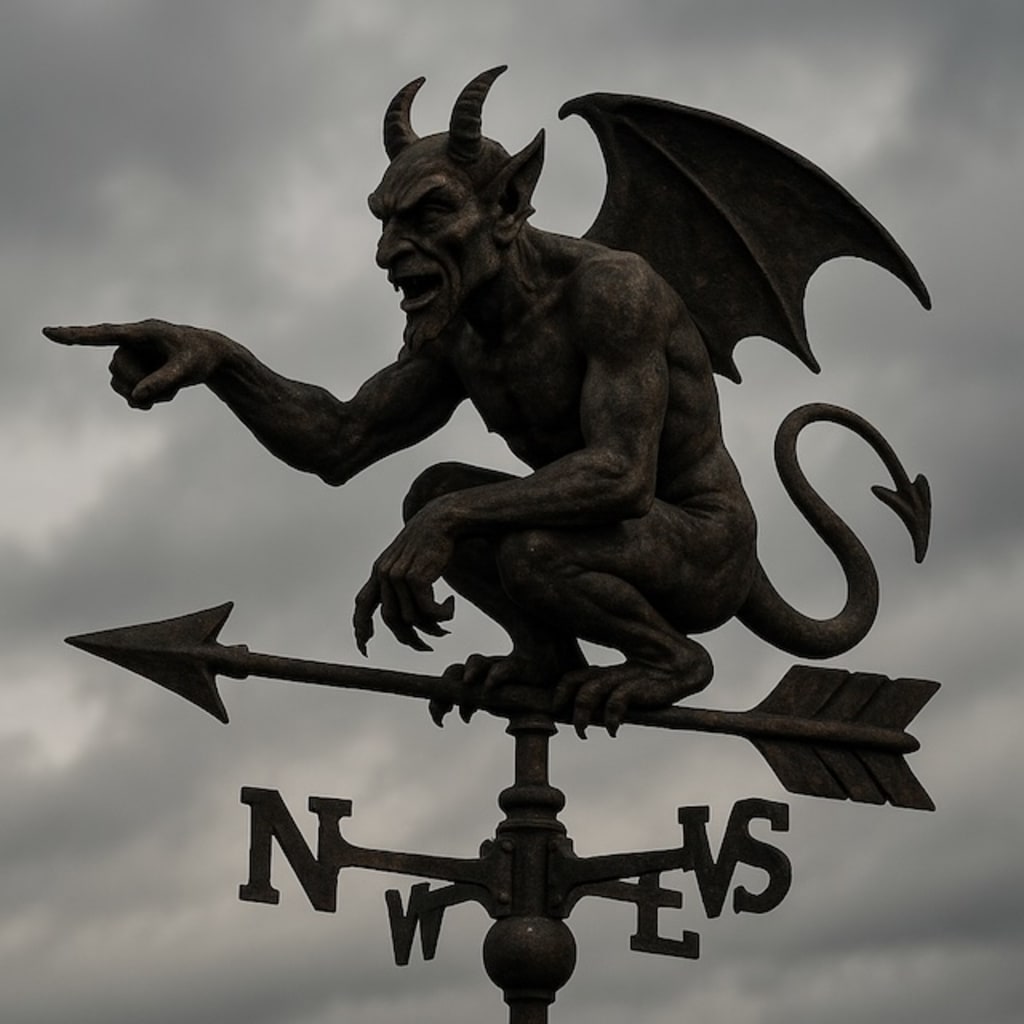
The thing about copper weathervanes is they get downright nasty when they oxidize. Green as goblin snot, as my sister Ellie would say, though she pretends to be a proper lady these days. That particular weather vane — a rooster with its chest puffed out like it owned the whole damn sky — had been perched atop Old Man Thatcher’s barn since before my grandpappy was knee-high to a grasshopper’s disappointing son.
Thatcher called the weathervane “Willie,” like it was a person instead of a hunk of metal that pointed whichever way the wind told it to. You know the type — old farmer who’s spent too many years alone with his corn and his regrets, talking to inanimate objects as if they might answer back.
The day I climbed up to clean Willie was hotter than two rats screwing in a wool sock. Thatcher had hired me for odd jobs around the farm, and apparently, polishing his precious weather vane counted as necessary labor.
“Don’t you go manhandling him,” Thatcher called up from below, his voice cracking like he was going through puberty all over again at seventy-eight. “Willie’s sensitive about his dignity.”
“It’s a hunk of metal, Mr. Thatcher,” I shouted back, already sweating through my shirt. “It doesn’t have feelings.”
The old man scowled like I’d just pissed in his porridge. “Shows what you know, Jeremiah Finch. Some things in this world got more life in ’em than most people.”
I rolled my eyes and got to work with my rag and polish. The copper had gone green in patches, making the rooster look diseased. As I rubbed at a particularly stubborn spot, I swear to God the thing shifted under my hand — not from the wind, but like something flexing a muscle.
I nearly fell off the damn roof.
Storm Warning
Two days later, the sky turned the color of a week-old bruise. The air hung heavy, pressing down on the farm like an invisible thumb. The kind of weather that makes dairy cows stop giving milk and chickens lay eggs with two yolks.
Ellie showed up at Thatcher’s place looking for me, her nurse’s uniform traded for jean shorts and a tank top. She’d been working double shifts at the county hospital and looked exhausted, but still managed to give me shit about my life choices.
“How’s the glamorous career in agricultural maintenance?” she asked, leaning against Thatcher’s ancient Ford tractor.
“Pays better than your job wiping old people’s asses,” I replied, though we both knew she made three times what I did. “What brings you to our little slice of paradise?”
She glanced up at the sky. “Storm’s coming. Bad one. They’re saying it might be the worst in fifty years.”
“That so?” I followed her gaze upward. Above us, Willie the weathervane spun in agitated circles despite the complete lack of wind. “Huh.”
“What’s with the rooster?” Ellie asked. “It’s broken?”
“Just Thatcher’s creepy weathervane having a seizure,” I said. “He calls it Willie.”
Thatcher appeared from the barn, moving with surprising speed for a man whose knees sounded like a bowl of Rice Krispies whenever he walked. “Willie’s warning us,” he said, his rheumy eyes fixed on the spinning copper rooster. “He always knows.”
Ellie shot me a look that said, *Is this old coot serious?*
“Mr. Thatcher thinks Willie’s alive,” I explained. “Has conversations with it and everything.”
“Not ‘it’ — *him*,” Thatcher snapped. “And Willie don’t talk much, but when he does, you’d be a fool not to listen.”
That night, I dreamt of a rooster with teeth like sewing needles, strutting across my chest while I lay paralyzed in bed. *Time’s coming,* it said, in a voice like copper sheets being torn apart. *Time’s coming for a change in the weather.*
Willie’s Whisper
The storm hit at dawn, rain slamming against the windows of Thatcher’s farmhouse like it had a personal vendetta. I’d stayed overnight to help secure the place — at least that’s what I told myself. Truth was, I didn’t much like the idea of driving home with Willie’s beady copper eyes watching me leave.
Thatcher had taken to his bed with one of his “spells,” leaving me to make sure the livestock was squared away. The chickens were huddled together in their coop, looking miserable and judgmental, while the three dairy cows lowed nervously in the barn.
“It’s just a storm,” I told them, feeling like an idiot for reassuring animals who couldn’t understand me. Apparently, Thatcher’s peculiar habits were contagious.
Lightning cracked the sky open, and in the brief, blinding flash, I saw Willie spinning like a mad thing atop the barn. The thunder that followed seemed to say my name — *Jeremiah* — drawn out like a dying breath.
“Fuck this,” I muttered, pulling my rain slicker tighter.
I was halfway back to the house when I heard it — a thin, metallic whisper cutting through the storm’s cacophony.
*Jeremiah Finch. Come up and see me. We need to talk about Thatcher.*
I froze, rain pelting my face. “Who’s there?” I called, feeling like the doomed idiot in every horror movie who investigates the strange noise instead of running in the opposite direction.
Nothing but the howl of wind answered me. I told myself it was just my imagination — too many of Thatcher’s weird stories getting under my skin. But as I reached the porch, I looked back toward the barn and saw Willie had stopped spinning. The copper rooster was now pointing directly at me, despite the wind blowing from the opposite direction.
Attic Wind
I found Ellie sitting at Thatcher’s kitchen table, a mug of coffee clutched between her hands. She’d come by to check on the old man, who was still upstairs “communing with his pillow,” as she put it.
“You look like you’ve seen a ghost,” she said as I dripped all over the linoleum.
“Worse. I think I’m going crazy,” I replied, then told her about Willie’s whisper.
She snorted. “You’ve been spending too much time with Old Man Thatcher. Next thing you know, you’ll be naming the pitchfork and asking the hoe about its feelings.”
“I’m serious, El. Something weird is happening.”
A tremendous crash from upstairs cut off whatever sarcastic response she was about to deliver. We both raced up the stairs to find Thatcher’s bedroom door flung open, the window shattered, and rain pouring in. The old man was nowhere to be seen.
“Mr. Thatcher?” Ellie called, her nurse’s instincts kicking in as she checked under the bed and in the closet.
A creaking sound drew our attention to the ceiling, where a trapdoor to the attic hung open. A wooden ladder had been pulled down.
“He couldn’t have climbed that,” I said. “Man can barely manage the porch steps.”
Ellie gave me a grim look. “Only one way to find out.”
The attic was a museum of dust and forgotten things — old furniture, boxes of yellowed photographs, a rocking horse with one eye missing. The storm sounded louder up here, like we were inside a drum being pounded by angry fists.
A circle of clear space had been maintained in the center of the attic, directly beneath a small round window that looked out toward the barn. Thatcher sat cross-legged in this space, his white hair wild, wearing nothing but a pair of long underwear that had seen better days, possibly during the Nixon administration.
“Mr. Thatcher,” Ellie said gently, approaching him like he was a spooked animal. “Are you okay? You shouldn’t be up here. It’s not safe.”
Thatcher’s head swiveled toward us with a creak that sounded disturbingly like Willie’s pivot point. “He’s angry,” the old man said, his voice oddly flat. “Been angry for years, but now he’s done waiting.”
“Who’s angry?” I asked, though I already knew the answer.
“Willie, of course,” Thatcher replied, as if explaining something to a particularly slow child. “He says it’s time for the clouds to part.”
Eye of the Storm
The center of the storm passed over us around noon, bringing an eerie stillness. The rain stopped, the wind died, and a sickly yellow light filtered through the clouds. We’d managed to get Thatcher back downstairs and into dry clothes, though he kept muttering about promises and debts coming due.
“I think we should take him to the hospital,” Ellie whispered as we watched the old man rock back and forth in his favorite chair. “He might be having some kind of episode.”
I nodded, though something told me Thatcher’s condition was beyond the help of modern medicine. “I’ll get the truck started.”
Outside, the world held its breath. No birds sang, no insects buzzed. Even the windchimes on Thatcher’s porch hung motionless. I looked up at the barn and felt my stomach drop.
Willie was gone.
The weathervane’s mounting rod stood empty against the sky, like a accusatory finger pointing at the heavens.
“El!” I shouted, turning back toward the house. “We’ve got a problem!”
Before she could answer, the front door slammed shut. I ran to it, yanking on the handle, but it wouldn’t budge. Through the window, I could see Ellie pounding on the other side, her mouth open in what must have been a scream I couldn’t hear.
Behind her, Thatcher smiled serenely, then pointed toward the barn.
I turned slowly, already knowing what I’d see but dreading it all the same.
Willie stood in the yard — not a small copper weathervane anymore, but a rooster the size of a pony, its green-tinged body gleaming wetly in the strange light. Its head cocked to one side as it regarded me with eyes like tarnished pennies.
“Hello, Jeremiah Finch,” came that same metallic whisper from before, though the rooster’s beak didn’t move. “We have unfinished business, you and I.”
Demand of the Weather vane
“What the hell are you?” I managed, backing away until I hit the porch steps.
Willie strutted forward, each footstep leaving a small, smoking depression in the mud. *I am the watcher, the warner, the wind-rider,* it said, its voice inside my head like someone dragging a fork across a copper pot. *I have stood guard over this land since before your grandfather’s grandfather was born.*
“What do you want?”
*I want what was promised to me.* The rooster’s head swiveled toward the house. *Thatcher knows. He’s always known.*
Through the window, I could see Ellie frantically trying different doors, while Thatcher simply sat in his chair, watching the scene outside with the placid interest of someone viewing a mildly entertaining television program.
*Fifty years ago,* Willie continued, *this farm was failing. Drought had turned the fields to dust. Thatcher was young then, desperate, with a wife heavy with child — your mother, Jeremiah.*
A cold feeling spread through my gut. “My mother? What does she have to do with this?”
*Thatcher came to me, begging for rain. I am old magic, bound to the land. I can influence the weather, for a price.* The rooster’s metallic feathers ruffled. *He offered me his firstborn.*
“That’s bullshit,” I spat. “My mother died in childbirth. She wasn’t sacrificed to some… some weathervane demon.”
*Not sacrificed — promised. But when the time came, Thatcher hid her away. She died bringing you into this world, beyond my reach. So I took what was due me in another way.*
Realization hit me like a physical blow. “You caused the accident. My father’s truck crash.”
Willie made a sound like coins rattling in a jar — laughter. *The debt must be balanced. But still, your line continued. You and your sister lived.*
“And now what? You’ve come to collect us instead?” My fear was rapidly transforming into anger. “Go to hell, you oversized lawn ornament.”
*Not you, Jeremiah Finch. Not your sister.* Willie’s copper eyes gleamed. *I want Thatcher himself. His life for the lives I was denied. Bring him to me, and your debt is cleared.*
The Reckoning
I stumbled back into the house, finding the door suddenly unlocked. Ellie nearly collapsed into my arms.
“Jesus, Jer, what the hell is that thing?” she gasped. “I couldn’t get out, and Thatcher just sat there — “
“Where is he now?” I interrupted, scanning the living room.
“Kitchen, I think. Jeremiah, what’s happening?”
I gave her the abbreviated version as we moved through the house, searching for Thatcher. Surprisingly, she didn’t question the existence of an ancient weather-controlling rooster demon. Growing up in a small town where the most exciting event was the annual tractor pull probably prepared us for accepting weird shit better than most people.
We found Thatcher in the kitchen, calmly making a sandwich like there wasn’t a supernatural showdown happening in his front yard.
“You sold out our mother to a weathervane,” I said flatly.
Thatcher didn’t look up from his mayo spreading. “Your mother was already gone by then. The bargain was for you and your sister, but I couldn’t let him take you. Not after losing her.”
“So you let him kill our father instead?” Ellie’s voice shook.
“I didn’t know he would do that,” Thatcher protested, finally meeting our eyes. “I thought I’d outwitted him. But Willie… he always finds a way to collect.”
“And now he wants you,” I said.
Thatcher nodded, a strange peace settling over his lined face. “Been running from it for years. But the debt’s gotta be paid, one way or another. That’s how these things work.”
“These things?” Ellie echoed. “How many demonic weathervanes are there?”
“More old magic in the world than you’d think,” Thatcher said, setting down his knife. “Especially in forgotten places like this.”
A deafening screech from outside rattled the windows. Willie was getting impatient.
“I can’t let you sacrifice yourself,” I said, surprising myself with how much I meant it. Despite everything, Thatcher was the closest thing to family we had left.
The old man smiled, looking younger somehow. “Who said anything about sacrifice? I’ve got one more trick up my sleeve.” He reached into his pocket and pulled out a small copper feather, green with age. “Took this from Willie years ago, when I first put him up. Part of him, see? Gives me a bit of leverage.”
“What are you going to do?” Ellie asked.
Thatcher headed for the door. “Make a counter-offer.”
Calm After the Storm
The second half of the storm was nothing compared to the first — just a gentle rain that washed away the evidence of Willie’s brief corporeal visit. By sunset, even that had stopped, leaving behind a world scrubbed clean and a spectacular double rainbow that arced over Thatcher’s farm.
Ellie and I sat on the porch steps, too mentally exhausted to do much besides sip the beers we’d found in Thatcher’s fridge.
“So,” Ellie finally said, “our grandfather made a deal with a weather demon.”
“Apparently.”
“And now he’s… what? Become the new weather vane?”
I glanced toward the barn, where Willie once again perched on his rod. Except now, the copper rooster had a companion — a smaller weather vane in the shape of an old man, pointing in the opposite direction.
“Thatcher said something about balance,” I replied. “I think he figured out that Willie couldn’t exist without something to counter him. Equal and opposite forces, or some mystical bullshit like that.”
“And the storm?”
“Won’t be the last. But I think they’ll keep each other in check now.” I took another swig of beer. “Thatcher said we should stay on and run the farm. Said it’s ours now, since it would have been Mom’s anyway.”
Ellie snorted. “I’m not quitting my job to become a farmer.”
“Me neither. But maybe we keep the place, come out on weekends. Make sure the balance holds.”
Above us, the weathervanes creaked as they shifted in the light evening breeze — the rooster and the old man, eternally opposed, eternally connected. From certain angles, if you squinted, you might think they were dancing.
“You know what the weirdest part is?” Ellie said after a while.
“Weirder than a demonic weathervane trying to collect on a supernatural debt?”
“Yeah.” She pointed toward the barn. “I swear I can hear them arguing up there. Bickering like an old married couple.”
I listened, and sure enough, beneath the normal sounds of a farm in the evening, there was the faint metallic whisper of two voices — one sharp and imperious, the other creaky but stubborn — engaged in what sounded suspiciously like a debate over whether the corn needed more rain or more sun.
“Well,” I said, raising my beer in a toast to the weather vanes, “at least they’re keeping busy.”
Ellie clinked her bottle against mine. “To Willie and Thatcher,” she said. “May they spin in opposite directions for eternity.”
“And may they keep their weird magical weather bullshit far away from us,” I added.
The sun dipped below the horizon, painting the sky in colors no artist could capture. A soft wind rustled through the fields, carrying the distant sound of metallic laughter.
About the Creator
Silence Do Good
I ain't no Ben Franklin and I ain't no Stephen King but I love to write and I love to read
Keep reading
More stories from writers in Horror and other communities.
Killing him slowly
There’s an intruder in my house again. He stumbles through the door, wet carrier bags in hand. He’s bought me offerings. I show my appreciation, letting him caress my beautiful body. He wants to touch me. I rub myself against his legs. He sighs, dropping the bags. He can’t resist touching me. Running his hand slowly down my spine, I arch my back towards his caress, let out a low purr. It’s what we both need.
By N J Delmas6 days ago in Horror
Reasons I (and everyone else) Would Be Burned As A Witch
The events in Salem were but one chapter in a long story of people being hunted, tried and killed for acts of witchcraft. Although, arguably the most famous, the Salem Witch Trials occurred late in the sequence, with hunts and executions beginning in Europe, around 1330.
By Loey Buiskool7 days ago in Horror
A Letter to the Firestarter
Dear Firestarter, We can all see you, we've been watching you since you began. In case you didn't know we were here before you and we will be here after. We witnessed your rise, your setbacks, your guilt and your lies. We witnessed you start the fire.
By Donny Foley4 days ago in Poets


Comments
There are no comments for this story
Be the first to respond and start the conversation.