
Vivisepulture: Or, To Be Buried Alive
"The Premature Burial" by Edgar Allan Poe (1844)

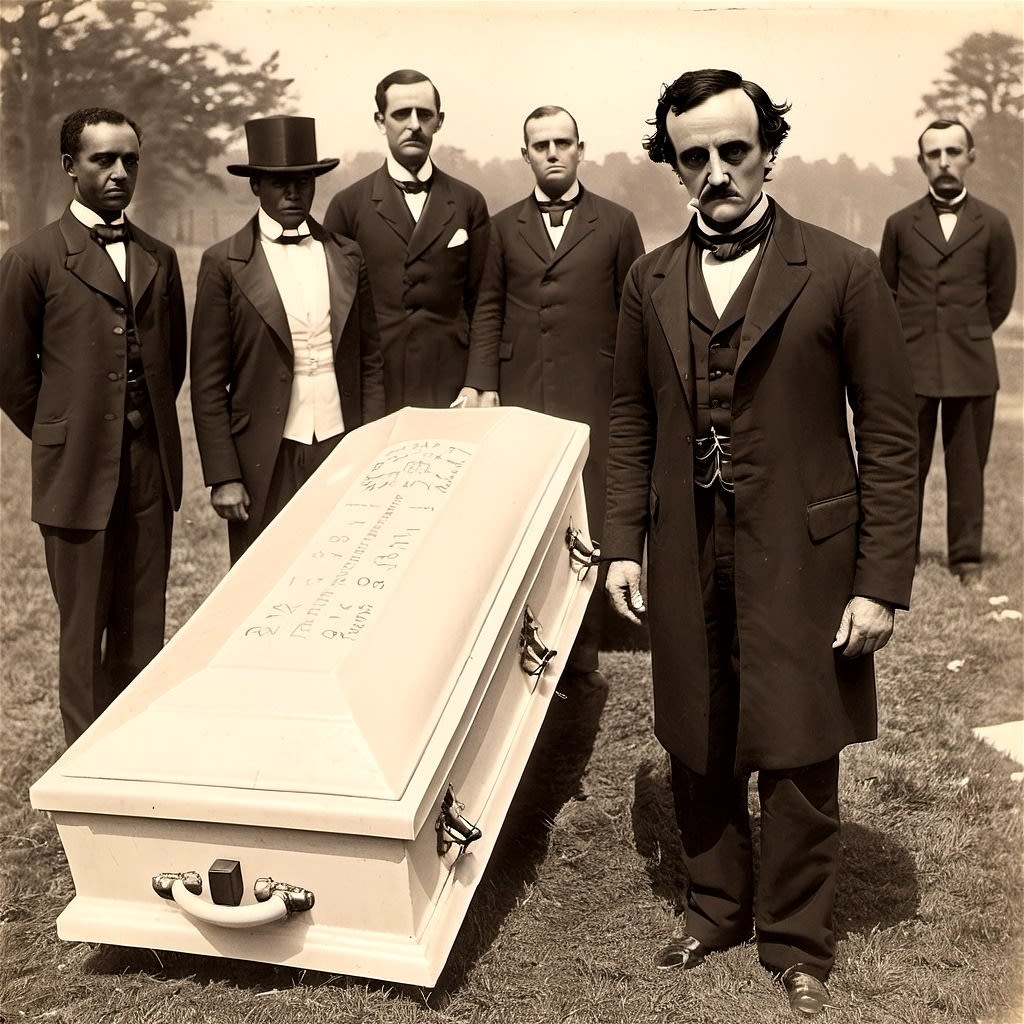
Fearful indeed the suspicion -- but more fearful the doom! It may be asserted, without hesitation, that no event is so terribly well adapted to inspire the supremeness of bodily and of mental distress, as is burial before death. The unendurable oppression of the lungs -- the stifling fumes from the damp earth -- the clinging to the death garments -- the rigid embrace of the narrow house -- the blackness of the absolute Night -- the silence like a sea that overwhelms -- the unseen but palpable presence of the Conqueror Worm -- these things, with the thoughts of the air and grass above, with memory of dear friends who would fly to save us if but informed of our fate, and with consciousness that of this fate they can never be informed -- that our hopeless portion is that of the really dead -- these considerations, I say, carry into the heart, which still palpitates, a degree of appalling and intolerable horror from which the most daring imagination must recoil. We know of nothing so agonizing upon Earth -- we can dream of nothing half so hideous in the realms of the nethermost Hell.
"The Premature Burial." Edgar Allan Poe
Life is a horrible illusion. We wander about in a haze of programmed responses, certain that every moment of our lives is invested with meaning, with purpose, and that somehow, we're protected by an invisible heat shield against the ever-present reality that our lives, as we know them, could end AT ANY MOMENT. When it happens, we will disappear from this "world" we've always known in the blink of an eye, and the light will grow not just dark, but be permanently extinguished. Or so we assume.
Some have been buried alive. That is the fate awaiting some, even today, in the modern world where we are assured that technology, and most especially embalming, have rendered such fears meaningless. Some have been interred in their caskets and buried in the deep, black, worm-besotted earth, half-dead, just waiting to emerge from their unrestful slumber to a new and hideous horror, a horror of the black suffocation of the pine box, the choking dust, the hideous, stifling terror of the depth, the hopelessness and doom of their new situation. Caskets from long ago unearthed show that cadavers have seemingly scraped at the lids of their coffins, reached up to pull out their hair and even turned about-face in mind-numbing, brain-cracking terror at their fatal predicament. Perhaps this is the Hell foretold, so long ago. It is perhaps not a place of fire, but a dark, confining prison box that may serve as a living (living?) allegory of the existential futility of earthly affairs.
Poe's "Premature Burial" is a small meditation upon this theme of fear, this staring down into the depths of death, this clutching at ultimate terror, feeling the bone hand of the skeleton grasp at our throats. It begins with anecdotal evidence that such inhumations exist, giving case histories of the poor, unfortunate souls so fated to live out their second death, their last conscious moments, struggling, in the hot confines of the box, with the realization that they are doomed. A woman is put too soon into her crypt. Coming alive again, briefly, she attempts to force the door with a shattered piece of her coffin. Failing this, her shroud becomes entangled in some protruding ironwork, and she dies sitting up on the stairway leading down to the charnel gulfs below.
The "luxuriant tresses" of Madame Lafourcade are the subject of Poe's second anecdote, wherein her lover (she runs away from her aristocratic husband to be with him) the poor journalist Bossuet, opens her grave to retrieve them. He finds she has been interred alive, and, taking her back to his lodgings, manages to revive her. Together they flee France for twenty years (who wouldn't?), and, upon returning, a magistrate declares her marriage officially null and void due to her strange circumstances. The lovers, presumably, die together happily, the Mrs. dying and being buried a second time. She may have realized at the end, that, like all of us, she was meeting death again, a second time, still alone.
An anecdote is then given of a man who, having a "galvanic battery" applied to him while on the dissection table, comes to life again before his autopsy, recalling Shelley's Frankenstein. Revivified, he comes back from beyond asserting that he was conscious through the ordeal of being declared dead, cognizant of events occurring around him, moment by moment.
Poe then proceeds from the language of dry detachment to relating a more personal narrative, the unnamed narrator's account of being a cataleptic, given to swooning into unconsciousness, episodes mimicking death, causing vast perturbation among his friends and associates, who are admonished not to inter him prematurely but to positively assess that, indeed, was he to give off the otherwise appearance of being dead, that it was indeed an accomplished fact and not a mere symptom of his periodic fits. So morbidly terrified of this singular and cruel fate did he become, so fixated on the utterly horrific prospect of being put up in his crypt while still possessed of conscious existence (albeit, in a temporarily subsumed state) was he, that he had a tomb the construction of which was partly owing to morbid and mad ingenuity, and partly to the fancies of obsessive nature of macabre and horrific legendry.
The Victorians, obsessed with the fear of premature burial, had a device for the ability of a prematurely interred person to, upon awakening, pull a length of rope or cord and ring a bell situated above ground; thus alerting an ever-present watchman at a vigil that it were, indeed, time to call for a shovel and spade. Our Nameless Narrator takes matters further, allowing for the creation of a sepulcher wherein he can easily escape, one equipped with food, drink, a breakaway coffin, a door that can be easily opened, and a long rope attached to a bell to alert the night watchman. In his terror at the idea of falling into a swoon that sees him prematurely interred, he's thought of everything.
All the World's a Grave
A vision of the world's graves being thrown open, revealing those many who are unlucky enough to be put into their tombs while still possessed of life, accosts him during slumber, telling him:
"I was mortal, but am fiend. I was merciless, but am pitiful. Thou dost feel that I shudder.—My teeth chatter as I speak, yet it is not with the chilliness of the night—of the night without end. But this hideousness is insufferable. How canst thou tranquilly sleep? I cannot rest for the cry of these great agonies. These sights are more than I can bear. Get thee up! Come with me into the outer Night, and let me unfold to thee the graves. Is not this a spectacle of woe?—Behold!"
Poe elaborates, morbidly, on the phosphorescent "death light," of the sound of their rustling grave garments--curiously, he seems to say nothing about the miasmal funk of decay itself.
The singularity of his vision of 'world decay" is the forerunner to his experience wherein from a vantage point of utter darkness, and gradually coming around to a sense of consciousness, he realizes that he has, indeed, much as Job, had the very "thing he feared the most come upon him." He writhes in darkness, searching out the levers that might open the specially constructed casket, or to find the rope that would pull the bell and, perhaps, alert those who may be listening for just such an occurrence, in the cold, dust-choked confines of the boneyard above. Alas! he can find no such accouterments of salvation; instead, he assumes, he has fallen into a cataleptic trance whilst among strangers and has been deposited unceremoniously in the common grave.
He loses his mind, such as it is, and is relieved of his mortal terror by several voices annoyed at his outburst. He then remembers that he is simply aboard a derelict boat, sleeping in the upper berth (a contained, box-like unit aboard an old sailing vessel), and that he and a friend took refuge here to ride out a storm.
He confesses that, after this, his morbid fascination left him. One supposes he confessed a lie. The story itself posits that, right at the beginning, it is only the individual experience of those sufferers upon the cusp of the tragedy of life and its inexorable end that can be fully appreciated; not, as it were, the death of many, many souls at once. Nothing could be more personal to the human sense of self, after all, than death; and what of waking up in the grave? All horror is experienced only egoistically, and in that last, final nightmare, we find that we indeed should be reduced to a clawing gibbering idiot, scratching at the hard, unyielding surface of our torment, above.
My friend and co-author Jon, who is dead now, once told me a joke.
"Do you know what Marilyn Monroe would be doing if she were alive today?" he asked.
"No," I replied.
"Clawing at the lid of her coffin."
Comedy and Tragedy, the Twin Masks.
The Premature Burial - Edgar Allen Poe
Connect with me on Facebook
About the Creator
Tom Baker
Author of Haunted Indianapolis, Indiana Ghost Folklore, Midwest Maniacs, Midwest UFOs and Beyond, Scary Urban Legends, 50 Famous Fables and Folk Tales, and Notorious Crimes of the Upper Midwest.: http://tombakerbooks.weebly.com
REVIEW - The Sanguine (Directed by Patrick McNerney and Daniel Jones)
This excellent film, produced and directed by Patrick McNerney and Daniel Jones (with the latter also writing and taking an on-screen role as The Elder) blends folklore with fantasy, creating a suspenseful and scary short.
By MegaFlix Movie Awards2 days ago in Horror


Comments (1)
A fantastic and unique perspective!