
VERSUS!: Grindhouse Grindage!
Cannibal Holocaust vs Cannibal Ferox


VERSUS! is an editorial column where remakes, originals, films of similar genres, etc. are placed in a face-off to see who did it best, major differences, as well as what we preferred!

Cannibal Holocaust may be one of the most infamous films in horror history. Director Ruggero Deodato found himself mired in controversy due to its shocking content. The film has been dissected and discussed endlessly since its release in 1980. Cannibal Holocaust did not just push boundaries in violence and visuals. With its release Deodato gave life to the found footage film. The influence of this movie echoes through the decades.
While Cannibal Holocaust is probably the most well-known film featuring Amazonian cannibals, it was far from the first. I would even argue that it is not the most extreme example of the subgenre. A film by the originator of the "Cannibal Boom", released shortly after Cannibal Holocaust, may very well hold that title.

Cannibal Ferox was released in 1981. Many say that this film is a rip-off of the Cannibal Holocaust but there is more to it than that. Director Umberto Lenzi was to Amazonian cannibals what Romero is to zombies. His film Man from Deep River started it all. Cannibal Ferox was Lenzi’s way of trying to retake the cannibal throne. From start to finish it is obvious that Lenzi wanted to make his own Cannibal Holocaust and push the limits to new extremes.
Plot Comparison
In the broadest sense, these two films share a plot. Americans go into the Amazon rainforest, mistreat the natives, and are killed for their misdeeds. In the end, the survivors are left to wonder if those of us from the “civilized” world aren’t the real savages. Both films jump back and forth between the action in the Amazon and a subplot in New York. As the saying goes, though, the devil is in the details.

In Cannibal Holocaust, a film crew headed by Alan Yates (Gabriel Yorke) and his girlfriend Faye Daniels (Francesca Ciardi) heads into the Amazon Rainforest to make a documentary. Alan and his crew rape, kill, and generally abuse the natives in order to make the most shocking film possible. They want to showcase the savagery of the Amazonian peoples. In the end, they are all killed by tribesmen and all that is left of them is a few reels of film. This film is taken back to New York and viewed by anthropologist Harold Munroe (Robert Kerman). In the end, he is left to wonder who the true savages are.
In Cannibal Ferox, an anthropology student named Gloria (Lorraine De Selle), her brother, and their friend Pat (Zora Kerova) travel to the rainforest. Gloria hopes to prove once and for all that cannibalism in the Amazon rainforest is a myth. Once there, they meet up with Mike (legendary Italian Splatter Film star Giovanni Lombardo Radice) and Joe (Walter Lucchin).
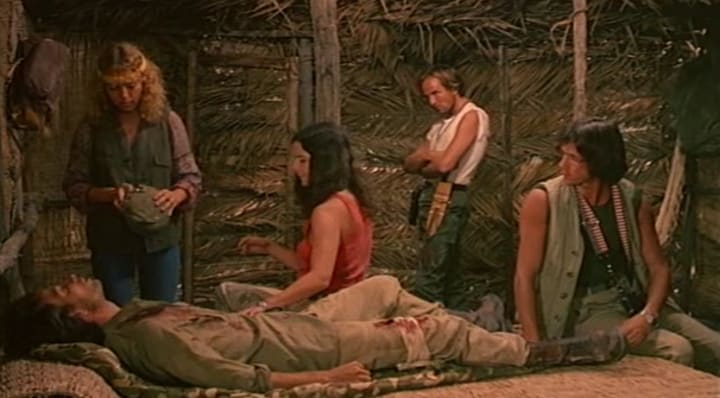
Mike is a sadistic bastard who takes pleasure in the torture and exploitation of the natives. When the tribesmen capture, kill, and cannibalize the interlopers it is his fault. This is a fact that makes his death at the hands of the tribe incredibly satisfying.
In the end, Gloria writes a book called Cannibalism: End of a Myth and completely covers up the entire ordeal. She is awarded her PhD but is left facing the same question as Monroe from Cannibal Holocaust.
Thoughts on Plots
In Cannibal Holocaust, Alan’s film crew is made up of despicable people but at least their reason for entering the Green Inferno makes some kind of sense. They’re going to show the whole world how violent and primitive the indigenous peoples of the Amazon are. This is horrible journalism but it makes sense.
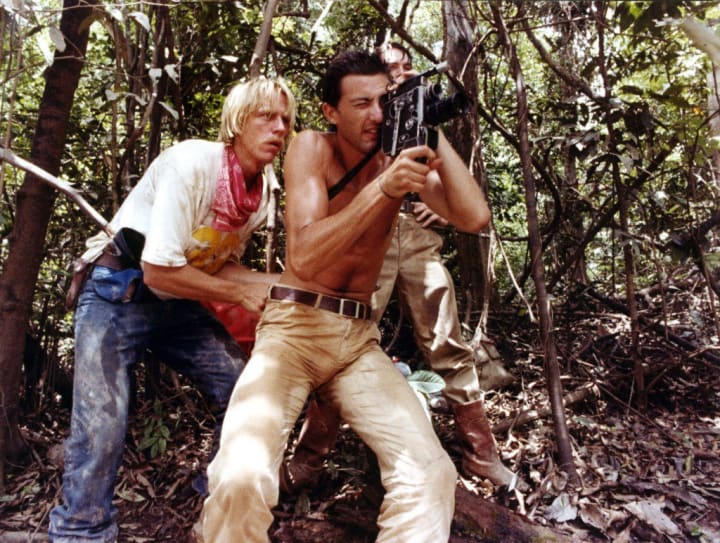
In Ferox, the premise of Gloria’s voyage is just stupid. I don’t understand how three people going into the jungle one time is going to disprove the existence of cannibalism. What makes even less sense is that a doctoral candidate is trying to prove a negative. That’s not how research works. It is impossible to prove that something doesn’t exist and Gloria should have known that.
As far as plot goes, Holocaust blows Ferox out of the piranha-infested water.
Where the Shock Lies
Scenes of rape, cannibalism, and cruelty are common in the both films. The most shocking scenes, however, may be the real deaths depicted on screen. No humans are killed in either film but the animal death toll for each is high. Watching animals die senseless deaths is what truly makes these films so shocking.
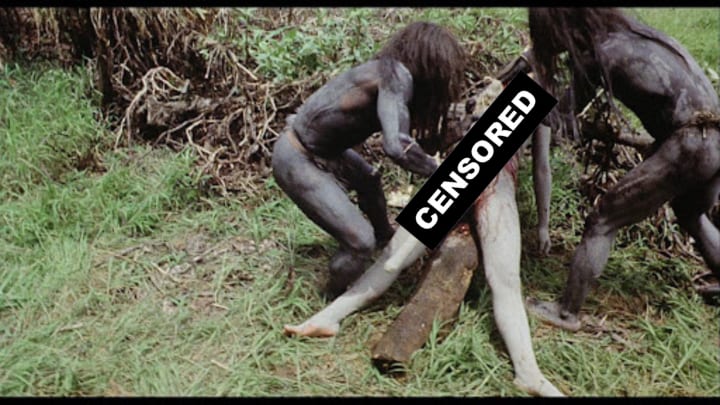
Cannibal Holocaust features six on screen animal deaths. The animals killed include a boa constrictor, a small monkey, and a piglet among others. At one point a huge turtle is killed and its shell is removed to expose its innards. These scenes were enough to cause a storm of controversy and make audiences everywhere uncomfortable.
Cannibal Ferox ups the ante when it comes to animal deaths. Within the first half hour several bugs are killed. Then, a mongoose is tied to a stake so that it can be eaten by a large constrictor. Listening to the mongoose scream as the snake coils around it may well be the most chilling thing in the film. Later a turtle and an alligator are butchered and a small monkey is eaten by a leopard. A piglet dies in this film as well. The difference is that in Cannibal Holocaust it is shot in the head and in Ferox, it is stabbed and dies slowly.
These kills do nothing to move the plot along in either film and were just wedged in for the sake of shock. The increased number of animal casualties and the cruelty with which they are killed make Cannibal Ferox tougher to get through than Cannibal Holocaust.
Visuals
Both of these films hold up surprisingly well. The cinematography walks the line between gorgeous nature shots and gritty depictions of death and cruelty. The practical effects and gore hold up well in both films as well. There isn’t much difference in those areas; the real difference comes from each film’s iconic kills.
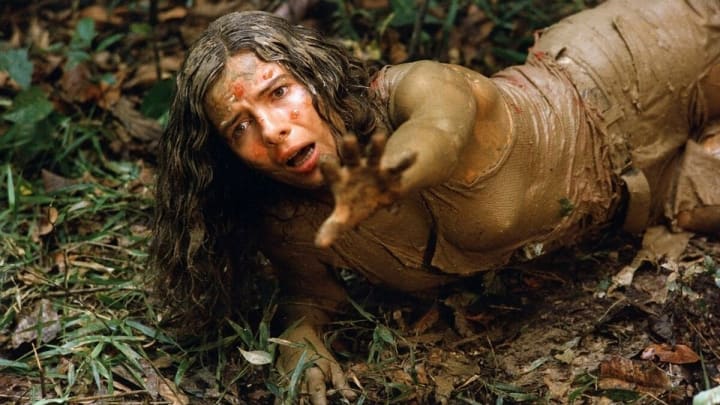
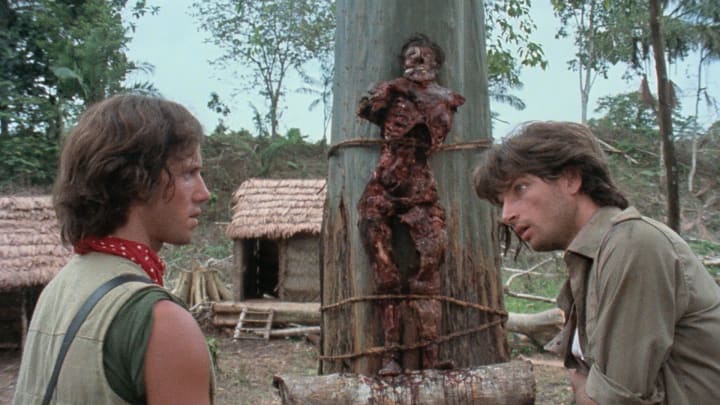
Cannibal Holocaust gave us the image of the young nude woman impaled on a spike. This image is synonymous with the film and is a testament to the visceral violence contained within. It is hard to see any nude impaled figure and not think of Cannibal Holocaust. Cannibal Holocaust may be one of the most infamous films in existence and this scene is a perfect representation.
While the woman impaled on the spike is the most iconic image from the film, the actual kill takes place off screen. The reason that this is such a great representation of Cannibal Holocaust is that while it is a shocking scene, we do not see the torturous insertion of the spike.
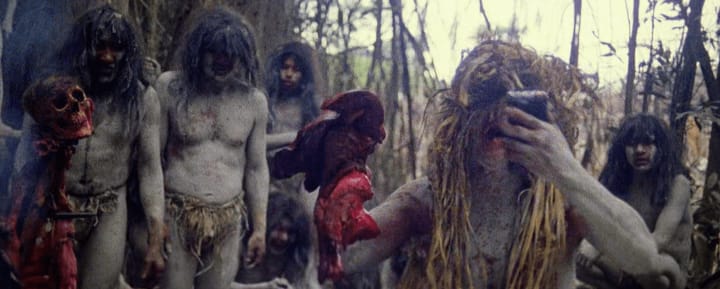
Cannibal Ferox, on the other hand, gives us Pam, stripped to the waist and suspended from her breasts with large hooks. Like the impaled girl, this is a great representation of the film. It is visceral, savage, and memorable. The difference is that we see the hooks sinking into her flesh. We watch her suffer. Cannibal Ferox pulls no punches.
Final Thoughts
If indeed Lenzi set out to make a more extreme and shocking version of Cannibal Holocaust, he succeeded. Cannibal Ferox is gritty, disturbing, and mean spirited. Cannibal Holocaust, though, is the superior film. Both of these movies are more than worth checking out. Test your mettle and make it a double feature.
About the Creator
Postmortem Video
We are Postmortem Video, a collection of genre nerds who love to write about horror, cult, and exploitation films! Look for our upcoming book soon from @AtraMorsPublishing!
All articles © 2025 Atra Mors Publishing. All Rights Reserved.
Keep reading
More stories from Postmortem Video and writers in Horror and other communities.
Ozploitation Royalty: Dennis Hopper Brings Mad Dog Morgan To Visceral Heights
In the autumn of 1865 the unique and notorious desperado, bushranger Dan Morgan, crossed the Murray River from New South Wales into Victoria to do battle with the law for the last time. What happened has been a secret for over 100 years. And so it should have been, if only to save face for the corrupt and hated colonial establishment of the day. This then is the fascinating tale, told for the first time, of the romantic and extraordinary villain they called Mad Dog Morgan. - Tagline from the film
By Postmortem Video4 years ago in Horror
The top 5 Haunted Places in Thailand you should never visit
Thailand's Most Haunted Locations Thailand's rich history and different cultural beliefs have inspired a plethora of ghost stories and eerie folklore. Here are a number of the oldest and most haunted locations with different places to visit in thailand that entice the brave:
By Michelle Lee3 days ago in Horror
Comments
There are no comments for this story
Be the first to respond and start the conversation.