
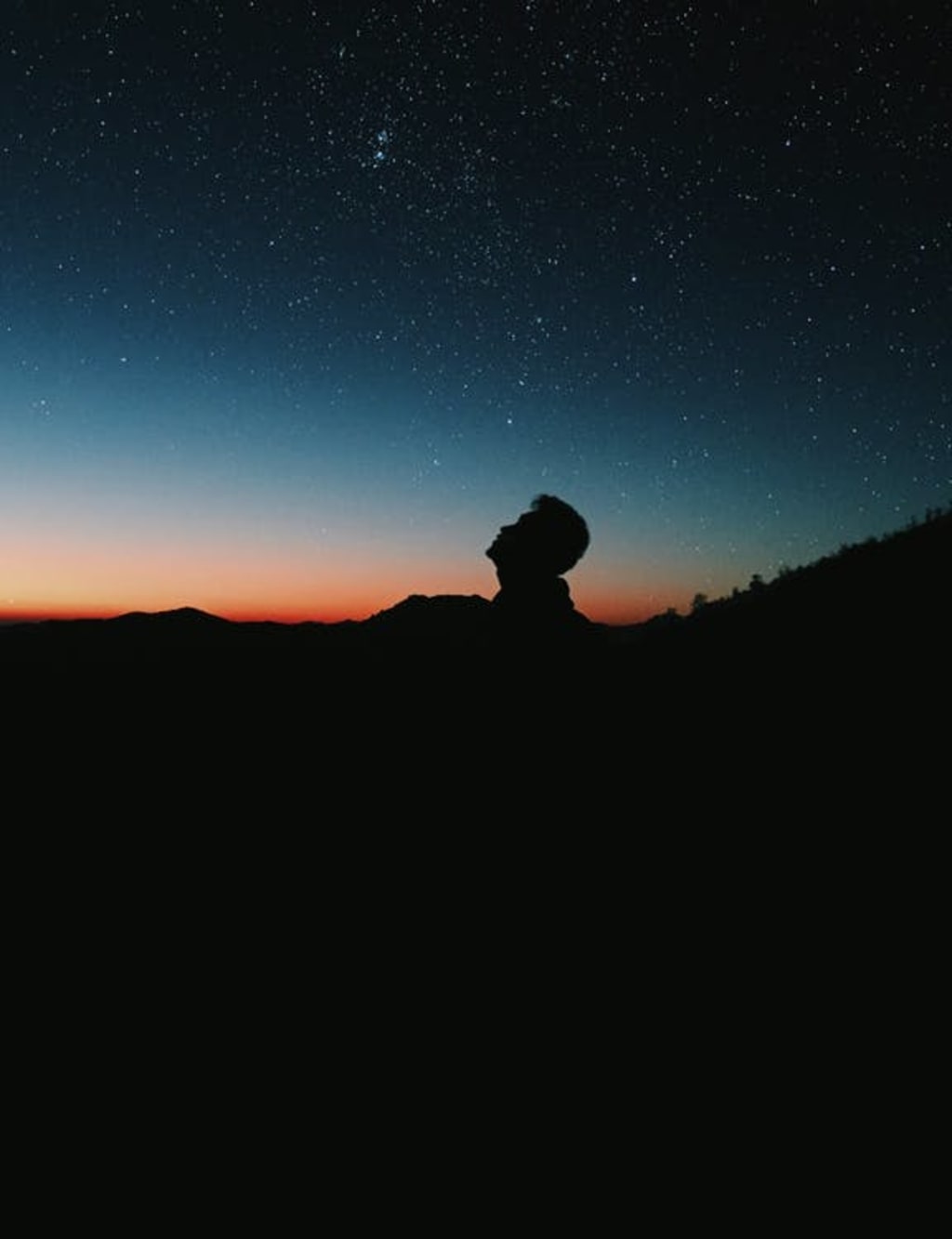
Nobody can hear a scream in the vacuum of space, or so they say. I used to wonder at that, how humans have immediately gone to ‘scream’. Not ‘laugh’, or ‘cry’, or ‘sing’. I would gaze up at the stars as a child and wonder to myself, why do we consider the horror of the heavens above all else?
I sit here in silence, with only dead stars as my companions and consider our ancestors, people scattered across a half dozen continents, of our cultures separated by sea and language and gods. These tens of thousands of years which part us all have one thing in common; humanity gazed up, and found beauty and terror in measures. They based the cycles of their lives upon the cycles of the stars, conducting the best time to pray, to wed, to birth. We saw ourselves equally in the heavens as we did upon the surface of water, a distorted mirror image like ripples in our reflections.
Perhaps it is simply ego, the hubris of man to equate celestial bodies in a mortal image. Grecian philosophers would gaze up and seek out patterns in pinpricks of cold silver, Egyptian priests would pay homage to the Sun, our father, our creator, our warden.
There is comfort in knowing that to gaze up is to see the same moon that Aristotle contemplated upon. In a way, it cements our sense of self in our connections to the people of the past. It is essentially this human connection which one finds beauty in upon the stars. We take stardust as our biological makeup, and we find our place amongst our people and our planets.
So we have always looked up, and managed to find beauty and patterns, gods and loved ones. Yet, we have decided that the sound of space is terrifying, is a void, is a vacuum. And that is because the defining feature of the sound of space is its absence. Pure, unrelenting, nothingness.
People go mad in silence. Our hearing is the one sense which can distort our psychology so thoroughly. ‘White Torture’, they call it. White as starlight. All that one can hear is themselves, blood rushing in eardrums, bones grinding in mouths, the squeeze of lungs sucking in panicked breaths through iron lips. Their own screams.
So imagine that horror, that primordial, cosmic, horrific sensory deprivation that is space, where nobody, not even yourself, can hear you scream.
Man offers White Torture, space offers Absence. But above all, we have believed that space offers Silence.
We may not be able to hear a scream in space. We may not be able to hear anything in space, not physically at least. Our carbon bodies were not made for the pressures of the void after all. But humanity is nothing if not tenacious.
In the summer, we sit outside with ice cold drinks, next to oceans with no intention of entering its waves but grateful for the salt spray and the cool breeze it blows. We sit there, sometimes with friends, sometimes alone, sometimes with a book or music, and we listen to the cries of gulls and the laughter of children, of arguments between lovers. We sit there, lost in noise and sense, not realising that we are being poisoned by the universe. Radiation enters our skin, destroying living cells that go dark then red in an effort to preserve our mammalian bodies. We are being cooked alive by the Sun, with only billions of miles of silent space between us.
I realise now what a blessing it is, the inability to hear the primordial roar of a million atom bombs that encompasses a sun’s ray as it blankets our lives.
We were never meant to hear screams in space. We were never meant to hear the cries of a dying star, or the howls of a supernova as it devours celestial bodies. We were never meant to hear space in its rawest form, and it is in the absence of sound that man turns to madness. And now, I alone have seen what happens when you take this abyss with a billion dead and dying and birthing stars, and you manage to hear its voice.
And as I sit here, abandoned on this emptied out ship, its remains little more than gnarled husk of metal, a dead titanium plated tree decorated in bones and sinew and the open maws of my once fellow travellers, I realise that space is screaming regardless, and we are blessed in our deafness. I would have laughed at such a notion once. I don’t believe I will ever laugh again.
I gaze at the sprayed corpses around me, of the meat and bone, their bodies reduced to their simplest, non-functional biological form. I cannot remember how long I have been sat here, in this desecrated place. Funny how shock turns time on its head. Funny how I’m the last one left, a sole survivor a billion miles from earth.
My hand spasms against the crushed hearing aid in my grasp, tearing metal into my palm and I gasp at the reminder of physical sensation. Red blood, a bite of pain, and I release a shaken breath, as if it is the first I have taken in a millennia.
I see Hodgkin’s recorder to the side, miraculously whole unlike its former owner. I stand, shaken as a new-born foal, or as the vibrations of a violin string, and stumble towards it. I click the camera on and see wide eyes staring back at me, eyes which have seen worlds beyond comprehension, beings which bear no adequate description except through the emotions they illicit, the fearconfusionterrorhorrordisgustterrorhorrorHORRORHORROR.
I try to wipe off the gore from my face, managing only to streak brain matter across my cheek.
I sit.
I breath.
I raise my hands and I begin to sign.
“No one can hear you scream in space. Or so they say. For those who have heard space’s scream tore themselves apart to escape its voice.
About the Creator
Keep reading
More stories from writers in Horror and other communities.
The House That Corrects You
The first time the house corrected me, I thought I was tired. I came home late, dropped my keys on the table, and kicked off my shoes. When I returned to the hallway a minute later, the shoes were neatly placed side by side, toes facing the door.
By shakir hamid5 days ago in Horror
Learn to Be Alone...
We often find that people are told to stop making 'X, Y and Z' their personality. Well, this only arose in the social media age as especially women's interests: reading, dramas, art etc. was heavily criticised as being 'useless'. It is historically well-documented that though many men require the work of women, whether it be through unpaid labour or entertainment, they also refuse to acknowledge it is important. This is why since it has been something of recognition, they have been complaining of a 'loneliness epidemic' now that women are withholding access.
By Annie Kapur6 days ago in Psyche
The Angry Man in Your House
"If you grow up with an angry man in your house, there will always be an angry man in your house" This statement has caused plenty of controversy online, people say its a statement that blames victims while also undermining those who break traumatic cycles to form health relationships... but if I'm honest now that I'm in my 30s it makes more sense to me than ever, and I'd argue that its not just about fathers and uncles.
By S. A. Crawford2 days ago in Humans



Comments
There are no comments for this story
Be the first to respond and start the conversation.