
The Vanishing: Five Lost in the Bennington Triangle
“In the shadow of Glastenbury Mountain, people walk into the woods… and never return.”

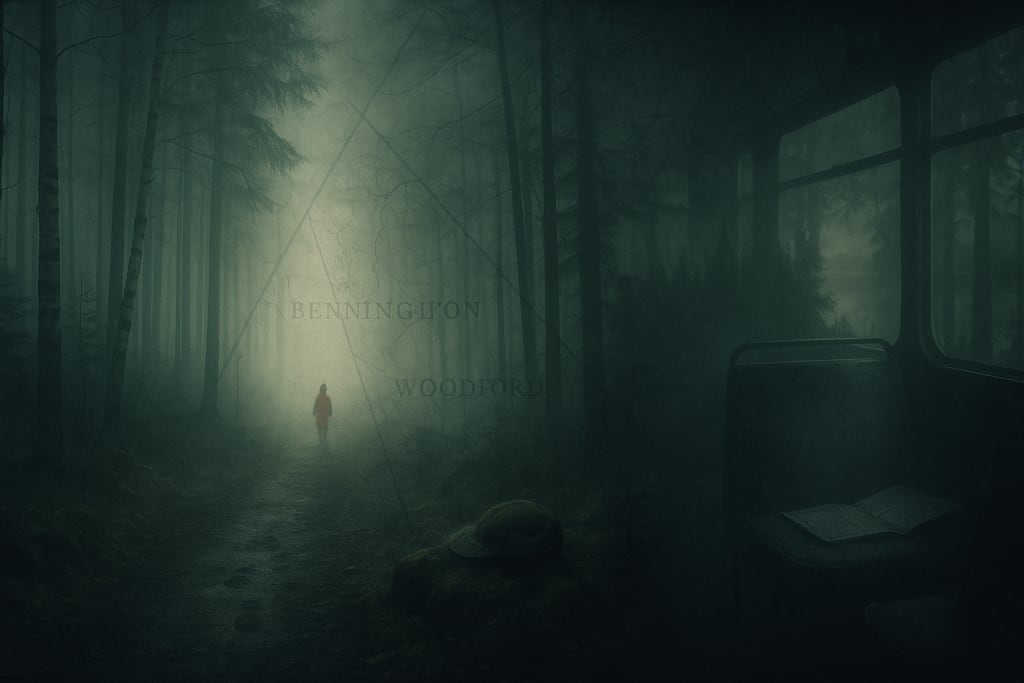
Prologue — Cold Wind Over Glastenbury
The wind comes down off Glastenbury Mountain like a long, patient breath. It moves through the black spruce and red maple, rattles the old logging roads, and combs the cleared lines where a town used to be. If you stand quiet enough, you can hear it whistle through things that are no longer here: clapboard houses, mill wheels, footfalls. Voices.
They say there was a time you could ride a railcar into Glastenbury and step into a rough little boomtown. Timber, charcoal, a company store, a future stacked like cordwood. But the slopes rose steep and mean, the trees thinned, and the timber barons left. Snow reclaimed roofs. Mud swallowed the paths. The wind stayed. And now, when it slips between the trunks on a cold afternoon, it sounds like someone drawing a long, careful finger along the rim of a crystal glass… and letting it sing.
Between 1945 and 1950, five people disappeared within reach of this mountain—vanished with a decisiveness that still makes locals lower their voices when they say the names. Hunters and hikers say the land out here feels off-kilter, like a compass a few degrees wrong. Check your map twice. Count your steps thrice. And if you feel the wind shift and the woods go suddenly, perfectly quiet… keep moving.
They call this place the Bennington Triangle. Not because anyone mapped out sharp corners and cursed coordinates, but because the disappearances make their own geometry. Points that never connect. Lines that go nowhere. And an empty center you can feel in your bones.
Act I — The Triangle Takes Shape
Picture a jagged wedge of southern Vermont: Bennington, Woodford, Shaftsbury, and the ghost of Glastenbury connecting the corners. The Long Trail threads its way through like a silver filament, sometimes friendly, sometimes distant, always older than you feel comfortable admitting. The locals know the mountain’s moods. In fall it is a painting... burning sugar maples and lemon birch, a cathedral lit by stained glass. In winter it turns monochrome and high-shouldered, shouldering storms without complaint.
The stories were older than the five vanishings. Strange echoes up the gulches, lantern lights where there are no roads, a feeling that the woods are one step behind you no matter how fast you hike. A hunter once said he followed a brook uphill for an hour only to end where he started, certain the water had reversed its own flow. Another swore he watched a doe move through the stand of fir and then simply cease... no crash, no brush, no shadow. Just... absent!
There are explanations, sure. Granite and iron seams that tug the needle. Weather that snaps from tranquil to lethal like a trap. But even explanations have a way of opening more doors than they close. Especially here.
Between 1945 and 1950, five of those doors stayed shut.
Act II — The Five Vanishings
1) The Experienced Guide (1945)
Early winter. Frost on the low grass. A small group moves along an old logging road, rifles slung, hearts easy. They’re hunting with a man who knows these slopes the way river water knows its banks: Middie Rivers. He walks a few paces ahead, close enough to hear but far enough to scout. The group watches the bobbing of his cap, the swing of his shoulders. The cap dips over a rise. The cap does not rise again.
They call. They follow the road to its bend. Nothing. Not a scuffmark, not a dropped cartridge. No panicked burst of tracks, no sign that he accelerated or fled or fell. The earth receives him gently, as if he were expected. Searchers comb the ravines and the thorny underbrush; they grid, they circle, they return. Rivers is not found. The woods keep their calm.
Later, one of the hunters will say, “I saw him. Then I did not.” No drama, no thunderclap. The difference between a candle’s glow and a blown-out wick.
2) The Girl in the Red Coat (1946)
A Sunday afternoon that gives you permission to breathe. Paula Jean Welden laces up her boots and sets out for a walk on the Long Trail. College kids do it all the time: clear the head, collect the mood. She wears a red coat; unmissable against the grays and greens of December. Hikers see her on the trail. A couple watches as she rounds a corner just ahead, young and sure-footed, red bright as a heartbeat.
When they turn the same corner moments later, the trail is empty. The red with it.
The search becomes an operation... men shoulder to shoulder, dogs tugging at leashes, even the National Guard up from barracks to beat the brush. The maps fill with penciled loops. The dogs lift their noses and tilt their heads and, at one maddening bend, behave as if the trail has simply decided to stop being a trail. The days slip. The nights lengthen. Students post handbills. The red coat never turns up.
Ask old-timers and they will lower their eyes when they say Paula’s name. “Broad daylight,” they’ll murmur. “Right there.” Then they’ll change the subject, which is its own sort of answer.
3) The Man Who Vanished from a Seat (1949)
A bus rocks through the Vermont dark, heater ticking, windows fogged with conversations. James Tedford sits in a seat near the middle, luggage tagged, itinerary open to the fold that takes him home. Ask the other passengers later and they will tell you he was there. Thin, quiet; a man with a life’s weight in his shoulders, present and unremarkable in the way that makes someone real.
When the bus pulls into its stop, the driver lets the handful of remaining riders stand, stretch, descend. Tedford’s luggage is above the seat. His itinerary rests on the cushion like a bookmark in an interrupted life. The man himself is not there.
Call it a miscount; call it a mix-up. But the numbers add up to a shape you know too well by now. A person, fixed. A moment, continuous. Then a seam in the ordinary we never noticed… until someone slipped through it.
4) The Boy Who Followed the Day (1950)
October copper on the hillside. Paul Jepson is eight. His mother minds a piggery and Paul, with a child’s holy faith in short distances, wanders within earshot and eyesight. He is seen. He is spoken to. He is within the radius that keeps worry asleep. Then the radius fails, and worry wakes hungry.
Bloodhounds arrive; they nose the leaf duff, eager for the story the world usually tells. Their line pulls toward a road, and there it stops. Not muddled or confused, just stops. As if the rest of the boy’s day were written on a page torn cleanly from the book. His favorite red jacket becomes a rumor. The hill keeps the jacket. The road keeps the rumor.
5) The Only One Returned (1950)
Frieda Langer sets off on a short hike with a cousin. She slips, dampens herself at a stream, laughs it off, and turns back to camp to change. She knows the trail. The cousin watches her go, the way you watch a person you expect to see again very soon.
Searchers rake the ground until the first snow. Spring comes and the mountain exhales its thaw, spilling secrets: bottles, antlers, lost gloves, a scatter of tin from a hunter’s pack. Months later, they find a body in a place that, by everyone’s account, had already been searched thoroughly. It is Frieda. Time and weather have taken what they like; what remains refuses to surrender a cause. She is the only one of the five who comes home. If you can call being found “home.”
The others remain conjugations of the same verb: to vanish.
Act III — Patterns in the Pines
What rings the loudest isn’t just that five people were lost. It’s the texture of the losses: the hunter who steps over a rise and does not step back into view; the girl in the red coat who is always just ahead; the bus passenger who evaporates from a numbered seat; the boy whose trail ends at a road the way a song ends at silence; the woman who returns without answers. Five notes on a scale that make a chord no one can resolve.
There are patterns, if you’re the kind who draws strings on a corkboard. Most disappearances seem to cluster late in the year. When the weather can feint, when dusk comes early and the cold lays traps in the hollows. Several vanishings involve people moving just ahead of others. “I saw him. Then I didn’t.”... “She was around the bend.”... “He was on the bus.” Shared visibility, then severed continuity. It’s almost like watching a stage that drops its curtain mid-scene.
And always, the mountain’s peculiar quietness. Ask anyone who has hiked those sections alone and they’ll mention it. How the woods go suddenly soundless, as if the air is holding its breath. Even birdsong seems to check its watch. Nothing out of nothingness...
Act IV — Explanations, and the Places They Won’t Go
The Ordinary Teeth of Wilderness.
The land can swallow a person without malice or magic. One misstep into a blowdown or sink, one slide down a hidden cutbank into a brook where the water hardens to ice. Hypothermia shrinks the world to a tunnel. Animals rearrange a search scene without trying. Snow erases and edits with a steady hand. Plenty of souls have gone missing on mountain slopes without the need for anything but bad luck.
Human Shadow.
A predator using trails and bus schedules like a net; a crime hidden beneath the chaos of winter storms; the simplest explanation that can still bear the weight of darkness. People do terrible things and the woods are the oldest accomplice of all.
A Map the Compass Doesn’t Recognize.
Magnetic anomalies nudge a needle, topography breeds disorientation, and what feels like “straight back to camp” is actually a wide tireless circle. Ask any ranger: a person can get very lost within a few hundred yards of where they know they are.
The Door You Can’t Name.
Then there are the whispers that live where explanations taper off. Lights in the trees with no source; a humming that fades when you try to locate it; time that seems to stretch thin and then snap back like elastic. Some hikers swear the paths “shift” underfoot. Not magic, just a subtle wrongness, a bend in the logic of space the way heat bends distance on a highway. Others talk about “step-ins”: places where you take one step and the next belongs to somewhere else. Call it a vortex, a seam, a slip. The mountain doesn’t argue. It just keeps the door unmarked.
Act V — Whispers of the Mountain
Everyone you meet around Bennington has a story or knows someone who does. A woman who refused to hike alone after a day on the Long Trail when her footprints doubled themselves and then… didn’t. A man who insists that, forty minutes before a storm rolled in, the forest smelled like wet iron, and all the color went two shades flatter. A pair of college kids who joked about seeing Paula’s red coat only to wake at 3:17 a.m. back in their dorm with the window rattling and their trail maps on the floor, red pencil circling a switchback they don’t remember circling.
You can chalk it up to the human thirst for patterns, for spooky coherence, for a story that moves the blood. But there’s an older logic here, the logic of places that outlast us. Mountains don’t keep ledgers or scrapbooks. They keep weather. They keep silence. If those things happen to hold a few names longer than we think is fair… well. The mountain will not stand to be argued with.
Sometimes people come to Glastenbury to listen. They bring thermoses and cheap flashlights and good intentions, and they park at trailheads and step into the trees just far enough to feel the colder braid of air where the branches knit. They stand there until their eyes adjust and the woods reveal, not secrets, but their own indifference. Which is its own kind of answer.
Epilogue — The Forest Remembers
The names matter. They deserve to be spoken out loud so the trees have to hear them again.
- Middie Rivers.
- Paula Jean Welden.
- James Tedford.
- Paul Jepson.
- Frieda Langer.
Five lives with mornings and chores and jokes and the exact texture of a favorite jacket. Five stories interrupted not at the end of a paragraph, but mid-sentence, comma dangling. We tell their tales to keep the comma from hardening into a period.
If you go... if the map tugs at you with its green promises and crosshatched ridges... go like a pilgrim, not a tourist. Mark your route. Respect the weather. Tell someone precisely where you’re headed and when you’ll be back. Take nothing from the woods but your own breathing, and leave nothing but your careful footprints. And if, on some long quiet stretch, the wind draws that crystal note across the rim of the mountain and you feel the hush gather tight around you, don’t stop. Keep walking. Speak your name under your breath like a kind of charm. Let the trail hear you.
Because sometimes, in certain corners of the world, vanishing isn’t a trick. It’s a pressure... subtle, patient, older than towns and timetables... waiting for a moment when the fabric thins. The best you can do is move through with humility and a steady pace, and hope that whatever doors exist remain closed.
And if you should glimpse a flash of red between the birches, if you should see the shape of a man stepping over a rise, if you should look down at a bus seat and find an itinerary open to a destination that feels unaccountably familiar. Remember that the mountain is not a museum. It is a mouth. And the forest, in the end, remembers what it swallows.
About the Creator
Veil of Shadows
Ghost towns, lost agents, unsolved vanishings, and whispers from the dark. New anomalies every Monday and Friday. The veil is thinner than you think....
Keep reading
More stories from Veil of Shadows and writers in Horror and other communities.
The Sounds From the Attic: The Hinterkaifeck Mystery
I. The Wind Over Hinterkaifeck The wind still moves through the place where the farm once stood. A lonely patch of earth in Bavaria, swallowed by grass and overburden. Locals say the ground there feels wrong, like it hums faintly when the night grows too still. They call it Hinterkaifeck, though the farmhouse itself is long gone. All that remains is the story. And what a story it is dear readers...
By Veil of Shadows5 months ago in Horror
"Scream 7" (2026): Running out of Fresh Screams
This is the seventh time we’ve had a Ghostface crisis. Scream 7 is the latest edition of the Scream franchise. Sydney Prescott and her family are under attack by another anonymous killer dressed in a Ghostface costume. While having issues with her daughter, Tatum, they run from the bloody murders, trying to determine who is behind it all.
By Marielle Sabbag7 days ago in Horror
Architecture of the Scythe
The Glass King I was a man of cold lines and hard angles. I was Silas Thorne, the "Architect of the New Century," a title bestowed upon me by critics who mistook my arrogance for vision. My face looked back at me from the gloss of Architectural Digest; my hands had drafted the shimmering glass spires that defined this city’s skyline. I didn't just build offices; I built altars to human ego. I believed in structural integrity, in the unshakeable laws of physics, and, most fervently, in my own untouchable prestige.
By Nathan McAllistera day ago in Horror
From ad men to mad men
It's after 2am in the morning when a local police patrol vehicle in Northern New Jersey spots a figure costumed as Quasimodo, The Hunchback of Notre Dame, proceeding southbound on the sidewalk along Lydecker Street. Though the hunchback’s costume stuffing offers added insulation, it's January, and friggin’ freezing. Carefully, the officers slow down, gently question the subject, and offer him a ride home.
By David W. Maury4 days ago in Humor

Comments
There are no comments for this story
Be the first to respond and start the conversation.