
The Stranger Within Me
I used to know who I was.


Or at least I thought I did.
I smiled without thinking about how it looked. I said “yes” only when I meant it. I felt things—freely, openly, without second-guessing every emotion.
But over time, that version of me disappeared.
Not suddenly. Not dramatically.
It was a slow fade, like a photograph losing color in the sun.
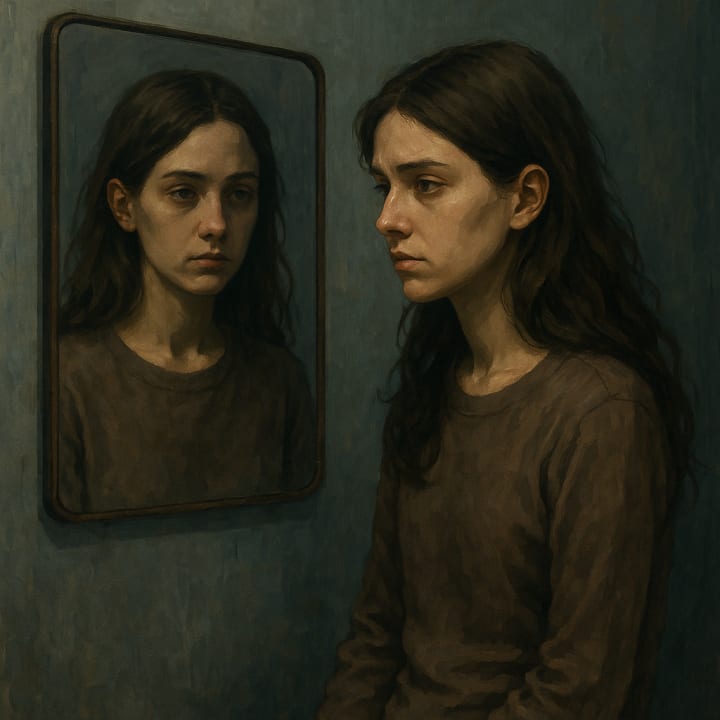
Now, I look in the mirror and see a stranger.
It didn’t start with trauma. It started with silence.
The kind of silence where you stop speaking your truth because it feels inconvenient to others.
The kind of silence where you laugh at jokes that hurt you.
The kind of silence where you nod along even when your soul is screaming “no.”
And eventually, I adapted. I became someone who could pass for “fine.” Someone agreeable. Someone who didn’t make waves.
Until one day, I realized I couldn’t find the person underneath the performance.

Psychologists might call it disconnection or identity disturbance.
Philosophers might say I’d become alienated—from myself, from meaning, from being.
But I didn’t need a label to know I was lost.
I felt it every time I looked in the mirror and didn’t recognize my own eyes.
I felt it when I couldn’t tell if I was tired or numb, anxious or just pretending not to care.
I wasn’t depressed in a movie-scene kind of way. I was functioning—just barely.
Showing up. Smiling. Performing.
And inside, I was quietly falling apart.
Therapy was a last resort.
I didn’t think I was “sick enough” to deserve help.
But I went anyway, because I was tired of pretending.
Tired of being two people—the one everyone saw and the one I didn’t understand.
In one session, my therapist asked me a question I still think about:
“What would happen if you stopped performing?”
I hesitated. Then whispered:
“I don’t know who would be left.”
She smiled, gently.
“Then maybe that’s the person we need to meet.”
Healing didn’t feel like a breakthrough.
It felt like unraveling.
It felt like crying in the car for no clear reason.
Like journaling five pages of confusion before writing one honest sentence.
Like saying “no” and fighting the wave of guilt that followed.
Like standing in front of a mirror and trying—really trying—to see myself.
It felt like grief.
Because I wasn’t just healing. I was mourning the version of me I had buried under years of fear and performance.
I started doing things that scared me.
Telling the truth when it felt easier to lie.
Letting people down rather than betraying myself.
Admitting, out loud, when I was not okay.
And little by little, the stranger in the mirror became familiar again.
Not because I became the person I used to be—but because I stopped trying to be anyone else.
So who am I now?
I’m someone who still struggles with self-doubt.
Who still has bad days. Who still forgets her worth sometimes.
But I’m also someone who feels more real than ever before.
More honest. More whole.
Even in the mess. Especially in the mess.
And maybe that’s the point.
We spend so much time trying to become someone impressive, someone likable, someone enough.
But maybe what we really need is to become someone honest.
To anyone reading this who feels like a stranger to themselves:
You’re not alone.
You’re not broken.
You’re just becoming.
And yes, it’s scary.
But it’s also sacred.
You are not losing yourself.
You are finally meeting her.
About the Creator
The Manatwal Khan
Philosopher, Historian and
Storyteller
Humanitarian
Philanthropist
Social Activist
Keep reading
More stories from The Manatwal Khan and writers in Horror and other communities.
When Brothers Become Enemies
Once, we shared bread. We grew up speaking the same language, singing the same songs, and praying under the same sky. But something broke in our nation — slowly, then all at once. Now, people who once stood shoulder to shoulder are turning on each other with blades, bullets, and blind hatred. Yesterday, that truth became horrifyingly real. My friend was slaughtered — not by a foreign invader, not by a criminal — but by his own countrymen, in front of a military castle meant to protect us all.
By The Manatwal Khan9 months ago in Horror
"Scream 7" (2026): Running out of Fresh Screams
This is the seventh time we’ve had a Ghostface crisis. Scream 7 is the latest edition of the Scream franchise. Sydney Prescott and her family are under attack by another anonymous killer dressed in a Ghostface costume. While having issues with her daughter, Tatum, they run from the bloody murders, trying to determine who is behind it all.
By Marielle Sabbag9 days ago in Horror
The Night Everyone in the Town Heard the Same Whisper
The town of Blackridge was the kind of place people forgot about. It was small, quiet, and surrounded by thick forests that seemed to stretch forever. The road leading into town curved through miles of tall pine trees before finally opening to a handful of streets, a small school, a diner, and an old town square with a clock tower that had stood there for nearly a century.
By imtiazalama day ago in Horror
Guard Your Battery
Why are some people so attractive just by standing there? It’s not because they are "likable," but because they don’t need everyone to like them. I realized later that truly charismatic people allow themselves to be criticized, but they never criticize themselves. They never try to please the world; instead, the world stops to watch them.
By Emily Chan - Life and love sharing6 days ago in Poets



Comments
There are no comments for this story
Be the first to respond and start the conversation.