
The Resonant Silence
A forbidden frequency. A haunting hum. One man’s descent into a reality not meant to be heard.

The Collector of Forgotten Sounds
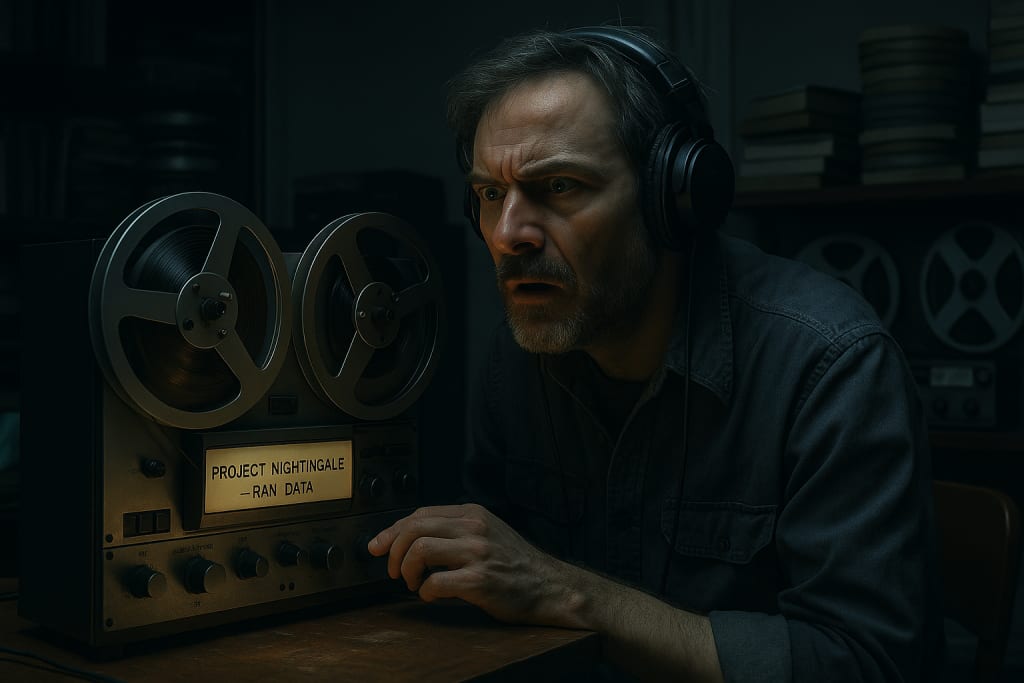
Elias was a sound engineer, a master of frequencies and an obsessive archivist of forgotten audio. While others chased popular music, Elias hunted for the unheard: the hum of ancient machinery, the forgotten dialects of dying languages, the eerie quiet of abandoned places. He believed every sound carried a story, a vibration of the past. His apartment, a soundproofed sanctuary, was filled with vintage recording equipment and shelves overflowing with dusty magnetic tapes.
A Tape Too Cold to Touch
One sweltering summer evening, at a liquidation sale of an old university's forgotten media lab, Elias stumbled upon a reel of magnetic tape simply labeled "Project Nightingale - Raw Data." The tape itself felt unnaturally cold, despite the stifling heat of the room. It promised nothing, yet the very ambiguity of its label called to him. He bought it for a pittance, a mere curiosity.
Back in his lab, he threaded the ancient tape onto his vintage reel-to-reel player. He expected static, perhaps some old, corrupted scientific recordings. What he heard instead was a single, sustained pure tone. It wasn’t loud, not jarring, but incredibly clear—a high-pitched, almost imperceptible hum that seemed to vibrate directly in his bones. It was a frequency so precise, so unwavering, it felt alien—unlike any artificial sound he’d ever encountered.
He adjusted his headphones, trying to pinpoint its origin, to find the break in the loop. But there was no break. The tone simply was. And the longer he listened, the more he felt a strange sense of calm wash over him, a profound tranquility that bordered on euphoria. He lost track of time, hours blurring into an eternity of that pure, resonant hum.
Whispers in the Hum
Over the next few days, the tone became an obsession. He played it constantly, quietly, often while working on other projects. He noticed subtle shifts. Sometimes, within the hum, he’d hear a faint, almost subliminal whisper, like wind through dry leaves, carrying fragmented words he couldn’t quite grasp. Other times, the hum would seem to shift, creating a subtle visual distortion at the edge of his vision—a shimmering, almost translucent figure, gone the moment he tried to focus.
He dismissed it as auditory fatigue, the tricks of a tired mind. But the sense of tranquility was replaced by a profound loneliness. He found himself withdrawing from friends, from daylight. The outside world seemed noisy, chaotic, jarring compared to the perfect, resonant silence within the hum. He found solace only in the presence of that single, unwavering tone.
His research into Project Nightingale yielded little. The university archives had almost no record of it, only a single, heavily redacted memo hinting at “experimental sound resonance studies with unforeseen psychological effects,” and a note about a researcher, Dr. Alistair Finch, who had disappeared years ago after becoming “consumed by his work.”
Elias felt a chilling connection. Finch, consumed by sound? Just as he was becoming consumed by this tone?
He listened to the whispers more intently, processing the audio with advanced filters. The fragmented words began to coalesce, forming coherent phrases—but in a language he didn’t recognize, ancient and guttural. Yet, he understood them. They spoke of “the binding,” “the other side,” and “the crossing.”
The Lonely Ones Beyond
The visual distortions grew stronger. Now, the translucent figures were clearer—elongated, almost skeletal—constantly moving at the periphery of his sight, dancing just beyond his direct gaze. They were always there, just out of focus, like reflections on glass. He was seeing them. And they were always accompanied by that profound sense of loneliness, an almost unbearable yearning.
He realized the terrifying truth: the tape wasn’t just a recording; it was a vessel. Dr. Finch had discovered a frequency—a resonant silence—that could bridge realities, opening a doorway to another plane of existence. And the voices, the figures—they were the inhabitants of that other side, slowly seeping into his perception, trying to break through... or perhaps, trying to pull him in.
The loneliness he felt wasn’t his own—it was theirs. A profound, eternal solitude from being trapped between worlds, yearning for connection, for release. And Finch, obsessed, had become their first bridge, their first anchor. He hadn’t “disappeared”; he had crossed over, consumed by the very connection he forged.
Elias tried to stop. He tried to turn off the tape, to remove it—but his hands, as if guided by an unseen force, always recoiled. The hum, no longer soothing, became a persistent, invasive pressure in his mind—a relentless call. He was losing control, his body a mere puppet, drawn inexorably toward the tape, toward the crossing.
He saw the final, chilling piece of the puzzle. Within the visual distortions, one figure began to solidify, to grow more defined. It was Dr. Alistair Finch himself—his face gaunt, his eyes hollow—reaching out to Elias, not in warning, but in a chilling invitation.
“Join us,” his disembodied voice echoed in Elias’s mind, clear as a bell.
“The silence is beautiful. The connection is eternal. We are waiting.”
The Final Counter-Frequency
Panic flared. Elias knew this was his last chance—before his own body became merely another vessel, another anchor for the beings on the other side. He had to sever the connection without destroying the tape, which might unleash them entirely. He had to contain it.
Driven by a desperate clarity, he began to work frantically. He connected his most powerful audio processors—not to amplify the sound—but to create a counter-frequency, a discordant hum that would interfere with the tape’s resonant properties, creating a barrier, a digital cage. He programmed it to emit a specific burst of white noise, a chaotic sound designed to disrupt the otherworldly harmony of the “Project Nightingale” tone.
The moment he activated the counter-frequency, the lab erupted. The air crackled with unseen energy. The tape reel spun wildly, its hum turning into a shriek that threatened to burst his eardrums. The translucent figures around him solidified for a terrifying moment—their elongated forms writhing, their silent screams echoing in his mind—as the counter-frequency tore through their connection.
The face of Dr. Finch, contorted in agony, pressed against an invisible barrier, trying to reach him... before dissolving into a shimmering mist.
Then, with a deafening POP, the lights in the lab blew out, plunging the room into absolute darkness. The shriek died. The pressure lifted. A profound, natural silence filled the room.
When the emergency lights flickered on, the tape reel was still, its magnetic tape shattered—shredded into useless ribbons. The old machine was burnt out. The unsettling hum was gone. The pervasive loneliness had lifted, replaced by an overwhelming sense of exhaustion... but also a deep, profound relief.
Elias never spoke of Project Nightingale. He dismantled his lab, sold most of his equipment. He could never again listen to pure sound without a lingering dread—a fear of what frequencies might hide. But he carried a silent understanding: there were realms beyond our senses, fragile veils that could be torn by the right vibration... the right resonant silence.
He knew that Dr. Finch was truly gone—perhaps at peace now, or perhaps forever trapped in that other reality he had sought to cross.
Elias lived a quieter life, his days filled with the natural, messy sounds of the world—no longer seeking the perfect hum. But sometimes, in the dead of night, if the world outside was truly, utterly silent, he would imagine he could hear it again—that faint, pure tone, a distant, calling whisper from a place that should never be crossed.
And he knew, with a chilling certainty, that some sounds were not meant to be heard—some frequencies were better left undisturbed—for they were not just echoes...
but the very resonant silence of another world, forever waiting for someone to listen a little too closely.
About the Creator
Noman Afridi
I’m Noman Afridi — welcome, all friends! I write horror & thought-provoking stories: mysteries of the unseen, real reflections, and emotional truths. With sincerity in every word. InshaAllah.
Keep reading
More stories from Noman Afridi and writers in Horror and other communities.
The Labyrinth in Glass
Elara was an artist, but not with paint or clay. Her medium was light, her canvas, a gallery of digital screens where she curated virtual exhibitions, weaving narratives from pixels and code. Yet, deep down, she yearned for something tangible, something with history—something that whispered tales of human touch. This yearning led her to dusty antique shops and obscure art auctions, where she hunted for pieces that possessed a soul.
By Noman Afridi9 months ago in Horror
"Scream 7" (2026): Running out of Fresh Screams
This is the seventh time we’ve had a Ghostface crisis. Scream 7 is the latest edition of the Scream franchise. Sydney Prescott and her family are under attack by another anonymous killer dressed in a Ghostface costume. While having issues with her daughter, Tatum, they run from the bloody murders, trying to determine who is behind it all.
By Marielle Sabbag3 days ago in Horror
Ranking of Scream Movies from Worst to Best
The Scream series has served as a commentary on societal fears and cultural phenomena. Each installment reflects the anxieties of its time, addressing issues such as media sensationalism, the impact of technology, and the evolution of horror fandom. By intertwining these themes with its narrative, Scream has elevated the horror genre to a platform for exploring broader societal issues, encouraging filmmakers to consider the cultural implications of their stories
By Ninfa Galeano2 days ago in Horror




Comments (1)
This story's fascinating. Elias's hunt for unheard sounds is really cool. I've always been into unique audio myself. That tape he found at the sale sounds mysterious. The fact that it was cold and the tone was so strange makes me wonder what it really is. Do you think there's some kind of hidden message in that hum? And how do you think he'll figure out where it came from? It's got me hooked.