

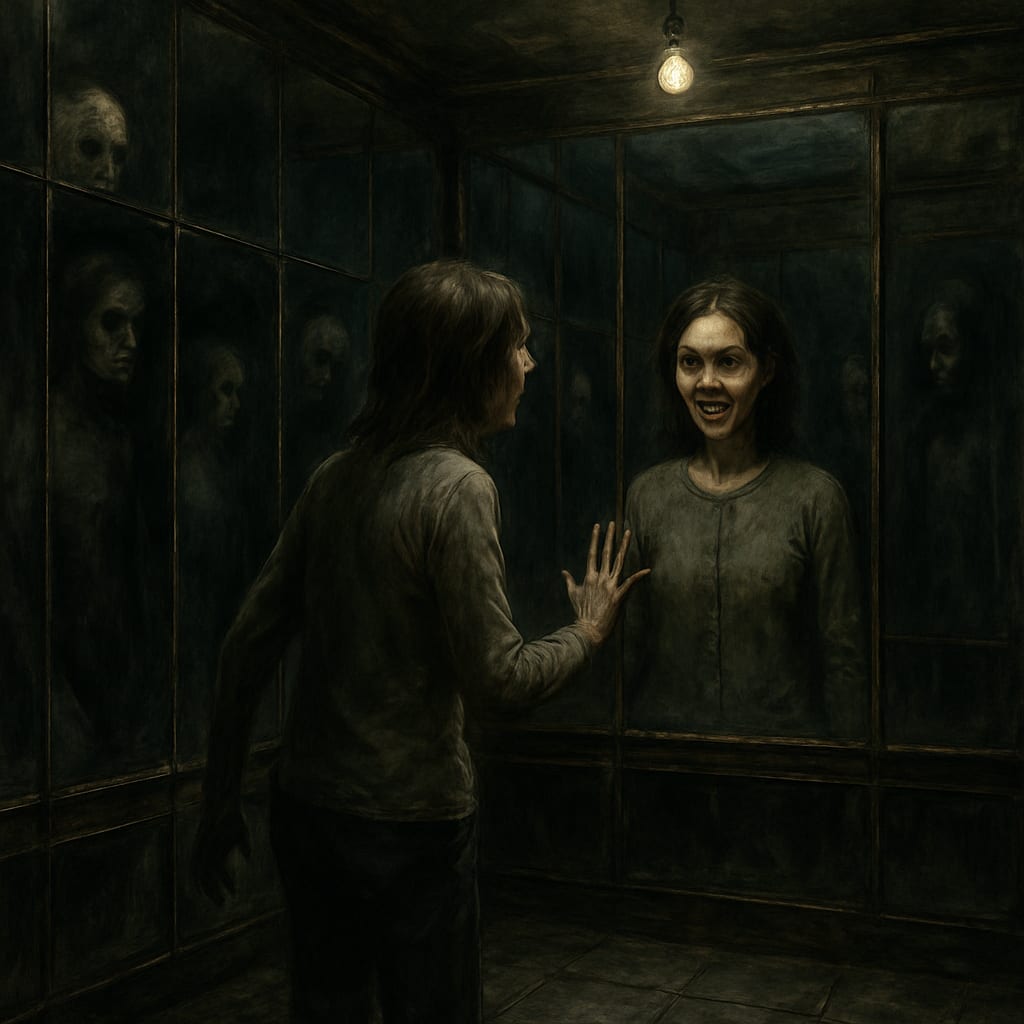
When Mia inherited her grandmother’s Victorian house in rural Maine, she expected creaky floors and old photo albums. What she didn’t expect was the mirror room.
Tucked behind the attic, accessible only through a narrow hallway most would miss, the room had no furniture—just mirrors. Floor to ceiling. All four walls. Even the ceiling and floor had mirrored panels, some cracked, some foggy with age. But the strangest part? None of them showed Mia’s reflection.
At first, she thought it was the lighting. The bulbs flickered weakly, and she chalked it up to faulty wiring. But when she brought a flashlight and stood directly in front of the largest mirror, she saw nothing. No flashlight, no face. Just emptiness.
Her curiosity wrestled with her fear. “Maybe the glass is two-way, or coated with something,” she told herself. But deep down, it felt wrong. Unnatural.
That night, she dreamed of her grandmother. The old woman stood in the mirror room, facing away from her. When Mia called out, the figure turned—and it wasn’t her grandmother’s face. It was Mia’s. But twisted. Smiling too wide. Eyes too dark.
She woke up gasping.
Determined to get answers, Mia began digging through the house. In the basement, behind a cabinet, she found a box labeled “Room of Echoes”. Inside were journals, clippings, and photographs.
Her great-grandfather, she discovered, was a spiritualist in the 1920s. He had designed the mirror room as a conduit to “other selves”—parallel versions of people from alternate realities. According to his notes, mirrors were “veils,” and when arranged in the right configuration, they could thin the fabric between dimensions.
Mia’s fingers trembled as she read one passage:
"Reflections do not mimic; they echo. Some echoes are patient. Others are hungry."
That night, she dreamed again. This time, she was inside the mirror room, but all the reflections were slightly off. They mimicked her movements with a half-second delay, their expressions subtly different. One grinned when she wasn’t smiling. Another mouthed something she couldn’t hear.
She awoke to a tapping sound. Faint. Deliberate. It was coming from the attic.
Grabbing her phone and a kitchen knife, Mia crept toward the mirror room. The hallway felt colder than usual. The air thicker. As she approached the door, the tapping stopped.
Inside the room, her flashlight flickered. She took one step in. Then another. And the door slammed shut behind her.
She spun around—but the door was gone. Just more mirrors.
She screamed. Pounded on the walls. Nothing. Her phone had no signal. Her reflection still refused to appear.
Then, slowly, the mirrors began to fog. Handprints appeared from the inside—on all sides.
One by one, they emerged.
Reflections of Mia—but not quite. One had no eyes. Another’s skin was grey and decayed. One looked normal—almost too normal—and smiled sweetly.
“You opened the room,” it said, stepping forward. “We’ve waited.”
Mia backed away. “This isn’t real. You’re not me.”
The smile faded. “No. You’re not.”
Hands reached out from the mirrors, grabbing her, pulling her toward the glass. She struggled, screamed, but her voice echoed weirdly, as if underwater.
Then—darkness.
When Mia opened her eyes, she was back in the room. But now, she had a reflection. It looked normal. Her flashlight worked. The door was there again.
She fled.
Downstairs, she packed a bag, ready to leave the house forever. But as she passed the hallway mirror by the front door, she froze.
Her reflection was still smiling.
But she wasn’t.
About the Creator
Keep reading
More stories from VISHWANATHA and writers in Horror and other communities.
The Whispering House
The Whispering House The old Victorian house on Holloway Lane had been abandoned for decades. Its peeling paint, shattered windows, and sagging porch made it the perfect dare for reckless teenagers. But no one ever stayed inside for long—not after hearing the whispers.
By VISHWANATHA9 months ago in Horror
One to See, One to Speak, One to Listen
Contains gore and horror some readers may find disturbing. Rated 14+ Author's Intro: This story is meant to revive the Gothic literature so famously crafted by one of my favourite writer's, Edgar Allen Poe, and as such, the language and style is deliberately antiquated. Thank you for reading my all time favourite work of horror - Les
By Call Me Les25 days ago in Horror
Raises for Police a Hot Topic at Hooksett Budget Hearing
Raises for police officers dominated discussion at the recent Hooksett budget hearing, highlighting a familiar but increasingly urgent dilemma for many small towns: how to retain qualified law enforcement personnel while keeping municipal spending in check. The packed meeting brought together town officials, police leadership, union representatives, and residents, all eager to weigh in on whether proposed pay increases are justified amid broader budget pressures.
By Salaar Jamali3 days ago in Horror


Comments
There are no comments for this story
Be the first to respond and start the conversation.