
The Real Story Of Operation Paul Bunyan(U.S. Nearly Went to War With North Korea)
Cold War Story

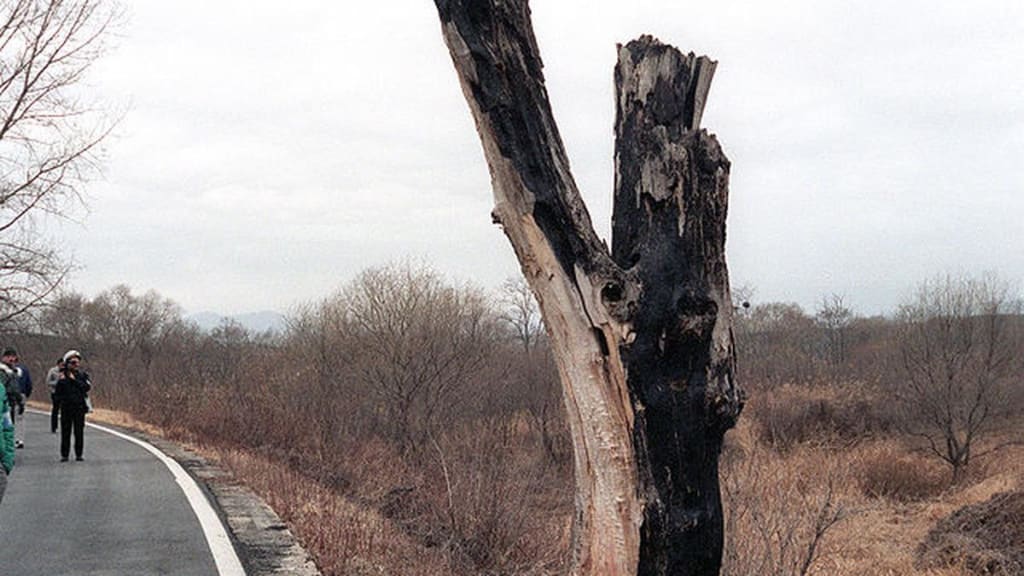
An unassuming poplar tree in the Korean Demilitarized Zone (DMZ) in the summer of 1976 became the implausible spark that ignited one of the most intense military escalations between the US and North Korea. A potentially explosive incident almost sparked a new war on the Korean Peninsula when what started as ordinary tree-trimming escalated out of control. The tree blocked view at an important checkpoint, and a weird standoff known as Operation Paul Bunyan ensued shortly after.
The Korean Demilitarized Zone (DMZ) was a small strip of territory that separated North and South Korea following the Korean War in 1953. In spite of its moniker, the Demilitarized Zone (DMZ) was among the world's most strongly fortified frontiers.
It represented the enmity between the United States-allied South Korea and communist North Korea, which was supported by China and the Soviet Union, during the Cold War. With troops from both sides posted meters apart, poised for battle at a moment's notice, the delicate truce was continually put to the test by militaristic rhetoric, skirmishes, and spying. Even a little event runs the danger of becoming a major conflict in an already volatile environment.
The DMZ was the site of a tragic turn on August 18, 1976, during an apparently routine operation.
U.S. and South Korean soldiers were unable to see the Bridge of No Return, a vital strategic conduit between North and South Korea, because a big poplar tree had grown too close to Checkpoint 3, an important outpost in the Joint Security Area (JSA). A squad of American and South Korean troops, under the command of Captain Arthur Bonifas and Lieutenant Mark Barrett, were sent to prune the tree in order to improve visibility.
They started their work with only axes, not realizing the disaster that was about to befall them. Senior Lieutenant Pak Chul, leading a group of North Korean troops, violently insisted that the operation cease while they were working, citing the symbolic importance of the tree.
Rapid escalation of tensions led to an unexpected and brutal assault by North Korean forces. On the scene, Captain Bonifas was slain, and Lieutenant Barrett subsequently died to his wounds after suffering serious injuries.
The murder of two American policemen stunned the globe and escalated a harmless tree-trimming mission into a catastrophic diplomatic crisis, threatening conflict between North Korea and the United States.
Operation Paul Bunyan, the United States' display of overwhelming might in response to these atrocities, was both symbolic and ludicrous. Just three days after the tragic event on August 21, 1976, the United States initiated a complex military operation—not to target North Korea, but to remove the notorious poplar tree.
With the help of tanks, fighter planes, assault helicopters, and B-52 bombers, hundreds of men returned to the scene, displaying an impressive show of might. An overwhelming force of more than 300 men was organized by the U.S. military. Cutting down the tree that had set off the disaster was the objective. As they stood silently by, the North Koreans allowed the tree to be chopped down.
The goal of Operation Paul Bunyan was to avoid direct confrontation while sending a strong message of strength and deterrent.
The massive operation, which required extensive military resources to cut down a single tree, brought attention to the strangeness of the stalemate and the fact that the two countries were on the verge of going to war over an insignificant matter. Even though the tree had fallen, the incident had a profound impact on the delicate truce between the two Koreas.
References
https://www.politico.com/magazine/story/2017/09/14/north-korea-1976-axe-murder-incident-215605/
https://www.thehindu.com/children/operation-paul-bunyan-when-a-tree-sparked-a-military-standoff/article68763759.ece
https://en.wikipedia.org/wiki/Korean_axe_murder_incident
About the Creator
One to See, One to Speak, One to Listen
Contains gore and horror some readers may find disturbing. Rated 14+ Author's Intro: This story is meant to revive the Gothic literature so famously crafted by one of my favourite writer's, Edgar Allen Poe, and as such, the language and style is deliberately antiquated. Thank you for reading my all time favourite work of horror - Les
By Call Me Les20 days ago in Horror
Stories Told At Twilight
A 300-word flash fiction regarding the above image: She never realized the pale blue of her eyes until now. Pressing the palm of her hands against the cold porcelain sink, she sank deeper into her own gaze. Her eyes were not only pale but striking.
By JB Inglanda day ago in Horror



Comments
There are no comments for this story
Be the first to respond and start the conversation.