
The real men in Black
The Mystery of the Men in Black: Myths, Encounters, and Theories
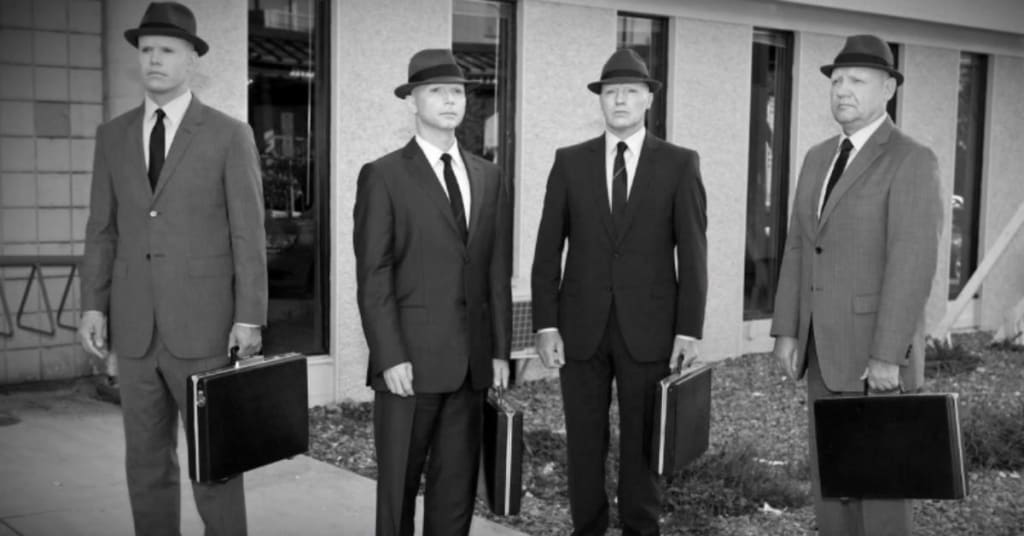
The Men in Black (MIB) have long been a subject of fascination, shrouded in secrecy and mystery. Popularized by movies like "Men in Black" and TV shows such as "Fringe," the real-life concept of the MIB is far more chilling than its fictional portrayals. These enigmatic figures are said to dress in black suits, often appearing uninvited in homes or intercepting individuals in the streets. Their primary mission seems to be to convince witnesses that their encounters with UFOs or aliens were mere figments of their imagination, warning them against sharing their experiences with others under threat of harm.
It is widely believed that the Men in Black either work for or with the government, often claiming to be representatives of a mysterious entity known as the "Nation of the Third Eye." Descriptions of these agents vary, but they are generally depicted as having an unsettling appearance, characterized by no facial hair, large unhuman eyes, bizarre movements, and monotone robotic voices. This has led to speculation that the MIB might not be human at all, but extraterrestrial beings collaborating with the government to keep certain secrets from the public.
One of the earliest reported encounters with the Men in Black dates back to the Maury Island incident in 1947. Since then, there have been hundreds of alleged visits by these mysterious figures. One notable case involves Albert K. Bender, who claimed to have been harassed and threatened by men in black after he planned to publish evidence of alien sources. Another famous incident involved actor Dan Aykroyd in New York City.
A particularly intriguing encounter occurred in Wytheville, Virginia, in 1987, involving radio reporter Danny Gordon. On October 7, Gordon reported that three local sheriff's deputies had witnessed a UFO. Skeptical at first, Gordon soon found himself inundated with calls from locals who had also seen the strange craft. To investigate further, he and a friend visited the site of the sightings, where Gordon managed to photograph the UFO. Before he could develop the photos, he received an anonymous call warning him that the CIA and federal government were very interested in the UFO sightings. Gordon also received other threatening calls advising him to stop his investigations.
Gordon’s house was broken into, though nothing was stolen, and he believed the intruders were looking for his photographs. Although his initial photos were of poor quality, he later captured better images of the UFO. Following these events, Gordon was harassed by phone calls from supposed government agents, and two men visited his home under the pretense of conducting an interview. They took photographs of his home and claimed the interview would be published, but the local newspaper had no record of it.
Gordon eventually discovered that some of his UFO photos were missing, and he became convinced that the men who visited him were the real Men in Black. The harassment and stress took a toll on Gordon's health, leading to his collapse from exhaustion. He was warned that continuing his UFO research could jeopardize his health, prompting him to abandon his investigations.
The Wytheville case is notable for the sheer number of UFO sightings reported—over 1,500 within three months. Gordon’s experience suggests that the Men in Black were desperate to prevent the photos he took from being made public. Despite his ordeal, Gordon never profited from his story, which lends credibility to his account.
Another significant case took place in the 1960s, involving UFO researcher Timothy Green Beckley. Beckley claimed to have captured a real Man in Black on camera. The man had been surveilling Jack Robinson, a Jersey City UFO investigator, and his wife. The Robinsons often found their home disturbed, with research papers moved around. They mentioned the surveillance to Beckley and his friend Jim, who visited the house and spotted the Man in Black standing in a doorway. Beckley managed to photograph him, but the mysterious figure vanished shortly afterward.
Skeptics might argue that such accounts could be fabricated, yet the persistent reports and the eerie similarities among them are difficult to ignore. When even official government members express concerns, as happened in 1967 with the United Air Force, it adds a layer of intrigue. Colonel George Freeman, a spokesperson for Project Blue Book, which studied UFOs, noted that men posing as Air Force officers were silencing UFO witnesses. Freeman stated that these impostors were committing a federal offense, yet they remained elusive.
The existence of the Men in Black remains unproven, but their presence in popular culture and numerous eyewitness accounts keep the mystery alive. Are they government agents sent to suppress knowledge of extraterrestrial life, or are they themselves alien beings? Or perhaps they are a mythical creation born from our fascination with the unknown. Whatever the truth, the Men in Black continue to captivate the imagination, representing one of the most enduring enigmas in UFO lore.
For those intrigued by this topic, the Men in Black symbolize the lengths to which powers that be might go to maintain secrecy. Whether real or imagined, their story serves as a compelling narrative in the ongoing exploration of UFO phenomena.
About the Creator
Keep reading
More stories from Mbeha maliwa and writers in Horror and other communities.
The most convincing time traveling stories you'll ever hear part 8
### Story 25: The Sentient Symphony In the heart of Harmonia, a city where music was the lifeblood of existence, lived the virtuoso composer and conductor, Orin. Harmonia was unlike any other city; here, music wasn't just an art form—it was a living entity, an integral force that shaped the very fabric of reality. The city's streets sang with melodies, and its architecture resonated with harmonies, creating a symphony that connected every soul.
By Mbeha maliwa 2 years ago in Horror
One to See, One to Speak, One to Listen
Contains gore and horror some readers may find disturbing. Rated 14+ Author's Intro: This story is meant to revive the Gothic literature so famously crafted by one of my favourite writer's, Edgar Allen Poe, and as such, the language and style is deliberately antiquated. Thank you for reading my all time favourite work of horror - Les
By Call Me Les24 days ago in Horror
Raises for Police a Hot Topic at Hooksett Budget Hearing
Raises for police officers dominated discussion at the recent Hooksett budget hearing, highlighting a familiar but increasingly urgent dilemma for many small towns: how to retain qualified law enforcement personnel while keeping municipal spending in check. The packed meeting brought together town officials, police leadership, union representatives, and residents, all eager to weigh in on whether proposed pay increases are justified amid broader budget pressures.
By Salaar Jamali3 days ago in Horror


Comments
There are no comments for this story
Be the first to respond and start the conversation.