
The Obsidian Chorus
Echoes of the Eternal Hymn

Part I: The Summoning
The storm’s arrival was no mere coincidence. It carried with it an oppressive weight, as if the elements themselves mourned the passing of my uncle, Charles Abernathy. He was an eccentric man—a collector of forbidden texts and whisperer of forgotten histories. His isolated estate loomed over Abernathy’s End, a place that had always felt touched by some ancient sorrow.
His final letter had been brief but compelling.
"Come at once, William. The Abernathy curse is upon me. You are the only one who can undo what I have unleashed."
When I arrived, I found him already diminished—a frail husk in a house choked with shadows. The once-majestic halls were unkempt, mirrors draped in black cloth, and every surface layered with dust. He gripped my hand with surprising strength.
"William," he rasped, his sunken eyes wide with terror.
"It began with the cavern… beneath the cliffs. A discovery, a mistake… And now the voices, they call to me. You must burn the journal, William! Burn it and let their cries die with me."
Before I could respond, his body convulsed violently, and he fell back onto his pillows, his chest rising no more.
Part II: The Journal
Alone in his study, I stared at the journal he had thrust into my hands. Its leather cover was rough, marred with an obsidian-colored stain. Against my better judgment, I opened it.
The earliest entries were mundane: geological observations, sketches of strange stones, and records of tides near the cliffs. But one passage stood out, written in a frantic, almost childlike scrawl:
"I have found it! The hymnstone, as the legends foretold. Its voice is faint yet unmistakable—a melody that cannot be silenced."
My uncle had chronicled his descent into obsession. He spoke of "dreams not his own," of a sensation that the cavern was alive, watching, waiting. There were drawings, too—shapes that defied understanding, all orbiting a singular black orb.
The last page bore a warning, written shakily:
"The hymn grows stronger. It speaks not to me but through me. If I cannot stop them, they will find another. Their hunger is infinite."
Part III: The Cavern
Despite my uncle’s plea, I could not resist the lure of the cavern. Armed with a lantern and a crowbar, I descended into the cliffs.
The entrance was hidden beneath a tangle of roots, as if the earth itself sought to keep it secret. The air was damp, thick with an unnatural chill. As I stepped deeper, the walls began to glisten, reflecting the flickering flame of my lantern. Then I heard it: a low, droning hum, faint at first but growing louder with each step.
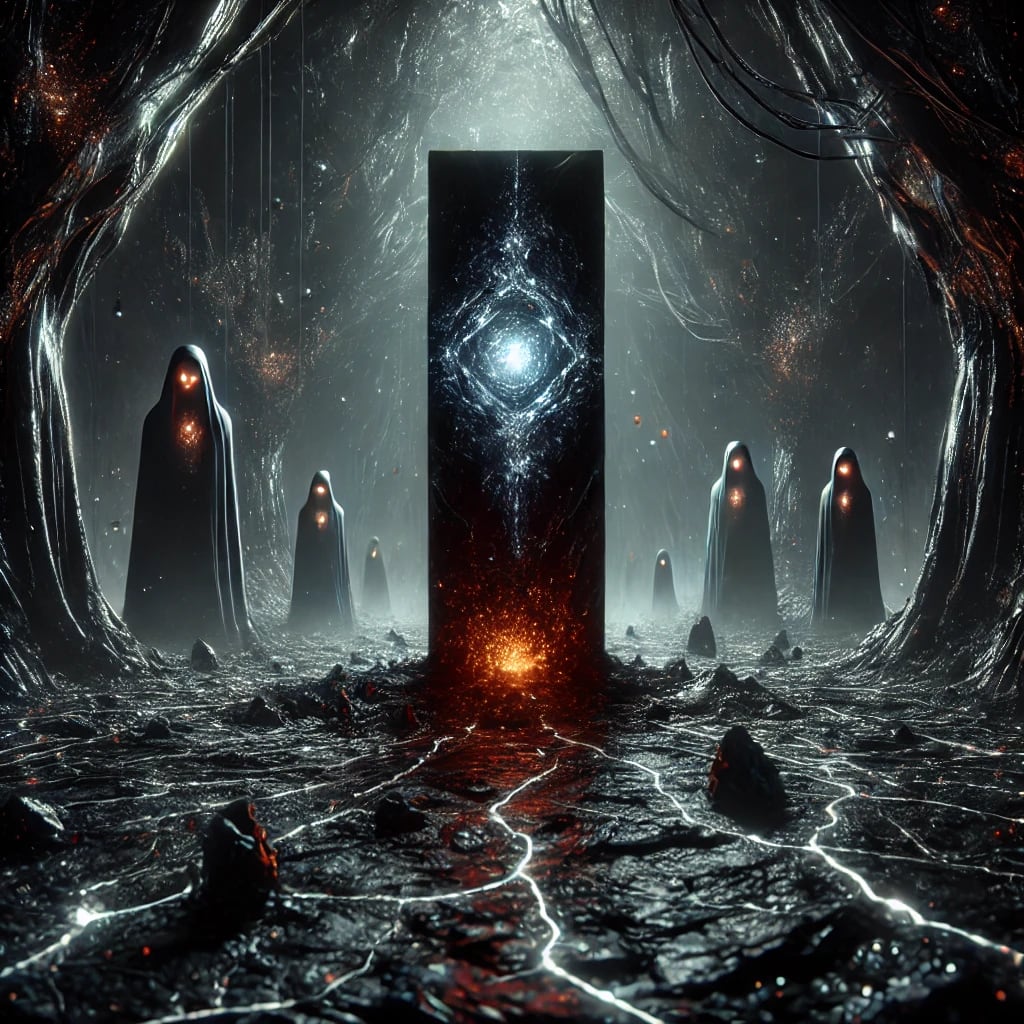
The cavern opened into a vast chamber, its walls veined with black, glass-like stone. The "hymnstone" stood at the center, an obsidian monolith pulsing faintly with an inner light. Its surface seemed to ripple as though alive.
The moment I touched it, the world fractured.
I was no longer alone. Shadows swarmed the chamber, their forms flickering and indistinct, their eyes glowing like embers. They whispered in a language older than the cliffs themselves, their voices weaving into a hypnotic melody.
"Join us," they sang. "Add your voice to the eternal chorus."
I stumbled back, but the shadows followed, reaching with clawed hands. My mind was not my own—I felt their presence burrowing into my thoughts, threading their hymn through my very being.
Part IV: The Abernathy Curse
Escaping the cavern was a blur, my memory fragmented by terror. I awoke in my uncle’s study, the journal open beside me. My reflection stared back from the windowpane, but it was wrong. Its lips moved, forming words I could not hear.
In my search for answers, I uncovered a dark lineage. The Abernathys had long been custodians of the cliffs, their wealth built on the mining of obsidian. But the records hinted at something deeper: a forbidden ritual tied to the hymnstone. My ancestor, Elias Abernathy, had written of a "sacred pact," forged in blood and sealed by song.
"The hymnstone must never fall silent," Elias had warned. "For its silence heralds the end of all who hear it."
I realized then that the voices were not the curse—they were the guardians. The true curse was silence, a void that would consume the souls of all bound to the hymn.
Part V: The Final Verse
The humming now follows me everywhere. Even as I write this, the shadows dance at the edges of my vision. I am not alone in this house—no one who has heard the hymn ever truly is.
My reflection no longer mimics my movements. It smiles when I do not, its glowing eyes filled with malice. I hear it at night, whispering the melody that will one day claim me.
I cannot destroy the journal, for it is the only tether to my sanity. Instead, I leave it for you, dear reader, as a warning. If you ever hear the hymn, do not follow it. Do not let it pull you into its obsidian depths.
And should you find yourself at Abernathy’s End, do not enter the cavern.
The hymnstone waits.
It waits for you.
-------------------------------------------------------------
Author's Note
The Obsidian Chorus is a tale rooted in both fear and fascination with the unknown. When I began this journey, I wanted to explore the intersection of madness, obsession, and legacy. The story of William Abernathy is one born from the eerie whispers of forgotten histories and the shadows that lie just beyond the reach of our understanding.
The hymnstone, as described in the story, is not just a supernatural artifact but a metaphor for the hidden parts of ourselves—the parts we fear to confront and the choices we wish we had never made. In many ways, William's descent into the abyss mirrors the ways in which we often bury uncomfortable truths, only to have them resurface with a force we can no longer control.
This story is a reflection of my fascination with the fine line between curiosity and danger, and the consequences of trying to control forces that are beyond us. I hope it serves as a chilling reminder of the dangers of ignoring the darkness, both within and without.
To my readers, I ask you to consider the legacy we all inherit—the stories we tell, the histories we suppress, and the fears we refuse to face. The obsidian chorus is a warning, but it is also an invitation: to look deeper, to listen carefully, and perhaps, to face the echoes of our own truth.
Thank you for joining me on this dark and twisted journey.
Jason Benskin
About the Creator
Keep reading
More stories from Jason “Jay” Benskin and writers in Horror and other communities.


Comments (3)
Great work on this story and the explanation kind of tells me that this could happen some way.
Loved your story. The commentary adds to the insight for reading it.
Author's Note The Obsidian Chorus is a tale rooted in both fear and fascination with the unknown. When I began this journey, I wanted to explore the intersection of madness, obsession, and legacy. The story of William Abernathy is one born from the eerie whispers of forgotten histories and the shadows that lie just beyond the reach of our understanding. The hymnstone, as described in the story, is not just a supernatural artifact but a metaphor for the hidden parts of ourselves—the parts we fear to confront and the choices we wish we had never made. In many ways, William's descent into the abyss mirrors the ways in which we often bury uncomfortable truths, only to have them resurface with a force we can no longer control. This story is a reflection of my fascination with the fine line between curiosity and danger, and the consequences of trying to control forces that are beyond us. I hope it serves as a chilling reminder of the dangers of ignoring the darkness, both within and without. To my readers, I ask you to consider the legacy we all inherit—the stories we tell, the histories we suppress, and the fears we refuse to face. The obsidian chorus is a warning, but it is also an invitation: to look deeper, to listen carefully, and perhaps, to face the echoes of our own truth. Thank you for joining me on this dark and twisted journey. —Jason Benskin