
The Ningen: Japan’s Government-Concealed Arctic Humanoid
Malevolent Monday Edition

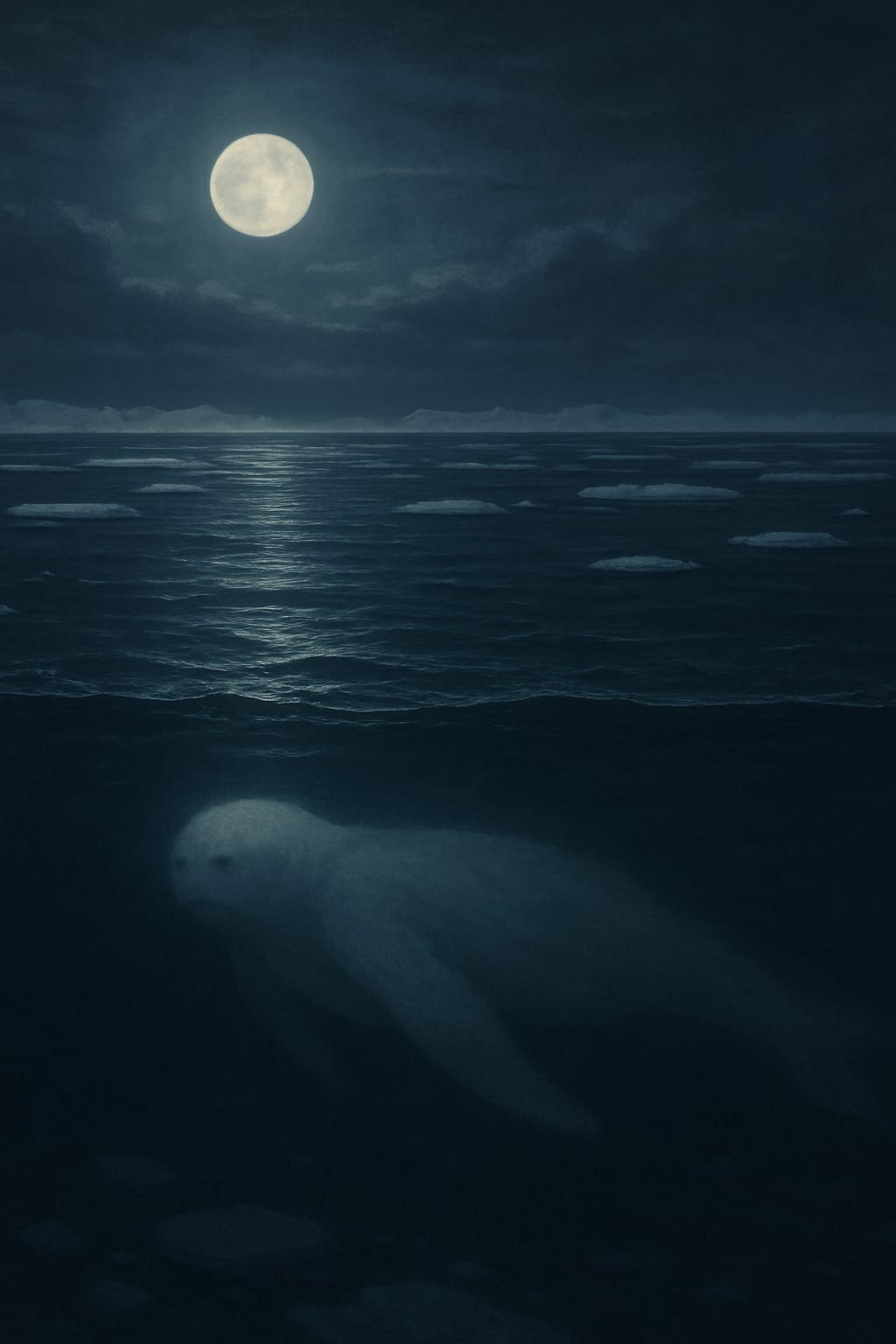
“White Under White”
Imagine a horizon that never blinks. A seam of gray sky stitched to a dead-flat sea, nothing to measure distance, nothing to hold onto but your breath fogging in your mask. The ship’s metal moans in the cold. Sonar pings like a heartbeat you don’t trust. And then, under the ice, something pale glides by. It’s not a whale. Not a seal. It is shaped like an idea you don’t want to have: a human form, impossible in scale, moving with the slow, deliberate grace of something that has never needed to fear you.
Sailors have a superstition for everything. Some bang the bulkhead twice before casting nets; some carry a talisman that smells like wax and old incense. But there’s no charm for what the Southern Ocean whispers about on midnight watches and encrypted forums. They call it Ningen - Japanese for “human.” A thing as big as a trawler, colorless as snow blindness, faceless as a dream you can’t wake from. They say Japan’s agencies know about it. That satellite photos became static, that reports were “misfiled,” that crews were quietly debriefed in windowless rooms where the coffee is too hot and the questions never end.
You didn’t hear any of this from me. You heard it from the sea itself. I’m just the messenger.
Act I: Sightings in the White Noise
The first story I received was from a deckhand who never signed his name. He wrote like a man trying to keep his sentences from shaking: “We were south, well past the point the navigator called good sense. Water like a plate, everything quiet. The spotlight cut across a shelf of low ice. It was underneath us, drifting. I saw a shoulder. That’s the only word I have for it. A white shoulder rolling, like a sleeper turning over under a sheet.”
He swore it had five digits... hand or flipper, who’s to say when the hand is three meters across? He swore it blinked. The blink, he said, is what ruined him for sleep: not the size, not the silence, just the small human habit of an eyelid coming and going, like it had learned to pretend it was one of us.
A second report, this one from a Japanese research assistant stationed temporarily aboard a survey vessel, came with photos attached. Nothing more than grain, glare, and the suggestion of something pale unraveling beneath the surface. She typed: “They took my camera after I showed my supervisor. He said it was glare, not to embarrass myself. Then two men from shore came aboard the next morning with new badges and new smiles. They returned the camera, empty.”
A third tale arrived as a voice memo... fisherman’s radio English delivered between static bursts. “You can hear it when it’s close. Not a sound. A not-sound. Like the sea has a throat, and it’s holding its breath.” He laughed in a way that wasn’t laughter. “My father told me, ‘If you see white under white, go.’ I didn’t. I followed it. I thought it might be money.” The memo ends with a scrape, a shouted order, and the kind of quiet that follows the memory of a near-collision.
There are more... A dozen at least. The details drift and clump like pack ice: a limb that bends too slowly, an outline too smooth to be mammal, too flexible to be machine. Sometimes a mouth; sometimes no mouth at all. Sometimes a face like an erased chalkboard. Always the same pallor... ningen white... like it is made from the sea’s own breath; frozen into a body, or like it was never meant to be seen in sunlight in the first place.
Act II: Hush Kits and Quiet Rooms
Say the words out loud... 'government concealment'... and people picture briefcases cuffed to wrists, black sedans that don’t fog in the cold. The truth of concealment is usually paperwork. Memos that say a sighting was “optical refraction.” Lab notes that mark anomalous sonar returns as “instrument drift.” A preliminary report that opens with “Remaindered by request.” No denials, no admissions, just administrative snow that buries what needs burying.
A retired radio tech describes a night when the ship’s encrypted channel lit up with a call sign he’d never seen. A voice crisp as a winter star ordering a change of coordinates. “New vector. No explanation. Captain didn’t blink. Next day, deck crew told not to take photos.”
Another source, this one in Antarctic logistics, wrote to us in a confessional tone, like someone practicing the sin before the priest does the absolving. He said that after every “white under white” report, a back-channel request would arrive: transmit raw data, delete onboard copies, mark the day as “limited visibility” regardless of actual conditions. “We called it the hush kit,” he admitted. “A zip file that swallowed everything.”
Deniability thrives on the cold. There’s no crime scene under ice, only layers. No one’s taking the sea to court. So you’re left with a thing that shouldn’t be, a handful of voices that can’t quite afford to be louder, and a bureaucracy that never needs to say your monster’s name to erase it.
Act III: Anatomy of an Impossibility
What are we looking at when we say Ningen? The folklore wants an answer that can live under a bedsheet: a cryptid, a marine homunculus, some vengeful echo of a drowned god. Science wants a category. Conspiracy wants a motive. The sea wants to keep its secret.
Let’s do what we do in this Dossier and stack the possibilities:
1. Misidentification — The Ice That Pretends to Be Flesh
Cathedral slabs calve with soft edges. Pressure ridges flex. Light refracts under snow like a drunk memory. Artists of the white world: what if your “shoulder” is a curve of brash ice rolling on a swell? If so, why the five-digit hand reported by more than one crew? Why the blink?
2. Known Animal, Unknown Angle
A whale at the wrong distance, a manta under slush, a colossal squid rising like an unwound rope... our eyes crave human proportion. But the motion reported is wrong: not the muscular burst of whale or the drifting flag of a ray, but a patient articulation, as if joints were thinking their way through the water.
3. New Animal, Old Water
If the deep can hide a beaked whale into the twenty-first century, it can tuck away something stranger. Pale pigmentation in abyssal fish is normal; why not a giant benthic... what?... amphipod? No. The proportions don’t fit. Still, our planet writes in archaic forms. Perhaps the Ningen is a letter we forgot how to read.
4. Human Artifact
An unmanned platform, a bio-mimetic submersible draped in gel, a military test bed wearing a ghost-white skin. But government projects prefer angles, seams, the polite geometry of engineering, not a vast, soft white architecture that curves like a shoulder and closes like an eyelid. Unless the design brief was to be misidentified.
5. Something We Don’t Have a Box For
Call it a mirror. Call it the sea practicing us. Call it the boundary between categories taking a long walk and not returning by dinner.
There’s a reason witnesses struggle for nouns. The Ningen seems to borrow ours... hand, shoulder, face, and return them warped by scale and context, like a funhouse mirror carved from quiet.
Act IV: The Vessel That Followed
One captain; he asked me to call him T... told me a story across two phone calls and a silence. The first call was all angles, the way sailors talk when they’re building a lie sturdy enough to step on. The second was soft. He’d decided to believe his own memory.
They were running a survey line along an unglamorous swath of Southern sea. Fog, intermittent snow, flat water. Midnight by the clock, but the sun never quite dies there in the season when the world’s axis tilts to favor endless day. Men sleep behind taped curtains. T. stands on the bridge nursing tea that tastes like the cup.
A dim swell rises beneath the vessel; not a wave, not turbulence. His stomach moves before his eyes catch up, the body’s old fear shivering like a dog in a thunderstorm. He leans forward.
“White under white,” he says to no one. Because there it is: a pale shape just below the surface, wide as their beam, gliding. The spotlight slashes across it. For an instant the beam outlines what could be a shoulder joining a torso so huge the mind refuses to hang a number on it. Then the light slips; the world returns to gray.
They follow.
Of course they do. At five knots, just enough to keep pace. The engines’ vibrations travel down through the steel; the hull hums like a tuning fork. The shape drifts ahead, not fleeing, not approaching, escorting them like a patient tug.
T. orders the winch crew to hold. Nets stay dry. The sonar tech reports something amorphous at a shallow depth... large but low-contrast, a ghost cloud. T. radios the log with the word fog three times in a row, as if three fogs make one permission.
Then it turns.
No flourish, no splash. The white under white rotates; how else to describe a thing that turns like someone trying to sleep?... then comes alongside. In that moment T. sees what he has never admitted publicly: a ridgeline he interprets as a collarbone, a suggestion of a chest that cannot be a chest, and the dark oval of something that might be an eye.
It looked at the ship.
Not with curiosity. Not with hatred or hunger. With the calm indifference of weather looking at a coat. T. says the crew went very quiet, the kind of quiet men use when they’re pretending courage by swallowing sound. Someone cried a little. Someone laughed once the way an alarm laughs.
Then, as if remembering other business, the shape slid forward, under, and away. The sea’s surface smoothed. The engines reminded everyone they existed. T. put the ship back on the line and wrote three words in the official log: light, fog, glare.
He wrote sixteen in his private notebook: “I have seen a human shape so large no human word fits.”
The day after they docked, two officers in wool coats asked for the raw sonar. They were polite. They shook hands with gloved hands. They did not deny anything because nothing was confessed. When they left, the ship felt lighter but no one slept better.
Act V: Theories of Silence
Why would any government shave the sharp edges off our monster and tuck them into an administrative drawer?
Maybe to prevent panic in waters already dangerous. Maybe to avoid poaching by lunatics who would chase the white shape with harpoons or hashtags. Maybe because the thing is not theirs to reveal. Or; and this is the theory that stains the tongue. Maybe because the Ningen is not an animal at all.
Imagine a decades-old program tuned to the marginals of existence: the coldest places, the quietest corners where radio goes to fade. Research into cryo-biology, gene expression under frost, biomimetic hulls that slip unnoticed below satellite glare. Imagine a prototype seeded into the Southern white, abandoned or successful, it hardly matters which, and imagine the creature we see is the sea’s way of wearing that idea.
Or reverse it: imagine an indigenous intelligence of the cold deep that has learned our outline the way a mockingbird learns a ringtone. We built ships shaped by our bodies; perhaps the Ningen built a body shaped by our fears.
What does silence serve? Control, mostly. But also mercy. To name a thing is to put it on a shelf. Perhaps the ones who file the reports without saying the word are, in their way, keeping the Ningen from being turned into a weapon, a brand, a game.
Act VI: Cold Lessons
Every legend has a moral; every dossier leaves you with a residue you can’t wash off.
The Ningen asks a simple question with very cold teeth: How big is our idea of “human”? We build our measurements around ourselves... the length of an arm, the span of a stride, the amount of fear a face can hold. Then something glides by under the ice shaped like us but impossibly more. We reach for the closest word and burn our fingers on it.
The witnesses share one common detail that survives retellings: a feeling of being seen. Not hunted, not studied... noticed. As if the white under white keeps casual inventory of us the way we count gulls on a rail. The sea is old and patient. If it has made a mask that looks like ours, perhaps it is telling us how we look when we move through a world we believe is too slow to matter.
You can argue all you want ashore. In the bar you’ll convince yourself it was ice. In the lecture hall you’ll invoke optics. At your desk you’ll draw a diagram in pencil the color of late afternoon. It helps until you go quiet at night and remember the blink.
There is one last account. It’s not dramatic. No chase, no crash. A crewman with a cheap phone crept onto the stern at 3 a.m., because that’s when men go looking for the piece of themselves the day has misplaced. He stared into the gray. He recorded thirty seconds of almost nothing.
At second twenty-two, the sea flexes with the smallest suggestion of shape. The wake flattens as if smoothing itself for a guest. Something pale, not the size of a ship, not even close. Maybe just a shadow of a shoulder; rolls, breathes (that’s the impression you get, even if the physics argues), and is gone.
He didn’t show it to anyone. He sent it to our inbox a year later with a single line: “I think it was saying goodnight.” Maybe mercy looks like a glance you don’t deserve.
Field Notes: If You Go Looking
I am not advising you to go. But if obsession sits in your head like a bird tapping at the window, heed at least these cautions:
- Maps Lie by Omission: The sea is bigger than your browser. “Known waters” only means “charted enough to sell insurance.”
- Cameras Fail Where Awe Begins: Cold eats batteries and courage. Do not lean on tech to replace witness.
- Do Not Chase White Under White: Close distance feels like victory until you understand you were allowed to approach.
- Leave No Bait: Nets, lines, and the human hunger for proof catch more than fish. Don’t make your curiosity a hook.
- Write It Down: Not for the agencies. For yourself. Memory, like ice, shifts and closes behind your wake.
If you do see something; if the water goes still and a pale drift shadows your hull, remember that your mouth is not the only instrument that can stay shut. Some secrets keep the world round.
Closing Narration: The Shape of Our Fear
We like monsters with teeth. Teeth are honest. Teeth tell you what part of you the world wants. The Ningen, if it exists, isn’t interested in biting. It is interested in being... an impossible verb the size of a ship, wearing a mask that looks like a rumor or shadow of us. And in that quiet, in that white under white, a different kind of terror lives: the terror that we are not the metric of the world.
The Southern sea keeps its calendar in wind and ice. It does not care if we enter the name Ningen in our files, or if we tell our children a story about a blank face that blinked from below. But if it ever chose to fully rise, to break the surface and stand... if the white under white became white above white, what would we do but measure our smallness against its being?
It is not owed revelations... It is owed awe... Stay curious. Stay cautious. And keep your light close...
About the Creator
Veil of Shadows
Ghost towns, lost agents, unsolved vanishings, and whispers from the dark. New anomalies every Monday and Friday. The veil is thinner than you think....
Keep reading
More stories from Veil of Shadows and writers in Horror and other communities.
The Mystery of the Doppelgängers
There are few things more unsettling than seeing your own face staring back at you. Not from a mirror, not from a photo, but from across the street, or sitting silently in a chair that should be empty. The idea of the "Doppelgänger"; the double who walks in your shadow, has haunted human imagination for centuries. Across cultures and generations, stories emerge of people meeting their exact twin: same eyes, same posture, same very essence.
By Veil of Shadows4 months ago in Horror
Wild Card Weekend Recap: What Happens Now?
I think I figured out why I love Wild Card Weekend so much. It's because it's the first playoff anything of the calendar year. The NFL season starts in the fall, and once upon a time, the champion was crowned either on or slightly before New Year's. The evolution of the NFL schedule has resulted in the playoffs starting just into the New Year, and currently, the final week of the season falls on the first weekend of the New Year, with Wild Card Weekend coming a week after that. So yes, chronologically, the NFL's Wild Card Weekend serves as the first playoff anything of the calendar year.
By Clyde E. Dawkins3 days ago in Unbalanced



Comments
There are no comments for this story
Be the first to respond and start the conversation.