
The Mystery of the Doppelgängers
Freaky Friday Edition
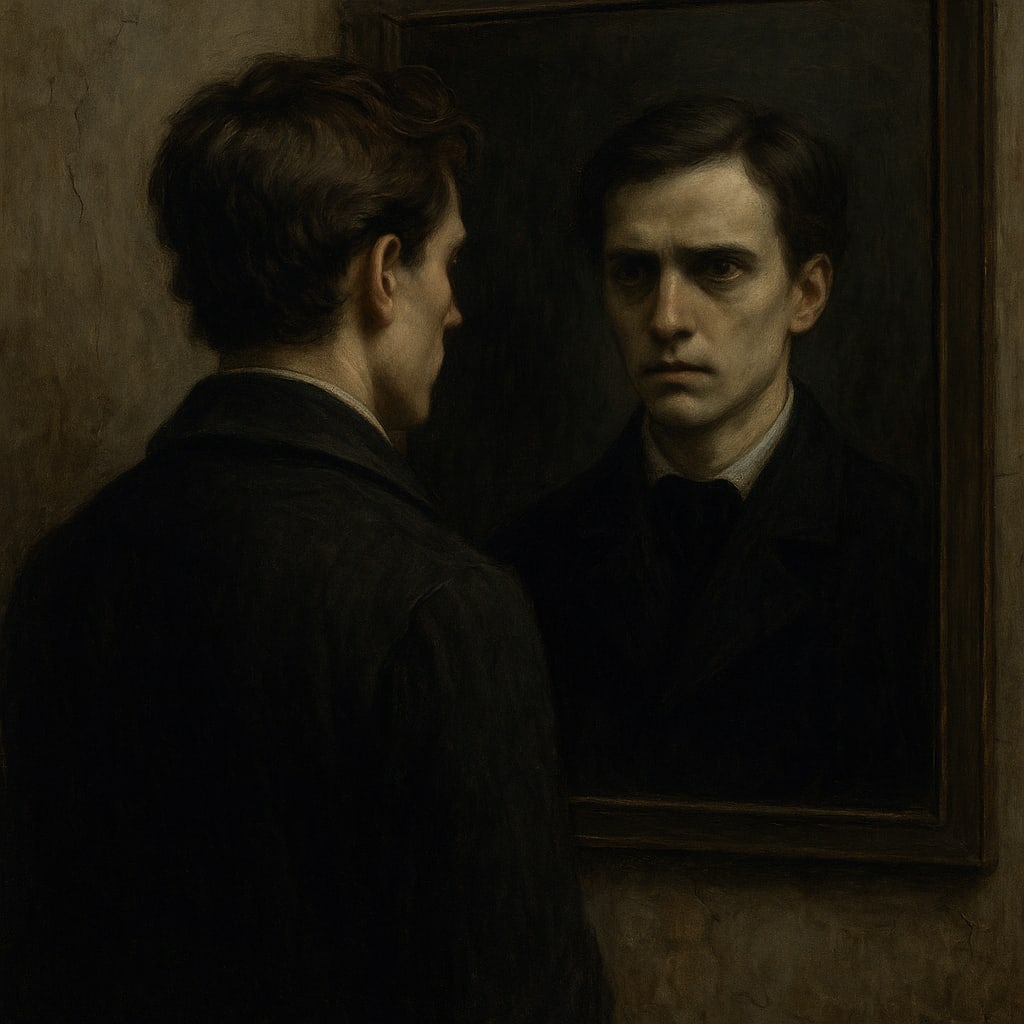
There are few things more unsettling than seeing your own face staring back at you. Not from a mirror, not from a photo, but from across the street, or sitting silently in a chair that should be empty. The idea of the "Doppelgänger"; the double who walks in your shadow, has haunted human imagination for centuries. Across cultures and generations, stories emerge of people meeting their exact twin: same eyes, same posture, same very essence.
Sometimes, the double is silent, watching. Other times, it seems to mimic or anticipate the person’s movements. And in some of the darkest accounts, it serves as an omen, appearing only to signal that death or tragedy is close at hand.
Whether we explain it as folklore, psychology, or something paranormal, the doppelgänger has proven remarkably persistent. From ancient myth to modern-day reports, the double-walker continues to follow us, an uncanny reflection that refuses to stay in the mirror.
Shadows of Folklore
The word doppelgänger itself is German, meaning “double-walker.” It first gained literary traction in the 18th century, but the belief is older, much older. In German tradition, the doppelgänger was never a positive sign. To see your double was to invite misfortune. In some tales, the doppelgänger was a ghostly twin with no shadow, drifting silently through familiar places.
But the Germans were far from alone in imagining such doubles. In Ireland, folklore speaks of the fetch. To see a fetch; the spirit-double of someone you know... was a certain death omen, for them or for you. Norse mythology brings us the Vardøger; a phantom twin that precedes you in action. People might swear they heard you arrive, saw you perform tasks, even spoke with you... only to encounter your real self later.
Other cultures have variations too. In ancient Egypt, the concept of the ka represented a spiritual double that lived alongside a person. In Native American traditions, some stories describe shadow-selves that wander during dreams. In each of these, the theme remains: the double is not a blessing, but a warning.
Faces in History
Folklore alone would be enough to give the doppelgänger weight. But history provides stories that are just as chilling.
Catherine the Great, the powerful Empress of Russia, was said to have once witnessed her double sitting calmly on her throne. Alarmed, she demanded her guards fire upon the figure, but their bullets passed through the apparition. Not long after, Catherine was dead.
Abraham Lincoln, known for his dreams and premonitions, told a curious tale shortly after his first election. Gazing into a mirror, he saw not one, but two faces staring back: his own, but one pale and ghostly. His wife, Mary Todd Lincoln, believed this was a portent of tragedy... that the pale reflection symbolized death. Lincoln himself half-dismissed it, but privately admitted it troubled him. Within five years, he was assassinated at Ford’s Theatre.
The poet Percy Bysshe Shelley also carried a story of doubles. He spoke of encountering his own image, silent and unsettling, on multiple occasions. Once, his doppelgänger pointed toward the sea. Soon after, Shelley drowned in a sailing accident.
Even the German writer Goethe, who gave us so much of the Romantic movement, told of seeing his own double on a road in Strasbourg. Years later, he realized he had become the figure he saw; wearing the same clothes, taking the same path. Was it a premonition, or something even stranger?
History doesn’t stop at royalty and poets. Countless lesser-known accounts exist: soldiers glimpsing their doubles on battlefields, statesmen seeing silent replicas in their chambers, ordinary people catching their likenesses at windows, only to fall ill soon after.
The Double in Literature and Legend
The eerie appeal of the doppelgänger has long seeped into literature. Writers from Dostoevsky to Edgar Allan Poe have explored the theme of the double. In Poe’s story William Wilson, the protagonist is haunted by a figure identical to himself, a double who thwarts his every wicked intention.
To Victorian readers, this wasn’t just a horror trope. It was tied to real fears of identity, madness, and the possibility that the self could fracture. In a world grappling with spiritualism, mesmerism, and the first sparks of psychology, the double seemed plausible. After all, if the soul existed, could it not cast a shadow of its own?
Modern Encounters
It would be comforting to think of doppelgängers as mere relics of folklore and superstition. Yet, reports persist to this day.
Online forums are littered with accounts of people seeing themselves in public. Walking down a street in another city, riding a bus at the same time they’re at home, standing silently in doorways. Sometimes the resemblance is so precise that friends or family members are fooled. One woman in Louisiana described running into her exact double in a grocery store, down to the mole on her chin and the freckle by her left eye. They both froze. Neither spoke. The other woman turned and left.
In another case, a man driving late at night swore he saw himself standing at the roadside, illuminated briefly by his headlights. Startled, he stopped the car. No one was there. Weeks later, he was nearly killed in a car accident on the same stretch of road.
Some of these modern reports may have rational explanations. Mistaken identity is common, especially in moments of stress or poor lighting. But there are accounts that defy easy dismissal. Sightings where multiple witnesses describe the same uncanny detail, or where the double appears in places the original could not possibly be.
The Science of Seeing Yourself
Psychology and neuroscience have attempted to grapple with the phenomenon of doubles. A condition called Heautoscopy... a rare neurological disturbance, causes a person to perceive their own body outside themselves. In these cases, patients may literally see a double, as vivid as a flesh-and-blood person. The causes are poorly understood but are linked to disruptions in how the brain processes self-image and spatial orientation.
Another condition, Capgras delusion, causes sufferers to believe that familiar people, even family members, have been replaced by identical impostors. While different from the classic doppelgänger tale, it underscores how fragile our perception of identity truly is.
Scientists often chalk doppelgänger sightings up to a blend of mistaken identity, fatigue, stress, or neurological oddities. But even the most skeptical admit there’s something profoundly unsettling about the human tendency to conjure doubles.
Paranormal Theories
Of course, science doesn’t hold all the answers, and the doppelgänger thrives precisely because it dwells in the borderlands of explanation.
Some paranormal researchers view doppelgängers as spirit entities; echoes of the soul that sometimes manifest visibly. Others suggest they are dimensional bleed-throughs: "glimpses of parallel selves walking beside us in alternate timelines."
Still others claim they are omens, plain and simple. To see your doppelgänger is to brush against the veil of death itself. That’s why the most famous accounts end in tragedy. Not because the double caused death, but because it signaled fate closing in.
In recent years, the “glitch in the Matrix” theory has gained traction, fueled by the internet. According to this view, doppelgänger sightings are not spirits but system errors. Moments when reality stutters and you glimpse a copy of yourself rendered in another layer of existence. It’s a digital-age reimagining of an ancient fear, but one that resonates in an era where simulation theories and multiverse speculation abound.
What the Double Wants
Perhaps the most terrifying element of the doppelgänger myth is not knowing what the double wants. Unlike ghosts, who may seek resolution, or demons, who crave destruction, the doppelgänger rarely speaks. It simply appears.
The silence is unbearable. When people describe their doubles, they almost always mention the eyes. The stare feels hollow, endless, as though the double is not merely looking but measuring. In folklore, the double’s presence often leads to illness, accidents, or death. Foreboding outcomes that give the impression that the double’s intent is not neutral. It may not need to act at all; it simply heralds the inevitable.
The Uncanny Reflection
When you look in the mirror, you expect to see yourself. When you see yourself somewhere you should not be... in the street, on a throne, pointing to the sea, the natural order is broken.
Doppelgänger stories survive because they speak to something primal in us: the terror of losing identity, of being replaced, of realizing that we are not unique. It’s the ultimate horror of recognition.
Tonight, as you close this article, you might glance once more at the shadows in the window, or at the stranger across the café. Maybe they’ll glance back. Maybe you’ll see something in their eyes that looks too familiar.
And if you do... you may want to turn away before it’s too late.
About the Creator
Veil of Shadows
Ghost towns, lost agents, unsolved vanishings, and whispers from the dark. New anomalies every Monday and Friday. The veil is thinner than you think....
Keep reading
More stories from Veil of Shadows and writers in Horror and other communities.
The Scariest UFO Encounters on Record...
We begin this story with a simple but chilling claim: what follows are not campfire inventions, nor “sounds creepy, so let’s include it” filler. These are documented eyewitness accounts. Cases preserved in files, reports, and transcripts, that anyone can access. That fact alone multiplies the dread tenfold.
By Veil of Shadows6 months ago in Horror
The Gluttony of Blackwood Manor
The Gluttony of Blackwood Manor The fog that clung to the Blackwood estate was not weather; it was breath. It sat heavy on the lungs, tasting of copper and wet ash, wrapping the Victorian spires in a shroud that never lifted, even at noon.
By Mohammad Hamid3 days ago in Horror



Comments
There are no comments for this story
Be the first to respond and start the conversation.