
The Mountain That Ate the Sky horror
"Some Mountains Don't Want to Be Climbed."

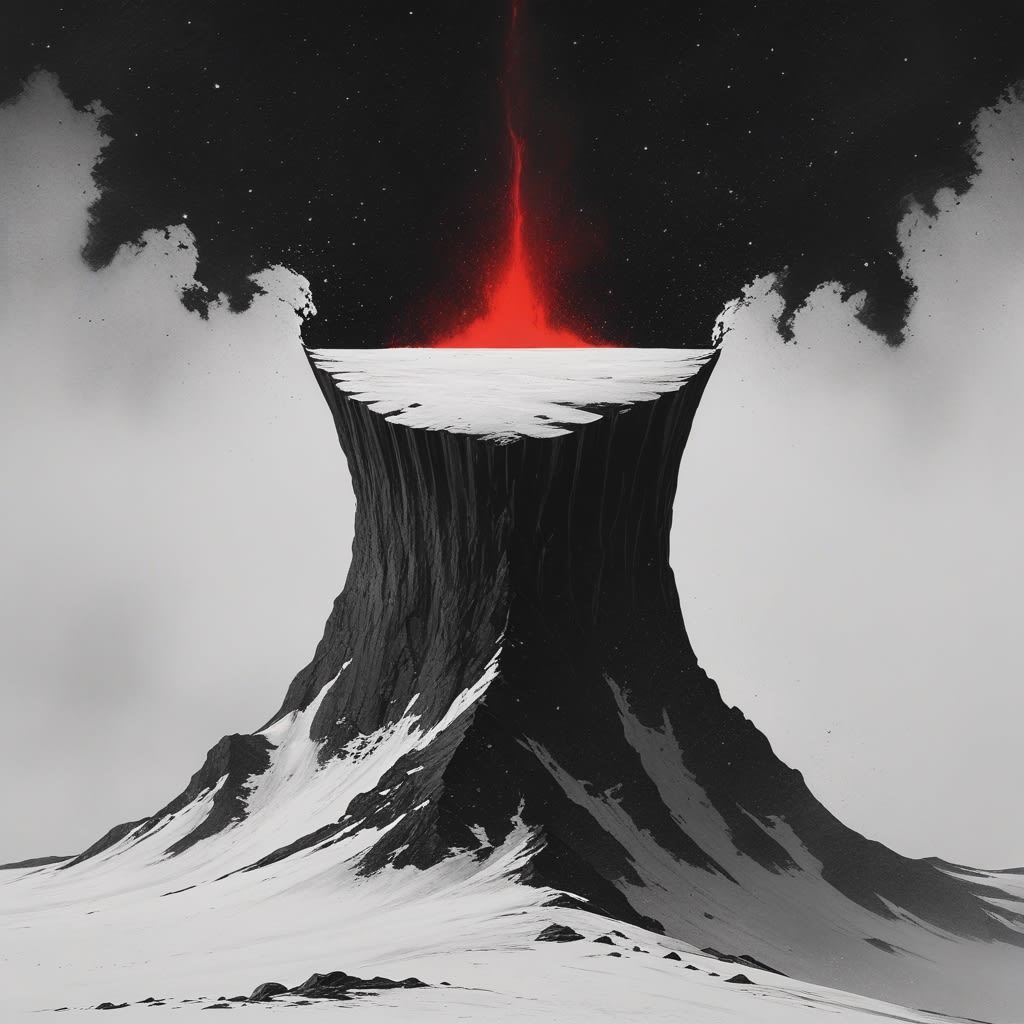
The Mountain That Ate the Sky
By Dr. Nivara Bloom
---
They call it Iskara. The mountain that ate the sky.
You won't find it on any map, not anymore. Coordinates are scrambled, digital records erased, and satellite feeds always go dark when they sweep over that part of the world. The locals in Northern Siberia believe the mountain is alive—that it breathes, hungers, remembers.
I didn’t believe them. Not until I went there myself.
I am Dr. Nivara Bloom, climatologist, atmospheric researcher, and now, perhaps, the last witness to the truth. This is not a scientific paper. It is a confession.
---
It began with a black envelope left at my office door. No postage. No name. Just a brittle envelope sealed in blood-colored wax. Inside, I found three things: a crumpled photograph of six mountaineers from 1963, a hand-drawn map of an unmarked peak, and a torn journal page with one sentence scrawled in Russian: "She wakes when the sky turns black."
I should’ve burned it.
Instead, I boarded a plane.
I told myself I was going for research. For answers about the region's strange weather patterns and magnetic anomalies. But part of me—some deeper, hollowed-out part—was drawn to the mountain for reasons I still can’t explain.
---
When I arrived in the village of Kharovsk, the people would not meet my eyes. An old woman spat when I asked about Iskara. A boy drew a mountain on the ground and then scratched out the sky above it. His father slapped him hard and dragged him inside.
Still, I found a guide.
Mikhail Petrov, a former Soviet ranger who had grown up near the mountain, agreed to take me halfway. “I do not go to her mouth,” he said. “Only fools try to feed her.”
We hiked for three days through dense pine forest and brittle ice. On the morning of the fourth, Mikhail stopped at a rusted fence wrapped in barbed wire and prayer cloths. He refused to cross it. “This is where I leave you,” he said, handing me a flare gun. “One flare if you need help. Two flares if you want to die faster.”
He turned and vanished into the trees.
---
Iskara was taller than I imagined. Taller than logic allowed. Jagged cliffs pierced through churning clouds like black ribs. There was no wildlife. No birds. Not even the sound of wind—only a dull, pulsing pressure in my ears, as though the mountain itself had a heartbeat.
I set up camp at base elevation and began collecting readings. My instruments went haywire. Compasses spun in circles. Barometers cracked from internal pressure. At night, the sky did not darken—it vanished. No stars. No moon. Just an endless, suffocating void. It was then I realized: the mountain hadn’t eaten the sky metaphorically.
It had literally taken it.
---
On the second night, I heard the voices.
They came from the rocks. Whispers like wind, but sharper. They spoke in languages I didn’t know—and yet I understood. They called me by name. Told me about my mother’s funeral. My failed marriage. My miscarriage.
They said, “She can give it back.”
I didn’t sleep.
---
On the third day, I found the climbers’ camp—the same one from the photograph. Tents shredded from the inside. Blood frozen on snow. A mirror nailed to a tree, cracked in seven places. On one flap of canvas, written in something like charcoal, were the words:
"She doesn't want to be seen. She wants to be felt."
I should’ve left. I should’ve lit the flare.
But instead, I climbed.
---
It took six hours to reach what should’ve been a ridgeline. But the terrain kept changing—what looked like solid ground turned into ice. Rock turned to ash. I swear the sky above me pulsed, a heartbeat echoing through the air. I looked up and realized I was no longer beneath a sky.
I was inside a mouth.
The clouds weren't clouds—they were teeth. The darkness wasn’t night—it was her throat.
I fell to my knees as the mountain spoke—not in words, but in emotion. A roar of loneliness. Hunger. Rage. She had once touched the stars and been cast down. Forgotten by gods and men.
And now she wanted to be remembered.
By devouring what we loved most: the sky.
---
I saw them then—the missing climbers. They stood around me, faces frozen, mouths sewn shut. One reached out a skeletal hand and pointed toward a narrow cave. “She waits,” I heard inside my mind.
I ran.
I didn’t stop until I reached the camp. I fired both flares, one after the other. I screamed, not for help, but for mercy.
Mikhail found me the next morning. I don’t remember speaking. I don’t remember the flight home. I only remember the pressure in my ears. The silence in the sky.
---
Now, months later, I see her in my dreams.
The mountain calls to me with each thunderstorm, each eclipse. I’ve resigned from the university. Instruments still arrive in crates, but I’ve stopped opening them. There’s no need to measure anymore.
I already know.
The sky is missing.
And she is still hungry.
---
Postscript
To anyone reading this: burn it. Erase my name. Forget the mountain.
Because remembering her… is how she finds you.
— Dr. Nivara Bloo
About the Creator
Dr nivara bloom
Dr. Nivara Bloom writes from the heart, blending emotion, mystery, and meaning into every story.
Keep reading
More stories from Dr nivara bloom and writers in Horror and other communities.
The Devil at Kuldhara Based on the real abandoned village of Kuldhara, Rajasthan, India.
The Devil at Kuldhara Based on the real abandoned village of Kuldhara, Rajasthan, India. They say no one has lived in Kuldhara for over 200 years. Not since the villagers vanished overnight — every door left ajar, every pot left boiling, and not a single trace of struggle. Just silence.
By Dr nivara bloom10 months ago in Horror
"Scream 7" (2026): Running out of Fresh Screams
This is the seventh time we’ve had a Ghostface crisis. Scream 7 is the latest edition of the Scream franchise. Sydney Prescott and her family are under attack by another anonymous killer dressed in a Ghostface costume. While having issues with her daughter, Tatum, they run from the bloody murders, trying to determine who is behind it all.
By Marielle Sabbag6 days ago in Horror


Comments
There are no comments for this story
Be the first to respond and start the conversation.