
The Lion and the Lamb
A Tale of Courage, Kindness, and Unlikely Friendship
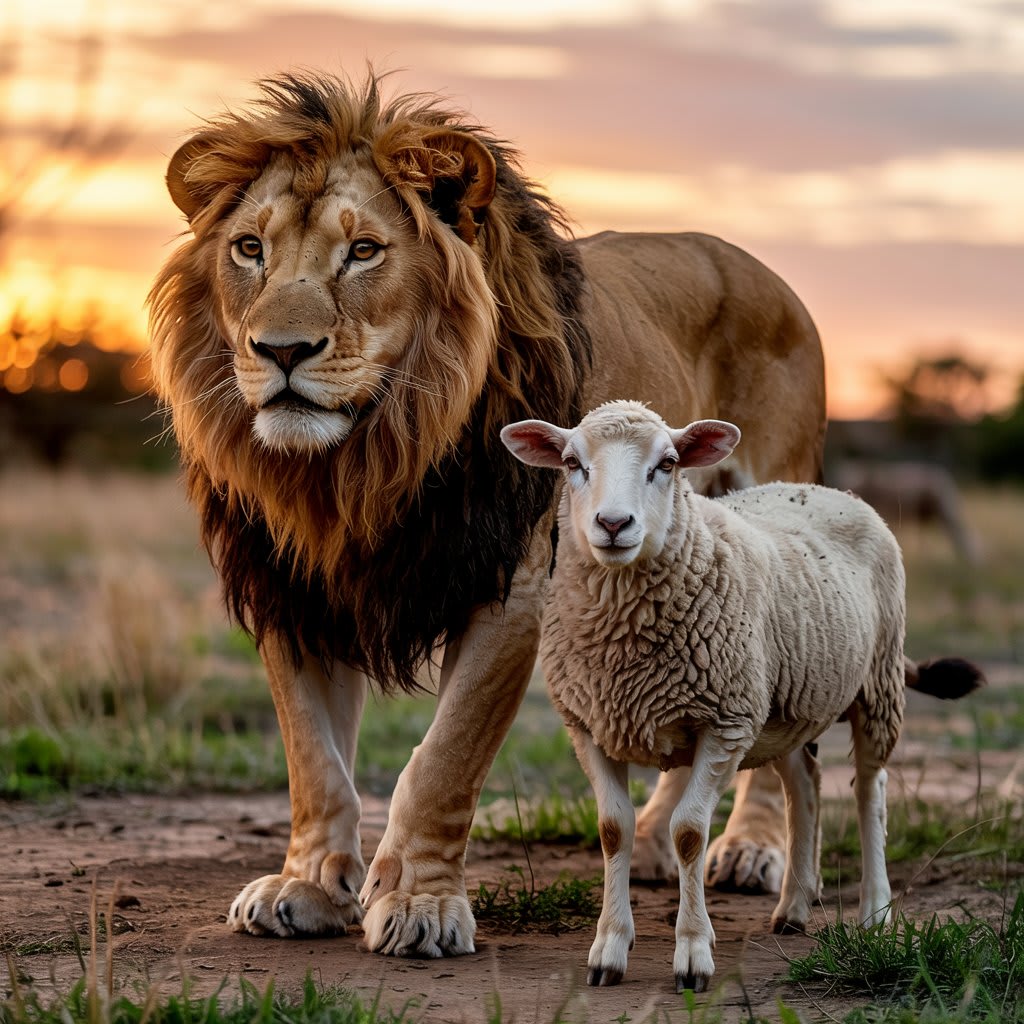
In the golden grasslands of the Great Savannah, where the sun blazed high and the wind whispered through the acacia trees, lived a mighty lion named Kazi. His mane was thick and dark, his roar could shake the skies, and all animals knew him as the King of the Savannah.
Kazi was feared by all. The antelopes ran at the sound of his paws. The zebras scattered when he appeared. Even the elephants, proud and large, gave him a wide berth. He ruled with strength, pride, and an unshakable sense of solitude.
In a quiet corner of the same vast land lived a small sheep named Luma. She was gentle, soft-spoken, and always surrounded by her flock. Unlike Kazi, Luma had never needed to roar, fight, or command. She had learned to survive by staying together, avoiding danger, and trusting her instincts.
One particularly dry season, the grass turned brown, and the rivers shrank into muddy puddles. Food became scarce, and tension ran high across the plains. Kazi, proud as he was, had not eaten in days. His body ached, and the hunger gnawed at his dignity more than his belly.
On the same day that Kazi’s hunger peaked, Luma found herself separated from her flock while seeking water. A sudden stampede of startled gazelles had scattered many animals, and in the chaos, she was lost.
She wandered alone, her white coat dusty, her legs trembling. As the sun began to set and shadows stretched long across the land, Luma came upon a waterhole—a rare sight in the drought-stricken savannah.
But she was not alone.
Kazi was already there, lying beside the water, his great head resting on his paws, eyes half-closed. His ears twitched when he heard her timid steps. He looked up, and their eyes met.
Luma froze.
Every instinct in her small body screamed to flee. She had heard stories of Kazi’s hunts. Of how he could leap with the power of a storm. Her legs stiffened, but her hooves felt rooted to the ground.
Kazi stared at her, too tired to rise. He was indeed hungry—but he was also exhausted, both in body and in spirit. As he looked into the eyes of the tiny, terrified sheep, something stirred in him—something he had long buried under his roar.
“What are you doing here, little one?” he asked, his voice deep but not harsh.
“I... I got lost,” Luma stammered.
“You should not be here. I am not safe,” Kazi warned.
Luma gulped, but then, with quiet bravery, she stepped forward. “You don’t look dangerous right now. You look... tired.”
Kazi let out a rough, dry chuckle. “That’s because I am.”
Silence fell between them, broken only by the occasional croak of a distant frog or the whisper of wind. Luma inched forward and knelt by the water’s edge, her eyes still watching Kazi warily.
They drank side by side. The lion and the lamb.
That night, Luma did not leave. Perhaps it was exhaustion, or a strange sense of trust—but she lay down a short distance from Kazi, under the stars.
Over the next few days, they stayed near each other. Luma would find patches of grass to nibble on and bring Kazi information—where the wildebeest had last passed, where the vultures were circling. She had a way of observing the land that Kazi, with his prideful stride, had never bothered to learn.
In return, Kazi kept her safe. Jackals and scavengers avoided the place where the lion rested. The mere scent of him was enough to shield Luma.
At first, Kazi viewed the sheep with curiosity. But soon, curiosity turned to admiration. Despite her size, Luma was brave. Not in the loud way of warriors, but in the quiet way of those who stand their ground when it matters.
And Luma, too, began to see the lion not as a monster, but as a creature weighed down by loneliness. He had been king for so long, but with no one to talk to, no one to care for—what was the point of the throne?
Weeks passed, and the rains finally came. The rivers rose, the grass turned green, and the herds returned. So did Luma’s flock, who found her one morning grazing near the waterhole, side by side with the lion they had feared all their lives.
Panic spread among them. “Luma! Get away! He’ll eat you!”
But Luma stood firm. “He won’t. He’s my friend.”
Her flock did not understand. Not at first. But they saw how Kazi never lunged. Never growled. He simply nodded in their direction and turned back to the water.
And so, the lion and the lamb became a symbol of something new.
Other animals began to approach the waterhole. Carefully at first, then with trust. Kazi, once the feared ruler, became a guardian. A protector of peace, not by force, but by choice.
He and Luma would sit often beneath the acacia tree, speaking of the old days, and dreaming of the future.
One day, Luma said, “You could have eaten me that day.”
Kazi smiled. “I could have. But I was tired of being feared. You gave me something no one else ever did—a reason to change.”
And so, under the wide African sky, the lion and the lamb lived not just in peace—but in friendship. Their story spread across the plains, carried by birds and breezes, as a tale of how even the fiercest heart can learn gentleness, and how the smallest soul can inspire great change.
About the Creator
Keep reading
More stories from writers in Horror and other communities.
The Ninth Hour of Malachi : SEASON 2
Season 2 Chapter 5 BROKEN DOCUMENTED FACT: The Monastery of the Silent Veil was built on the ruins of a pre-Christian pagan site known for ritual sacrifice. Historians note a significant number of suicides among the early monks, with bodies often found twisted into unnatural postures, mimicking the position of a figure being broken on a wheel. The term "Malachi's Hour" first appears in a 13th-century text, referencing the ninth hour of the day...the hour of ultimate darkness before dawn.
By Tales That Breathe at Night5 days ago in Horror
Affection and Healing for Yourself
During the night of the last quarter moon, I gathered my ritual supplies. I carefully handled the chunk of black tourmaline that would protect me from your overall negative and narcissistic energy. I carefully walked the house with my stick of selenite in hand, asking the universe to cleanse our working space.
By Alisha Wilkins ✒️🦋🖋️7 days ago in Fiction




Comments
There are no comments for this story
Be the first to respond and start the conversation.