

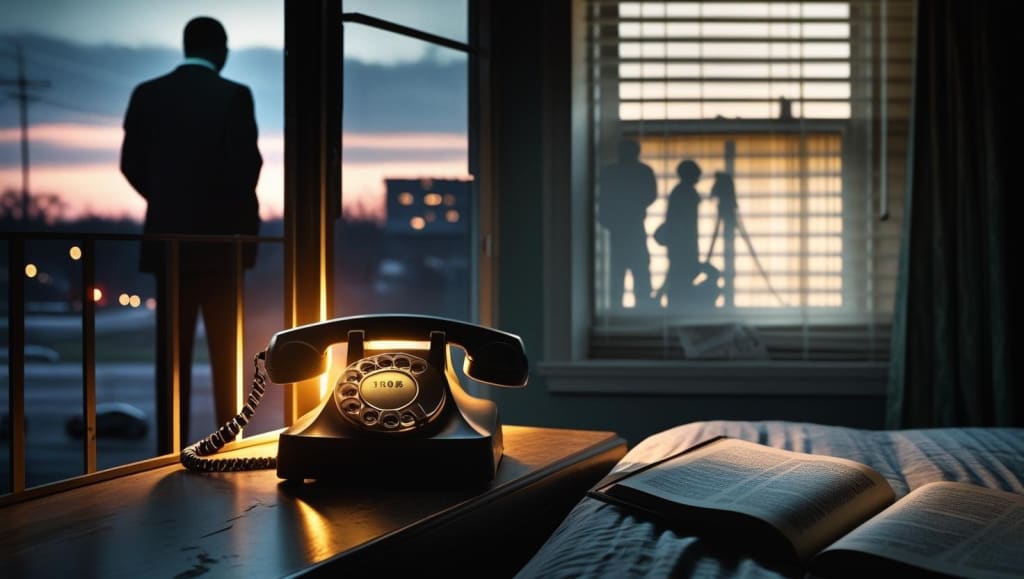
The walls of Room 306 were a pale green, the kind that looked dull even in the morning light. A rotary phone rested on the nightstand between two twin beds, its cord slightly tangled, receiver cradled tightly in place. Dr. Martin Luther King Jr. had been up since dawn. The Memphis sky was overcast, but the energy around the Lorraine Motel buzzed with purpose.
It was April 4, 1968.
Outside, supporters and friends moved between rooms, sharing coffee, newspapers, and quiet anticipation for the march scheduled for the next day. Inside 306, King sat near the phone, writing a few last notes for the speech he planned to give that evening at Mason Temple. The air was thick with reflection. Not fear—he had long made peace with that—but with a weight of inevitability.
Andrew Young walked in without knocking, holding a newspaper and wearing a sly grin.
“You were right,” he said. “The court approved the march.”
King smiled but didn’t lift his eyes. “Good. Let’s hope it stays peaceful.”
Young sat on the edge of the bed, folding the newspaper in his lap. “You know, that speech last night… you were preaching like you knew something.”
King finally looked up. “Maybe I did.”
The phone rang once—sharp, sudden. Young flinched. King reached for it with calm fingers.
“Room 306,” he answered.
The voice on the other end was familiar, tired, and slow. Reverend Ralph Abernathy.
“Martin, just checking in. Dinner’s ready downstairs, and Jesse says you still haven’t changed clothes.”
King chuckled. “Always watching me, huh?”
Abernathy’s voice lowered. “You good, brother?”
There was a pause. King turned toward the window, seeing his own reflection in the glass, faint and flickering.
“I’ve been thinking,” he said. “If this is the end of my road, Ralph, I’m okay. But I’m worried about what’s next for all of you.”
“You’ve carried enough. Let us carry the rest,” Abernathy replied softly.
A beat passed. King smiled, full of love and sorrow. “See you in ten minutes.”
He hung up and stood, stretching slowly, as though waking from a long nap. “They’re ready downstairs,” he said to Young, who nodded and stood to straighten his tie.
King walked to the dresser, pulling out a fresh shirt and blazer. He paused before the mirror, fixing his collar. Outside the room, the distant sound of a car horn and the echo of footsteps filled the air. Life went on. Memphis breathed.
On the balcony, James Orange and Jesse Jackson were laughing about something. Orange was telling a story—probably the one about the farmer and the mule again. King stepped out into the air, crisp and sweet with the scent of spring blossoms. He placed both hands on the railing and looked out over the parking lot, taking it all in: the quiet rustle of trees, the soft hum of a city on the edge of something it couldn’t name.
“Doc!” Jesse called out, “Don’t you want to see what they cooked up downstairs?”
King turned, smiling. “I’m coming. Just admiring the view.”
A camera clicked below—journalists always waiting, always watching. He thought of Coretta, of his children, of the letter he’d written from Birmingham Jail, of Selma, of Montgomery. His life had been one long call—sometimes a shout, sometimes a whisper—but always a call.
And now, it felt like the line was going quiet.
A sharp crack split the evening air.
For a moment, no one moved.
Then chaos. Screams. Running feet. Jesse yelling, “Get an ambulance!” Andrew grabbing at King’s shirt, calling his name over and over. Blood pooled under the balcony. The phone inside Room 306 rang again, unanswered.
---
The next morning, a maid entered the room, her hands trembling. She hadn’t slept. She looked at the bed, still made. The blazer lay over the back of the chair. The phone was off the hook, humming an empty dial tone.
She stepped to the window, pulled back the curtain, and looked down at the now-empty parking lot. A small bouquet of flowers had been laid just below the balcony. Someone had scrawled a note on the motel notepad and slipped it under the door:
“You spoke. We heard. Now it’s our turn to answer.”
She placed the phone back on the receiver. The click echoed in the silent room.
And Room 306 fell quiet again.
But far beyond that motel, the last call still rang out—in marches, in songs, in cries for justice. A voice silenced, but never gone. A call made, waiting for the world to pick up.
About the Creator
Reader insights
Nice work
Very well written. Keep up the good work!
Top insight
Masterful proofreading
Zero grammar & spelling mistakes
Keep reading
More stories from Farid Ullah and writers in Horror and other communities.
Inside the Mind: The Secret Mechanics of How We Think
Have you ever stopped in the middle of a thought and asked yourself, “Why am I thinking this?” One minute you're focused on work, the next your mind is replaying a childhood memory, jumping to future fears, or dreaming up wild imaginations. Our thinking seems random, chaotic, and unpredictable—but beneath that surface lies a complex and fascinating system that runs our entire experience of life.
By Farid Ullah6 months ago in Education
5 Most Haunted Objects in History: From Annabelle to Robert the Doll
I have a confession to make: I am obsessed with European history, specifically castles. There’s something about a stone fortress that feels like a magnet for the paranormal. In my mind, every castle is haunted, usually by a lady in a white dress, a headless nobleman, or (the absolute worst) creepy ghost children.
By Areeba Umair6 days ago in Horror
Miss Persephone's Manual to a Seemingly Ordinary Life
Miss Persephone was found at the dining table, her blue eyes swollen, her tears arriving and retreating like the tides of the ocean. Earlier that day, her family had visited her in the retirement home where she had lived for eight years. It was her eightieth birthday.
By Imola Tóth2 days ago in Fiction



Comments (1)
Masterful