
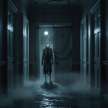

No one had lived in the Hawthorne House for over forty years not since the Carter family vanished without a trace one cold November night. No signs of struggle, no open doors, just dinner half-eaten on the table, and silence thicker than fog.
Locals didn’t talk about it much. They crossed the street when walking past it. Even the birds never sat on its roof. The place had a way of watching… waiting.
So when Nora, a young historian, arrived in town determined to document abandoned homes, no one warned her about Hawthorne. Or maybe they did, but the warnings came in glances and shifting eyes things she was too focused to notice.
She stepped into the house on a rainy Thursday, the sky bleeding gray, her boots squelching into the damp carpet. The air was stale, but not empty. It was heavy, like breath held too long.
Her phone flickered. Then died.
She muttered, “Of course,” and took out her flashlight.
The furniture was still there. A rocking chair swayed ever so slightly, as though someone had just gotten up. There was a child’s drawing on the wall, scratched over in crayon. She paused. The scribbles had eyes.
Cobwebs danced with the light as she passed through the narrow hallway. The sound of dripping water echoed, though no leak could be found. The floor creaked, but not just beneath her like something beneath the floor was shifting, breathing, turning.
In the hallway, the wallpaper peeled in strips, revealing something strange beneath—not wood or concrete, but what looked like pale skin. She touched it, and it was warm.
That’s when she heard it.
A whisper.
Very faint. Like someone mouthing her name behind her ear but never breathing it out. She turned. Nothing.
Again. Closer.
Nooorraa…
She spun around, heart racing. There was no one there. But now the air felt tighter. Her flashlight dimmed, then flared back. On the wall behind her, the drawing had changed. The eyes were wider. The smile was gone.
She ran out of the hallway, her heart punching her ribs, but every door she opened led back to the same place. The same hallway. The same drawing. The same whisper.
Nora was rational. She didn’t believe in ghosts. But when she checked her wrist and saw bite marks, her logic began to rot. The skin was broken, raw. She hadn’t felt it happen.
Then the lights turned on.
All of them.
A voice crackled from the old radio on the shelf. No power. No batteries.
Still, it spoke.
"You shouldn’t have come."
The air grew colder. She could see her breath now, curling like smoke. Shadows gathered in corners, slow and deliberate. One by one, they blinked.
Yes they blinked.
The house wasn’t haunted. It was alive.
Each room was an organ. The creaking floorboards, its groans. The walls, its skin. The windows, its eyes. And the whispers—its voice.
She screamed when the staircase folded in on itself, becoming a spine. Something above the chandelier slithered, wet and massive. It dropped like a rope, then retracted with a hiss.
And then everything went dark.
When Nora awoke, she was outside. Mud on her face. Blood in her ears.
She crawled to the road, barely able to scream. A farmer found her and called for help. She survived.
But she never spoke again.
Not because of fear.
But because she said the house had taken her voice.
It speaks with it now.
At night, if you walk near Hawthorne House, you may hear a woman whispering from the shadows.
It isn’t a ghost.
It’s the house calling your name, using the voices of those it’s already eaten.
And if you answer…
you’ll never leav
Some doors don’t close behind you—they close inside you, locking away the part that dared to listen when silence spoke.
Thank you very much for reading!❤️
About the Creator
"Scream 7" (2026): Running out of Fresh Screams
This is the seventh time we’ve had a Ghostface crisis. Scream 7 is the latest edition of the Scream franchise. Sydney Prescott and her family are under attack by another anonymous killer dressed in a Ghostface costume. While having issues with her daughter, Tatum, they run from the bloody murders, trying to determine who is behind it all.
By Marielle Sabbag5 days ago in Horror
A 12-Year-Old’s Descent from Urban Legend to Attempted Murder
In the quiet suburbs of Waukesha, Wisconsin, in May 2014, a story emerged that seemed more like a horror movie plot than a police report. Three 12-year-old girls went into the woods to play, but only two walked out willingly. The third, Payton Leutner, was left bleeding from 19 stab wounds, the victim of a calculated sacrifice intended to please a fictional internet character known as Slender Man.This case remains one of the most disturbing examples of how the digital world can bleed into reality, blurring the lines between childhood imagination and dangerous delusion.The Myth of Slender ManTo understand why two pre-teens would commit such an atrocity, one must understand the "deity" they served. Slender Man originated in 2009 on the Something Awful forums as a "Creepypasta"—a type of internet horror legend. He is depicted as a tall, faceless man in a black suit with tentacle-like appendages.For most, he was a fun, spooky story. But for Anissa Weier and Morgan Geyser, he was terrifyingly real. They believed that in order to become his "proxies" and protect their families from his wrath, they had to kill someone.The Day of the AttackThe plan was orchestrated over several months. On May 31, 2014, following a birthday sleepover, Morgan and Anissa lured Payton into a local park under the guise of playing hide-and-seek. Once in the woods, the situation turned graphic.Morgan Geyser carried out the physical attack, stabbing Payton 19 times with a five-inch kitchen knife while Anissa encouraged her. The blade missed Payton’s heart by less than a millimeter—a distance described by doctors as the "width of a human hair."After the attackers fled, Payton displayed incredible resilience. Despite her life-threatening injuries, she crawled out of the woods toward a nearby bike path, where a passerby discovered her and called 911.The Legal and Psychological AftermathThe case ignited a global conversation about the impact of the internet on developing minds. Both girls were charged with first-degree intentional homicide, but their defense teams argued they were not monsters, but children suffering from severe mental health issues.The FindingsMorgan Geyser: Diagnosed with early-onset schizophrenia. She truly believed Slender Man would kill her family if she didn't act.Anissa Weier: Diagnosed with shared delusional disorder (folie à deux), meaning she had been drawn into Morgan’s delusions until they became her own reality.Ultimately, both girls were found not guilty by reason of mental disease or defect. Morgan was sentenced to 40 years in a psychiatric institute, while Anissa received 25 years. Anissa was released under strict supervision in 2021, while Morgan remains under institutional care.Lessons from a Digital TragedyThe Slender Man stabbing serves as a grim reminder of the "echo chamber" effect of the internet. For these girls, the more they read about the myth, the more evidence they found to support its existence."I believed that if I didn't do it, Slender Man would come and kill my whole family in three seconds." — Morgan Geyser during police interrogation.This case forced parents and educators to realize that the "monsters" children find online aren't always just digital images; they can become psychological catalysts for real-world harm. It highlighted the desperate need for better mental health screening in schools and a more nuanced understanding of how children process online folklore.Conclusion: Survival and ResilienceWhile the story is often centered on the attackers and the myth, the true hero is Payton Leutner. Her survival was nothing short of miraculous. In later years, Payton spoke out, showing remarkable strength and a refusal to be defined by the 19 scars she carries.The Slender Man case stands as a cautionary tale for the digital age—a reminder that while the internet is a place of infinite creativity, for the vulnerable, it can also be a place where the shadows grow far too long.
By Irshad Abbasi 4 days ago in Horror
A Knight of the Seven Kingdoms Series Review (Season 1)
As one of the biggest properties in fantasy, A Song of Ice and Fire remains immensely popular with audiences. After reaching far into the past with House of the Dragon, a second spin-off was on the cards. A Knight of the Seven Kingdoms serves up a bite-sized slice of action and drama, but it still claims a spot among the best small-screen titles.
By Robert Cain7 days ago in Geeks


Comments (1)
Great story! You really managed to create a haunting atmosphere.