

Evelyn was a photographer who chased stories. Not the glamorous kind—she hunted forgotten places: ghost towns, decaying hospitals, overgrown graveyards. So when she stumbled across an obscure blog post about Whistler House, nestled deep in the Adirondacks, she was intrigued.
The post was cryptic. Just one grainy photo of a moss-covered Victorian, and a caption: “The house that remembers.” No location. No history. Just a comment thread full of warnings.
"Don’t go in."
"It doesn’t forget."
"They’ll know you were there."
Of course, Evelyn went.
She spent days combing satellite maps and property records until she triangulated its location. It was deep in the forest, miles from any trail. When she arrived, dusk was bleeding across the sky. The house stood hunched, half-swallowed by vines, windows like empty eyes. She raised her camera. Click.
Inside, the air was thick—like stepping underwater. The floorboards creaked under her boots, each step a memory echoing in dust. Strange: the furniture looked... lived in. A bowl of apples sat on the table, one half-eaten. A jacket was slung over a chair.
Upstairs, she found the master bedroom. A journal sat on the nightstand. She opened it, expecting nonsense. But the first page said:
“Evelyn, stop reading.”
She froze. The handwriting looked like hers.
Flicking to the next page:
“You have to get out before night. They only come when it’s dark.”
Her heartbeat climbed. A prank? She checked the back of the journal. Blank. But she noticed the pages weren’t old. They were fresh. She could smell the ink.
A sudden sound downstairs. Footsteps.
She turned off her flashlight and held her breath. The footsteps were slow. Deliberate. Getting closer. Her hand trembled over her camera. The floorboard just outside the room groaned. She raised the camera instinctively and snapped a photo.
The flash lit up the hallway. Empty.
She turned and bolted down the stairs, slipping on the last step and crashing into the wall. Then something strange happened. Everything went quiet. No wind. No creaking. Even her breathing seemed muffled.
The front door was gone.
Not closed—gone. Replaced by a wall of faded wallpaper.
Panicking, she tried a window. Solid wood behind the glass. She stumbled into the kitchen and found a back door. She yanked it open—and stared in disbelief.
The hallway from upstairs stretched before her.
Same carpet. Same peeling wallpaper. She was looping.
She ran. Room after room, they all twisted back into each other like a maze folding in on itself. Every door, every window, every stair led back to the same place: the bedroom with the journal.
Now the second page read:
“You took their picture. That’s how they see you.”
She dropped the book. Her fingers were trembling.
Suddenly, a click. Her camera, triggered by motion. The screen blinked on. A new image: the hallway. But now, a figure stood at the end of it. Tall. Gaunt. No face—just a swirl of shadows.
She looked up. Nothing in the hallway.
When she looked back down, the screen showed the figure closer. Now halfway down the hall. The camera had taken another photo—automatically.
Click.
Now it was just outside the bedroom.
She grabbed the camera and smashed it against the nightstand. It didn’t stop. Click. Click. The photos kept appearing—each one pulling the shadow closer.
Then a hand landed on her shoulder.
She screamed and spun around. No one was there.
But her shoulder ached, like something had grabbed her hard. In the mirror across the room, she saw a handprint on her jacket. Black and pulsing like a bruise.
And beneath that, her reflection smiled.
She wasn’t smiling.
—
Evelyn doesn’t remember how she got out. One moment she was screaming in that house; the next, she was in her apartment, covered in mud and scratches, the camera beside her—intact. As if none of it had broken.
But something followed.
She stopped sleeping. The journal appeared beside her bed every night, pages filling themselves. The entries weren’t warnings anymore. They were instructions.
“Go back. You left the door open.”
“Someone else went in.”
“They’re in your world now.”
She tried burning the journal. It reappeared. She smashed the camera. It was waiting on her kitchen table the next morning.
Then one day, she checked her camera roll—and saw photos she didn’t remember taking.
A man in a parking garage.
A child on a swing.
A woman staring at a cracked mirror.
All strangers. All caught mid-movement, staring at the lens as if they knew.
The last photo was of her. Taken from across the room.
She was asleep.
She never heard the shutter.
—
Evelyn vanished three weeks ago.
A new blog post showed up on that same obscure site. Same grainy photo of Whistler House. Same caption.
“The house that remembers.”
But now, one more image was added:
A photo of you reading this.
About the Creator
Keep reading
More stories from yaseen rasheed and writers in Horror and other communities.
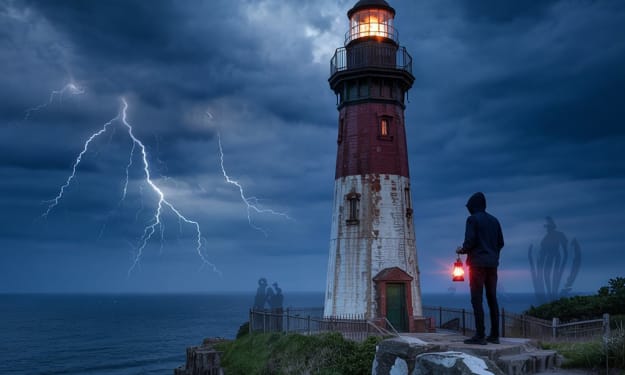
Beacon of the Deep
When the light goes out, the darkness awakens. The wind howled through the cliffs of Ebonreach, hurling sea spray high into the air. Waves battered the base of the lone lighthouse, the ancient structure standing like a sentinel at the edge of the world. For as long as anyone in the village could remember, the light had never gone out—not during storms, not during wars, not even during the night the sea swallowed the fishing fleet whole.
By yaseen rasheed9 months ago in Horror
The Zodiac Killer: Randomness as Rehearsal?
California, late 1960s... The country was loud. Televisions glowed late into the night. Radios carried voices across highways and into homes. America was watching itself, war overseas, unrest in the streets, optimism colliding with anxiety in real time. And in that noise, something learned how to whisper.
By Veil of Shadows3 days ago in Horror

Comments
There are no comments for this story
Be the first to respond and start the conversation.