
The Hollow at Ashridge Peak
Some Roots Should Never Be Remembered (Part 1)

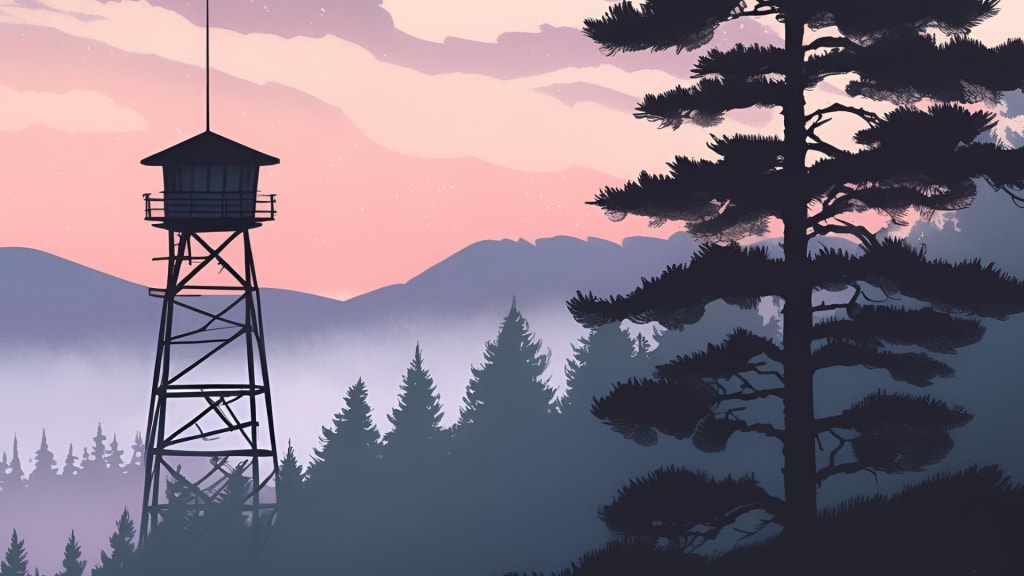
There’s a road out east of Arrowhead Lake that doesn’t show up on most maps. It’s narrow as a snake’s rib and runs shoulder-tight against the edge of a range so steep it makes your teeth ache to look down. The asphalt is cracked and bulging, flaked by frost and heat, beaten soft by time. There are no guardrails. Just gravity and memory.
It’s not a shortcut. It’s not a scenic drive. It’s the kind of road you only take when you’re lost or when something worse is behind you.
The locals call it Ashridge Way, though most don’t call it anything anymore. For good reason. A dozen rusting cars lie at the bottom of its gullies, bleached like bones. The official count says fifteen fatalities over the last ten years. Unofficially, the number is higher. Way higher.
Just past mile marker eleven, there’s a split in the ridge where the trees grow dark and thin. Pines that lean in like they’re listening. That’s where the town used to be. Ashridge Peak.
No signs welcome you. No lights guide your way. It’s the kind of place you don’t find unless it wants to be found. And lately, it’s been wanting.
The people who live there—what’s left of them—don’t talk much. They keep their heads down. They grow their food, fix their fences, light candles when the wind dies.
But sometimes the wind doesn’t die. Sometimes it watches.
They say a long time ago, before the town was built and before the mountains were cut for gold, something buried itself in the roots of those hills. Something that feeds on silence. On memory. On guilt.
It’s not a ghost, they say. Ghosts want to be seen.
This wants to be obeyed.
They used to tell stories around campfires. Warnings in the form of tales. Kids with sharp ears and sharper eyes would listen and swear they saw something in the dark. Something tall. Something still. Something older than sin and quieter than sorrow.
Then the stories stopped.
People forgot. As they always do.
And that’s when it started waking up.
On October 29th, three hikers were supposed to return to a ranger station twenty miles west. They were biologists—paid researchers—sent to study fungal regrowth in fire-damaged soil.
Their tents were found two days later, torn open like paper. Their radios were crushed. Their boots were still by the fire pit, perfectly arranged. And in the center, where the ashes should have been, was a circle of peeled bark, blood-soaked and steaming despite the cold.
None of their bodies were ever recovered.
The locals didn’t go looking. The rangers didn’t press. They marked the site as unsafe terrain and called it a “predator event.”
That’s what they do in these parts. They name it something manageable. Something they can file away.
But that night, one of the oldest women in Ashridge took a spade and dug a hole beside her porch. She filled it with cedar resin, bone dust, and water from the creek that doesn’t freeze. Then she whispered to it.
She hadn’t spoken aloud in over four years.
The next morning, she was gone. Her clothes folded neatly at the foot of the stairs. Her windows sealed shut with mud.
No one knocked. No one called.
Just after midnight, the wind changed direction.
And the trees started whispering again.
Elias Mercer hadn’t planned on coming back to Ashridge.
The last time he’d taken that road, he’d sworn it would be the last. But death, like the mountain, had a way of pulling people home—especially when the dead left no explanation and even fewer footprints.
He drove a 2006 Corolla with a cracked windshield and a failing AC that coughed warm air even with the dial twisted cold. The tires hummed against the worn blacktop like insects caught in glass. His thumb rested on the steering wheel’s old leather wrap, the same spot he always rubbed when he was trying not to think too hard.
The air grew colder as the car climbed.
It was October 31st, though you wouldn’t know it. The sky wasn’t orange with festivity or strung with the fake cobwebs and grinning plastic skeletons he remembered from childhood. It was ash-grey and low. Bruised with stormfront. The trees had thinned on both sides of the road, but they reached higher, as if yearning for something just out of sight.
He hadn't seen another car in an hour. The road behind him had narrowed to a single lane, and the guardrails had disappeared completely. Below, he glimpsed the edge of the valley, where the pine tips vanished into a heavy quilt of mist.
A sign, hand-carved and half-rotted, leaned into the wind ahead:
“Ashridge Peak – 3 mi. Travel slow. Some things don’t want to be disturbed.”
He didn’t remember that sign from before. He didn’t remember the fog being this thick either.
Elias hadn’t been to the town since the funeral. Not the current one—not the one that brought him back now—but the first. The one that really counted. The one that took his younger brother, Caleb.
Caleb had drowned, or so they’d told him. Twelve years ago, in the spring melt, he’d gone down to the lower creek and never come back. His boots were found half-buried in moss three days later. His body never turned up.
Elias had left that week. College, escape, survival—it didn’t matter what he’d told people. The truth was simpler. He’d seen something. Something in the trees the night before Caleb vanished.
And it had seen him back.
Now, his aunt Margaret was dead. Her obituary was three lines long and didn’t make the paper, just the town bulletin board. “Peaceful in her sleep,” the deputy said over the phone. “Probably her heart. She was older, after all.”
But Elias knew better.
Margaret Mercer didn’t die peacefully. She was the hardest woman he’d ever known—razor-voiced and ritual-driven. A walking shrine of the old mountain ways. She collected bones from the riverbank and burned herbs that stank like rot. She always wore black and hung mirrors near every door, "to confuse the ones that watched from the trees."
He hadn’t spoken to her in nearly a decade. But the call still came.
She’d left him the house. And a note.
He hadn’t read the note yet. Just carried it in his coat pocket like a stone.
He reached the town line just as the fog thickened.
Ashridge Peak was little more than a scatter of crumbling buildings, half-built sheds, rust-streaked water towers, and pine boards nailed across old storefronts. The main road bent like a broken wrist before disappearing into the hills. A chapel bell hung silent from its tower. Across from it, the general store was still standing, its windows covered in butcher paper and its porch sagging like tired shoulders.
The only sound was wind and gravel.
Elias slowed as he passed the old bus stop. Someone had spray-painted over the schedule years ago.
“You leave different than you came.”
He didn’t smile.
Not here.
Not now.
The house was just up the hill—past the firewatch station, left at the fork that pointed to nowhere. Margaret’s place had always stood alone, a sharp-edged relic with cedar shingles and heavy shutters. It leaned like it was resisting the wind, though it had withstood every storm since Elias was born.
He parked out front.
The wind stirred the trees, and the trees stirred something in him.
He stepped out and shut the car door. The sound echoed too far.
The house greeted him with silence. The kind that wasn’t empty, just expectant.
He stepped onto the porch. The wood creaked beneath his boots like a breath held too long. The key was still under the crooked planter box. He let himself in.
Inside, the air was the same as he remembered—sharp, woody, laced with something acrid and herbal. The furniture hadn’t moved. The fireplace was stone-black and empty. The walls were lined with books and faded photos of people he couldn’t name. The same mirror still hung over the entryway, wrapped in dried vines.
There, pinned to the back of the door, was her note.
Just a single line in her crisp, spidery hand:
“Don’t let the trees lie to you.”
The first night was colder than he remembered.
Ashridge never got warm—not really—but this was the kind of cold that seeped past your clothes, past your skin, into the marrow. The kind of cold that made silence feel heavier.
Elias lit a fire with the dry logs stacked beside the hearth. The wood was old but burned hot, snapping and hissing like it had something to say. Shadows danced up the stone walls and along the ceiling beams, where dead herbs still hung in bundles. He didn’t know what half of them were—his aunt had called them “guarding greens,” whatever that meant.
He unpacked slowly. The house was mostly as she’d left it: lined with old books, maps, tins of dried things, labeled and sealed with wax. The kitchen still smelled like smoked meat and crushed sage. There was a warmth to it, beneath the dust—like someone had lived here with purpose. Not joy, maybe, but focus. Resolve.
He took the guest room upstairs. Not her room. Not yet.
He was almost asleep when he heard it.
A sound beneath the floorboards.
At first, he thought it might be the old pipes groaning from the fire’s heat. But the rhythm was wrong.
It was tapping.
Three slow taps. Then nothing.
Then a pause.
Then three more—closer.
He held his breath.
And then the silence returned, heavier than before.
The morning brought wind and grey skies. The sun didn’t rise so much as bleed faint color through the cloud cover. He drank stale instant coffee from a chipped mug and stepped out onto the back porch. The trees were still. Too still. Even the evergreens looked muted, like someone had drained them of color.
The forest began just beyond the back fence—an old iron thing swallowed by rust and vine. As a kid, he remembered being warned not to go past it alone. “Things don’t stay gone out there,” his aunt used to say. “And sometimes what comes back isn’t what left.”
She said it like fact. Like weather.
Now, it made him uncomfortable just looking at the trees.
He nearly turned to go inside—until he noticed something on the fence.
A bundle of black feathers tied with twine.
They weren’t there the day before.
He walked to it, slowly. The feathers were oily, too long for any crow. The twine looked handmade—fibrous and coarse. Something was stuffed inside the knot, barely visible.
He hesitated, then pulled it loose.
Inside was a tooth. Human. Molar, maybe. Split and brown at the root.
He dropped it.
Back in the kitchen, he pulled open drawers until he found what he was looking for—his aunt’s ledger.
It wasn’t a diary. It was a catalog.
Years of observations, names, sketches. He flipped past pages filled with moon phases, dried clippings, names he didn’t recognize. On the final page, his eyes stopped.
October 25th – Taproot rising. Wind no longer answers. Something in the wood is listening again. Do not let him stay past the first frost. The forest wants what it was owed.
There was no name. Just a smear of something dark across the bottom corner.
Later, Elias drove into town. He needed air. Perspective.
Ashridge’s “center” was two streets and a gas station. Most buildings were shuttered, abandoned, or only half-used. A small group of men stood outside the feed store, watching him like he'd brought something with him from far away. He nodded. They didn’t.
At the general store, the clerk was a woman in her fifties with sun-creased eyes and hair tied tight. Her nametag read “Marla.”
“You Margaret’s nephew?” she asked as he stepped up with a bottle of water and matches.
He nodded. “I’m Elias.”
She took a long pause before ringing him up. “She was a hard woman. Knew things the rest of us stopped talking about.”
“I didn’t know her well.”
“You do now,” Marla said. “You wouldn’t be here if she hadn’t called you back.”
“She didn’t call me.”
Marla just gave a tired smile.
“That’s not what I meant.”
That night, Elias dreamed of trees bending over him, branches threading through his mouth and nose like needles. He saw his brother Caleb—eyes milky, standing at the tree line—and when he opened his mouth to speak, only the wind came out.
When Elias woke, there were wet footprints on the hardwood floor.
Leading from the back door to his bedside.
But the door was still locked.
(to be continue...)
About the Creator
David Dao
Eager on learning new things.
Killing him slowly
There’s an intruder in my house again. He stumbles through the door, wet carrier bags in hand. He’s bought me offerings. I show my appreciation, letting him caress my beautiful body. He wants to touch me. I rub myself against his legs. He sighs, dropping the bags. He can’t resist touching me. Running his hand slowly down my spine, I arch my back towards his caress, let out a low purr. It’s what we both need.
By N J Delmas5 days ago in Horror




Comments
There are no comments for this story
Be the first to respond and start the conversation.