
The Decomposition of the Human Body in Earth
A Complete Process and Timeline

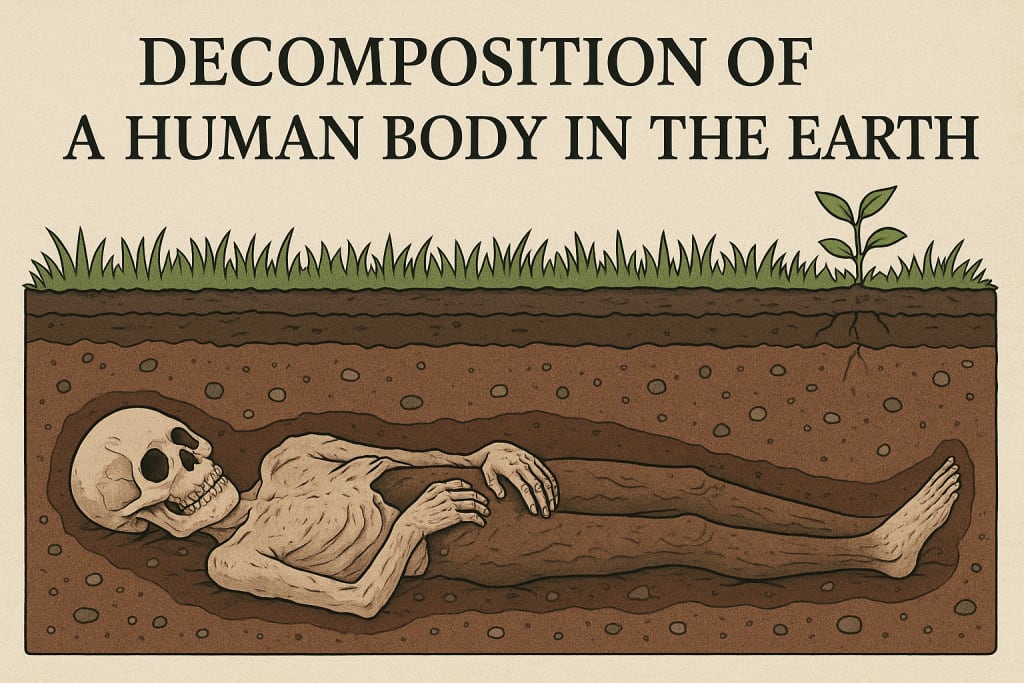
Decomposition is a natural process that occurs after death, wherein the human body undergoes complex biological, chemical, and physical changes as it returns to the earth. The environment, cause of death, burial conditions, and body composition all influence the rate and stages of decomposition. This journal provides a comprehensive examination of the decomposition process, detailing each stage, the biological mechanisms involved, and the timeframes typically observed when a body is buried in the earth.
The Decomposition Process: Overview
Decomposition begins immediately after death and progresses through five major stages:
Fresh Stage (0-3 Days)
Bloat Stage (3-10 Days)
Active Decay (10-20 Days)
Advanced Decay (20-50 Days)
Dry/Remains Stage (50 Days - Several Years)
Each stage is marked by distinct processes and changes within the body and surrounding environment.
Stage 1: Fresh Stage (0-3 Days)
Autolysis: Shortly after death, the body cells cease functioning, leading to self-digestion. Enzymes within cells break down cellular structures.
Livor Mortis: The pooling of blood in the lower parts of the body due to gravity.
Rigor Mortis: Muscles stiffen within 2-6 hours post-mortem and then dissipate after 24-48 hours.
Algor Mortis: The body cools to match ambient temperatures.
At this stage, no external signs of decomposition are evident, but microbial activity begins internally.
Stage 2: Bloat Stage (3-10 Days)
Putrefaction: Anaerobic bacteria in the gut proliferate, breaking down tissues and releasing gases like methane, hydrogen sulfide, and ammonia.
Gas Buildup: These gases cause the abdomen to bloat, skin to stretch, and sometimes burst.
Odors: Foul-smelling compounds such as cadaverine and putrescine are released.
Insect Activity: Blowflies and flesh flies lay eggs on the body, leading to maggot infestation.
This stage is marked by noticeable swelling, skin discoloration, and a strong odor.
Stage 3: Active Decay (10-20 Days)
Maggot Consumption: Maggots voraciously consume soft tissues, significantly reducing body mass.
Liquefaction: Fluids leak from body cavities as tissues liquefy.
Skin Slippage: Skin may peel away, exposing underlying tissues.
Intense Odor: The smell peaks due to the breakdown of proteins and fats.
In burial conditions, oxygen levels are lower, which can slow the rate of decay compared to an exposed body.
Stage 4: Advanced Decay (20-50 Days)
Reduced Insect Activity: As soft tissues diminish, insect activity declines.
Soil Impact: The soil around the body becomes enriched with decomposition fluids, altering its chemistry.
Tissue Breakdown: Remaining tissues decompose into simpler compounds.
Adipocere Formation: In moist environments, body fat can transform into a waxy substance called adipocere, preserving tissues longer.
At this stage, much of the body’s soft tissue is gone, leaving cartilage, tougher tissues, and bones.
Stage 5: Dry/Remains Stage (50 Days to Several Years)
Skeletonization: Only bones, cartilage, and hair remain.
Bone Degradation: Over years, bones break down due to microbial activity, soil acidity, and moisture.
Complete Integration: Eventually, bones fragment and integrate with the surrounding soil.
If a body is buried deeply or in an airtight coffin, this stage can be delayed by decades.
Factors Affecting Decomposition in Soil
Depth of Burial: Shallow graves decompose faster due to more oxygen and insect access. Deep graves slow decomposition.
Soil Type: Acidic or alkaline soils can accelerate or decelerate bone degradation.
Temperature: Warmer temperatures speed up microbial and insect activity, hastening decay.
Moisture: High moisture levels can promote adipocere formation, slowing decomposition.
Oxygen Availability: Less oxygen in deeper or compact soil retards aerobic bacterial activity.
Clothing: Bodies with clothing decompose more slowly as fabrics can provide protection.
The Role of Insects
Forensic entomologists use insect activity to estimate time since death. Different species colonize at various decomposition stages. For example:
Blowflies: First to arrive during the bloat stage.
Beetles: Appear during active and advanced decay.
In buried bodies, insect access is limited, which can skew traditional timelines.
Chemical and Microbial Changes
pH Fluctuations: Soil pH drops due to the release of organic acids.
Microbial Succession: Bacteria communities evolve through decomposition, aiding in tissue breakdown.
Nutrient Release: Elements like nitrogen, phosphorus, and potassium enrich the surrounding soil.
Special Cases
Coffin Burial: Airtight coffins preserve bodies longer by limiting microbial and insect access.
Embalming: Chemicals like formaldehyde delay decomposition significantly.
Environmental Mummification: Arid, cold, or oxygen-poor environments can naturally mummify bodies.
Timeframes Summary
Stage Timeframe (Typical Conditions)
Fresh 0-3 Days
Bloat 3-10 Days
Active Decay 10-20 Days
Advanced Decay 10-20 Days
Dry/Remains 50 Days - Several Years
Deep burial, cold temperatures, and embalming can extend these durations significantly.
Forensic Importance
Understanding decomposition aids forensic investigations in determining time since death and environmental context. Soil analysis, insect presence, and chemical markers all contribute to accurate assessments.
Conclusion
The decomposition of a human body in the earth is a complex interplay of biological, chemical, and environmental factors. While the stages follow a predictable sequence, many variables can influence the speed and nature of decay. From the initial fresh stage to the final integration of bones into the soil, the process reflects the cycle of life returning to nature. Knowledge of this process is vital in forensic science, archaeology, and environmental studies, offering insights into the past and aiding in justice in modern times.
About the Creator
Fawad Khan
I’m Fawad Khan a passionate speaker and researcher sharing journals, fiction, history, education, current affairs, and English literature. With deep research and clear voice, I bring knowledge to life. Learn,grow, and stay informed with me.
Keep reading
More stories from Fawad Khan and writers in Horror and other communities.
The Role of the CIA in the World
The Central Intelligence Agency (CIA) of the United States, founded in 1947 with the signing of the National Security Act, has played an unparalleled role in shaping the international landscape. As the foremost intelligence agency of the world’s most powerful country, the CIA operates not only as an information-gathering body but also as a covert operational force, influencing political dynamics, economic trends, and military strategies globally. Over the decades, the CIA has been central to numerous historical events, international conspiracies, and significant geopolitical shifts. This journal delves deep into the multifaceted role of the CIA, examining its origins, functions, global operations, successes, failures, and the controversies surrounding its activities.
By Fawad Khan6 months ago in Criminal
5 Most Haunted Objects in History: From Annabelle to Robert the Doll
I have a confession to make: I am obsessed with European history, specifically castles. There’s something about a stone fortress that feels like a magnet for the paranormal. In my mind, every castle is haunted, usually by a lady in a white dress, a headless nobleman, or (the absolute worst) creepy ghost children.
By Areeba Umair7 days ago in Horror
Miss Persephone's Manual to a Seemingly Ordinary Life
Miss Persephone was found at the dining table, her blue eyes swollen, her tears arriving and retreating like the tides of the ocean. Earlier that day, her family had visited her in the retirement home where she had lived for eight years. It was her eightieth birthday.
By Imola Tóth3 days ago in Fiction


Comments
There are no comments for this story
Be the first to respond and start the conversation.